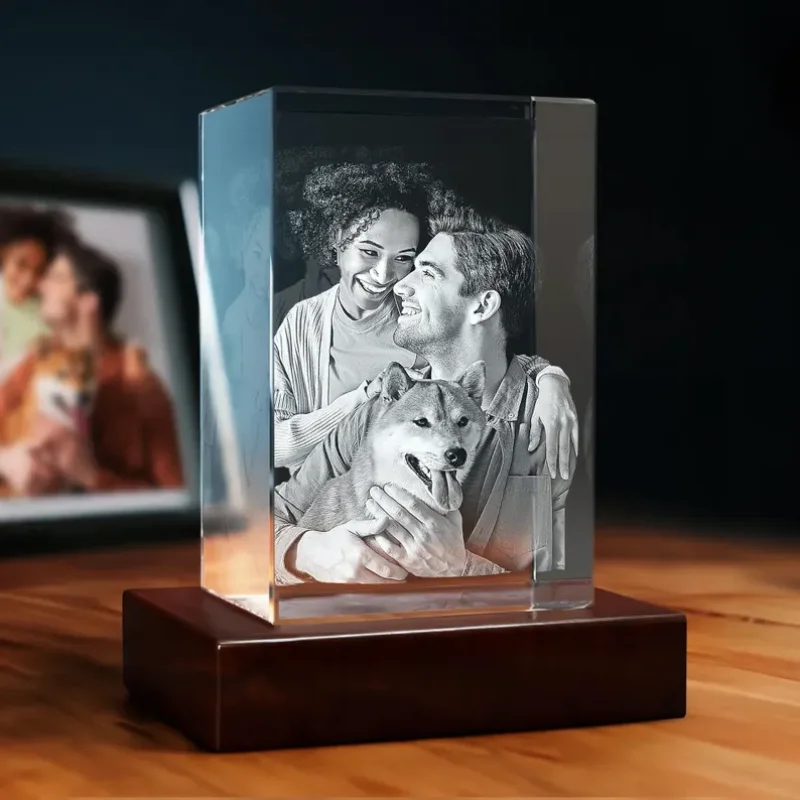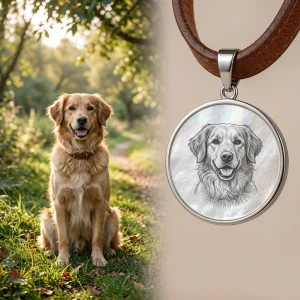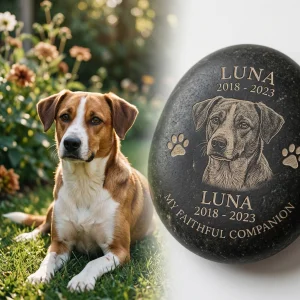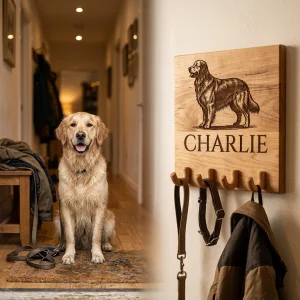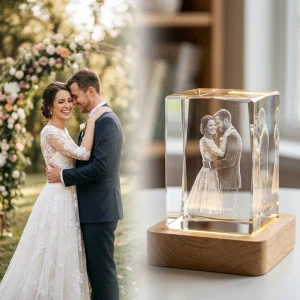
Subsurface Crystal Laser Engraving: Turning 2D Wedding Portraits into 3D Glass Keepsakes
High-grade wedding photo crystal engraving demands optical-grade K9 crystal. Standard soda-lime glass, commonly found in windowpanes and drinking glasses, contains iron impurities. These impurities produce a distinct green tint along cut edges. Soda-lime glass also harbors microscopic air bubbles and internal physical stresses. Directing a focused laser inside low-grade glass triggers unpredictable thermal expansion around these bubbles, cracking the block instantly.
K9 crystal is a lead-free borosilicate optical glass. It features a refractive index of 1.516, an Abbe value of 64.1, and an optical purity rate exceeding 99.99%. Free of internal inclusions down to sub-micron scales, K9 allows coherent light beams to pass through without scattering. The surface remains smooth while high-intensity light converges internally.
Surface Etching vs. Subsurface Laser Engraving (SSLE)
Surface etching relies on far-infrared CO2 lasers firing at a 10,600 nm wavelength. Glass absorbs this wavelength immediately at the outer boundary. Extreme heat fractures tiny flakes off the outer surface. That leaves a rough, frosted texture you feel with your finger. While fine for basic text, surface etching sits exposed to grease, dust, and scratch damage.
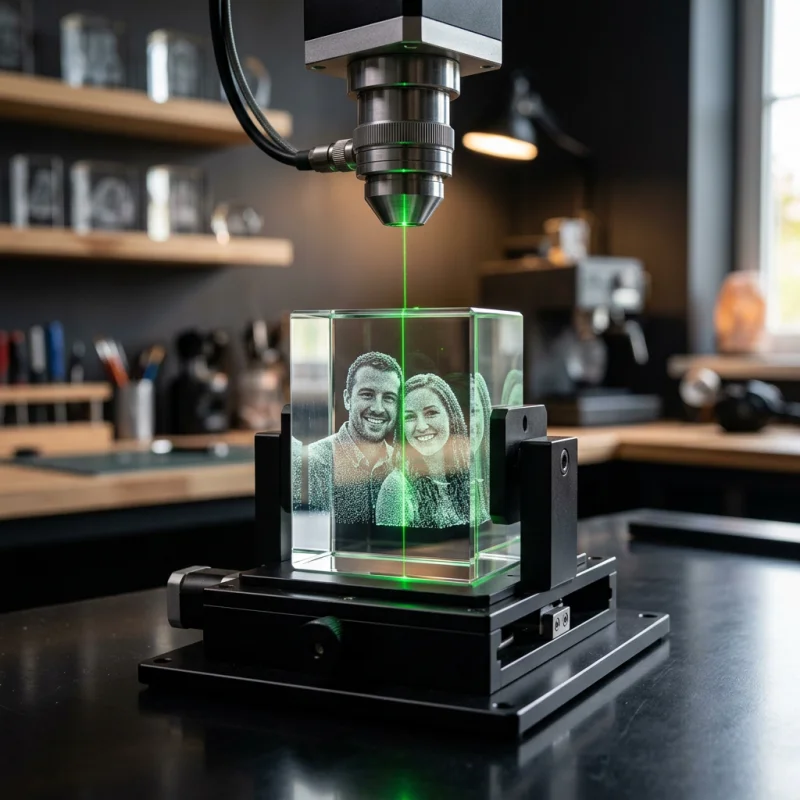
Subsurface Laser Engraving (SSLE) operates deep inside the glass volume. Exterior surfaces stay smooth. Dirt can't enter the internal structure. The inner image lasts indefinitely because oxygen and ambient pollutants never reach the micro-fractures.
Tactile differences are immediate:
- Surface Etching: Rough outer finish, 0.1 mm maximum depth, vulnerable to skin oils, planar 2D output.
- Subsurface Engraving: Polished outer finish, variable focal depth up to 100 mm, zero exposure to wear, fully realized 3D spatial volumetric output.
Photo Requirements and 3D Depth Mapping
Creating a custom wedding crystal gift starts with digital image processing. Standard 2D wedding portraits lack depth coordinates. Laser systems need precise X, Y, and Z parameters to plot every points in space.
Input source photo requirements:
- Resolution: Minimum 300 DPI at true scale (e.g., 1800 x 1200 pixels for a 4x6 inch crystal).
- Contrast: Distinct separation between hair, facial features, and apparel.
- Lighting: Balanced directional or studio fill light across both faces.
Dark reception photos taken in low light cause issues. Camera sensor noise turns into random, misplaced micro-cracks inside the crystal. Oversaturated white dresses lose texture details, leaving flat empty patches in the point cloud.
Conversion begins by isolating the couple. Graphic technicians mask out venue backgrounds, eliminating exit signs, background crowds, and floral clutter. Software then builds a grayscale depth map. White pixels designate maximum forward depth like nose tips and chests. Black pixels set the farthest background boundaries. Midtones map the curves of cheeks, hair, and clothing fold lines. Automated algorithms project these 2D pixels into a 3D coordinate system.
The Physics of Green Diode 532nm Lasers
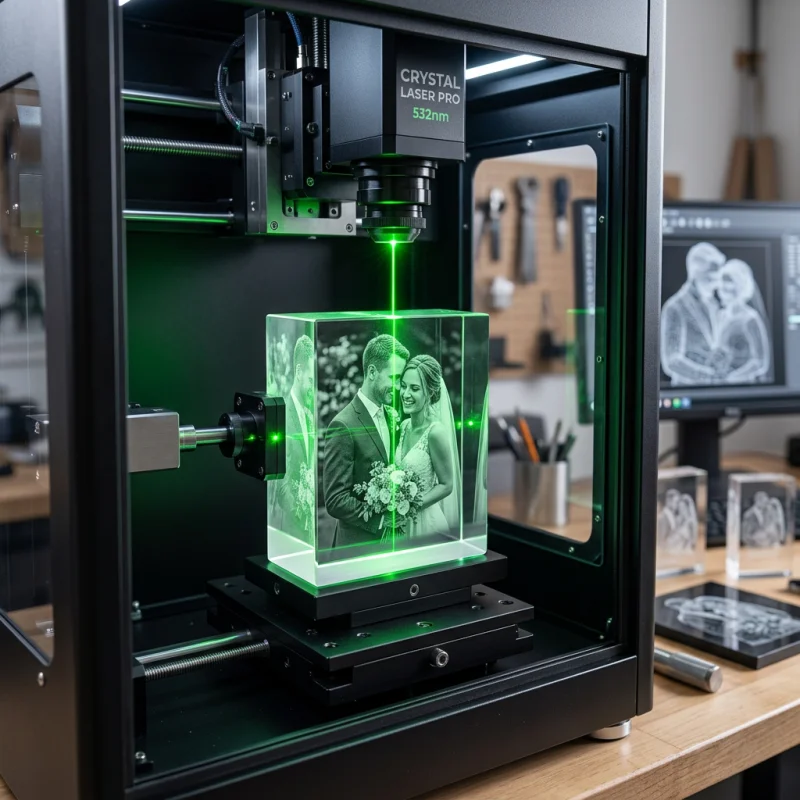
Standard industrial laser markers burn surface materials. SSLE requires a frequency-doubled Nd:YAG pulsed solid-state laser. This system doubles the fundamental 1064nm wavelength into a green light spectrum at 532nm.
K9 optical glass is completely transparent to 532nm green light. The laser beam enters the polished crystal face without causing thermal stress at the surface. High-numerical-aperture lenses focus the incoming beam to a focal spot under 30 micrometers wide.
At this focal spot, power density climbs past the optical breakdown threshold of glass, reaching approximately 1010 W/cm². The intense electric field breaks atomic bonds within nanoseconds. A controlled micro-explosion occurs. This forms a single micro-fracture, or voxel, measuring between 20 and 80 microns wide. Galvanometer scanner mirrors shift the focal plane rapidly along X, Y, and Z axes, placing up to 400,000 distinct micro-fractures inside the block within minutes.
Equipment and Manufacturing Parameter Matrix
Different laser types suit specific manufacturing tasks. The table below compares machine parameters across common glass processing tools.
| Parameter | CO2 Laser Engraver | UV Laser Marker | Green Diode SSLE Laser |
|---|---|---|---|
| Wavelength | 10,600 nm (Far-IR) | 355 nm (UV Cold) | 532 nm (Green) |
| Primary Function | Outer surface etching | Micro-surface marking | Subsurface 3D point clouds |
| Focal Spot Size | 100 - 150 microns | 10 - 20 microns | 15 - 30 microns |
| Target Zone | Surface only (< 0.1mm) | Surface only (< 0.05mm) | Internal volume (1mm to 100mm depth) |
| Pulse Frequency | 10 - 50 kHz | 20 - 100 kHz | 3 - 5 kHz |
| Processing Time | 1 - 3 minutes | 2 - 5 minutes | 4 - 12 minutes (density dependent) |
Display Illumination Physics
An engraved crystal block looks faint under ambient ceiling lights. Internal micro-fractures rely on light refraction to show details. To reveal the 3D form, display bases use high-CRI surface-mounted LEDs.
Edge-lighting sends light through the polished bottom face. Light rays travel upward through the clear glass. When rays strike an internal micro-fracture, they scatter toward the eye. Warm white LEDs (3000K) work well with warm vintage photography styles. Cool daylight LEDs (6000K) create crisp contrast across modern white wedding gowns and suits.
What type of photo works best for 3D crystal engraving?
High-resolution photos with clear fill lighting across subjects work best. Close-ups or waist-up shots captured at 300 DPI produce maximum detail. Avoid underexposed photos taken in dark reception halls, as digital camera noise creates unwanted scatter points in the crystal block.
Can 2D photos from older wedding albums be converted into 3D crystals?
Yes. Flat 2D photos can be scanned at high resolution (600+ DPI) and processed through depth-mapping software. Graphic designers isolate subjects and manually assign depth vectors to facial features, clothing, and hair to extrude a proper 3D model.
Will the internal laser engraving fade or yellow over time?
No. The subsurface micro-fractures are permanent structural changes inside the K9 optical crystal lattice. Because the outer glass seal remains unbroken, environmental factors like humidity, UV sunlight, atmospheric oxygen, and dust cannot reach or degrade the image.