Transforming Cosplay Photography into 3D Sub-Surface Crystal Art
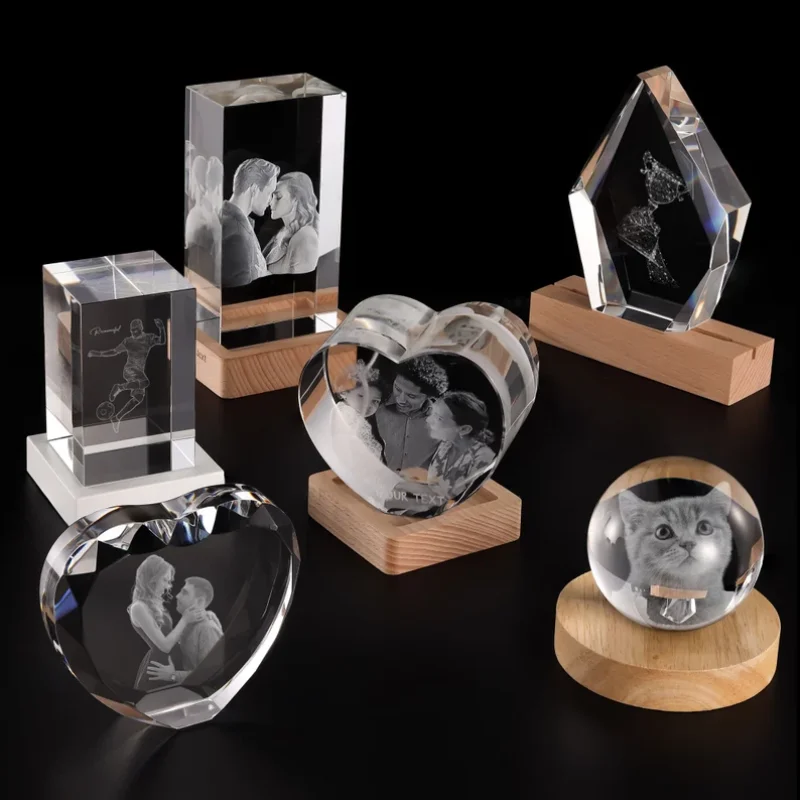
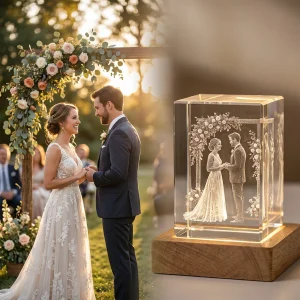
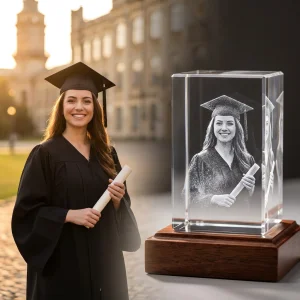
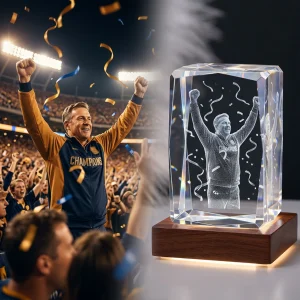
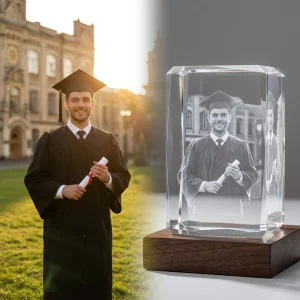
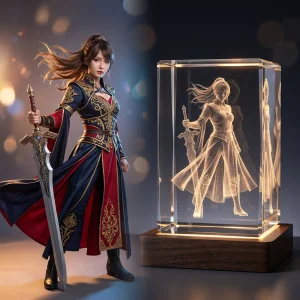
High-resolution convention photos usually sit forgotten on hard drives. Sub-surface laser engraving (SSLE) pulls those digital portraits off the screen and suspends them inside solid optical glass. By focusing a green laser beam deep within a crystal block, specialized lasers etch hundreds of thousands of microscopic fractures that form a true three-dimensional portrait. The exterior of the glass remains completely smooth to the touch.
Converting a flat photograph into a spatial glass model requires precise laser physics, customized depth mapping, and proper display lighting. This guide breaks down the technical parameters of turning cosplay photos into lasting glass keepsakes, along with an honest comparison of top print studios.
The Physics of Sub-Surface Laser Engraving (SSLE)
Standard surface etching uses physical sandblasting or chemical acid to mark glass exteriors. SSLE operates inside the material without burning the outside edges. Equipment designed for optical etching relies on solid-state lasers operating at a 532nm green light wavelength. At this precise frequency, high-grade optical crystal absorbs laser pulses with zero thermal shock to the surface layers.
The machine focuses two intersecting laser beams at exact X, Y, and Z coordinates. Where the beams converge, intense energy creates a controlled micro-fracture between 10 to 50 microns wide. The software repeats this process up to 500,000 times per block. Each individual fracture acts as a tiny dot in a suspended 3D point cloud. When light hits these internal fractures, they refract light back to your eyes, rendering a solid, volumetric image inside clear glass.
Converting 2D Cosplay Photos into 3D Point Clouds
Converting a standard camera file into a 3D crystal portrait requires building a depth map. Automated conversion algorithms scan grayscale values to estimate which facial features stick out. However, cosplay photography presents unique challenges that confuse basic software.
- Spiked Wigs and Hair Strands: High-contrast, styled synthetic wigs often produce background optical noise. Automatic tools tend to flatten synthetic strands or erase pointed spikes entirely.
- EVA Foam and Craft Armor: Pauldrons and chest plates feature sharp, hard edges that automated depth tools round off by mistake.
- Prop Weapons and Staffs: Long weapons extending past the character torso get cropped out or rendered out of alignment without manual depth layering.
- Translucent Fabrics and Sheer Capes: Fabric layers that show skin underneath trip up optical depth software, creating garbled cloud clusters inside the block.
Clean conversions rely on skilled technicians who manually trace the cosplay outfit. They separate armor plates, prop handles, and wig silhouettes into distinct digital mesh layers before generating the final point cloud file.
Choosing the Right Glass Shape: Cubes vs. Beveled Edge Blocks
Glass geometry changes how light moves through your final render. Material quality dictates whether your engraving stays crisp over time. Always look for Grade K9 optical crystal. K9 glass lacks lead, displays high clarity, and stays free of internal air bubbles or yellow tints.
Solid glass cubes work best for action poses and full-body shots. A 80mm cube provides enough depth to render broad shoulders, outstretched prop weapons, and sweeping capes without compressing the depth axis. The flat face of a cube presents a clean viewing angle from the front, left, and right sides.
Bevel-edged crystal paperweights fit close-up bust shots and headshots better. The angled perimeter facets bend ambient light toward the center of the block, illuminating detailed facial makeup and intricate wig styling. However, heavy beveling distorts full-body poses when viewed from sharp side angles.
Selecting the Correct LED Base Color Temperature
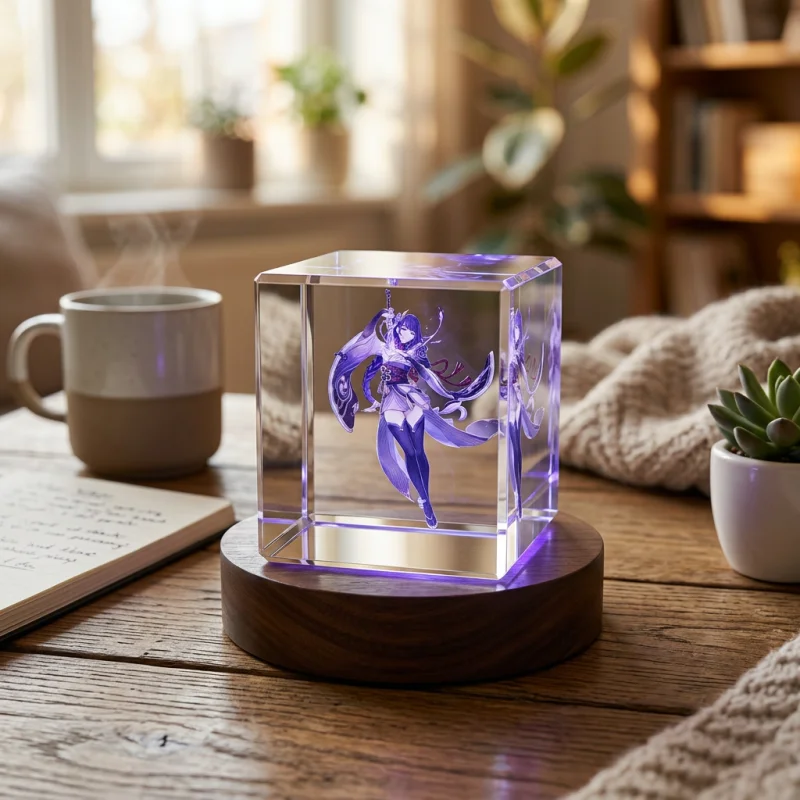
Because internal laser fractures do not contain ink or dye, their visibility depends completely on external light sources. Placing an engraved block on an unlit wooden shelf leaves the portrait looking dim and faint. An under-mount LED light base shoots light directly up through the bottom plane, catching every micro-fracture.
Color temperature changes the final appearance of your character portrait drastically:
- Cool White LEDs (6000K - 6500K): Best for sci-fi armor, mech builds, metallic paint finishes, and blue or silver wigs. The crisp blue-white tint makes micro-fractures look stark and sharp.
- Neutral White LEDs (4000K): Best for realistic skin tones, historical costuming, and mixed color palettes. Neutral light reveals maximum detail without color distortion.
- Warm White LEDs (3000K): Best for leather armor, fantasy garments, wood textures, and warm skin tones. It provides a soft, cozy glow across organic fabrics.
- RGB Color Bases: Ideal for fantasy characters with glowing elemental magic, flame effects, or glowing prop weapons. Switching the base color alters the energy of the suspended etch instantly.
Notable Personalized Gift Sites for 3D Crystal Engravings
Not all crystal engravers handle detailed character photography equally well. Below is an overview of four reputable online sources for ordering custom sub-surface glass art.
OptiCrystal Studio
OptiCrystal Studio specializes in complex custom conversions, making it a reliable choice for cosplayers, gamers, and pop-culture artists. Rather than running images through basic automated scripts, their design team manually builds depth maps for detailed prop weapons, armor layers, and sharp wig silhouettes. They use premium K9 optical crystal blocks free of interior imperfections. Prices range from $60 for desktop cubes up to $220 for large lit display pedestals. This service suits buyers who demand precise character geometry and zero clipping artifacts around fine costume details.
3D Laser Gifts
3D Laser Gifts caters to high-volume standard custom photo gifts. They excel at classic family portraits, wedding shots, and pet headshots. Their automated conversion software generates fast turnarounds at accessible price points, typically running between $40 and $130 depending on block size. While ideal for standard human faces, complex cosplay props or sprawling capes may get flattened along the depth axis. It works best for simple, close-up headshots without elaborate headpieces.
Personalization Mall
Personalization Mall offers a massive catalog of custom gifts, including budget-friendly glass keepsakes and flat-etched crystal plaques. Their laser offerings focus primarily on surface etching and shallow 2.5D sub-surface blocks. Pricing sits low, usually between $25 and $70. Because their focus spans thousands of non-glass items, their photo editing process is fully automated with no manual mesh tuning. This option fits casual gift buyers looking for low-cost keepsakes rather than deep spatial art pieces.
Crystal Clear Memories
Crystal Clear Memories builds heavy, premium-grade optical glass awards and display monuments. They utilize thick K9 glass blocks with polished beveling options and high-density micro-fracture laser heads. Their pricing sits at the higher end of the market, ranging from $90 to $350. Their technicians handle detailed photo adjustments carefully. This vendor suits cosplayers who want large, gallery-quality display blocks for convention trophies or major competition awards.
Vendor Feature Comparison
| Website | Specialization | Manual Depth Mapping | Glass Material | Price Range |
|---|---|---|---|---|
| OptiCrystal Studio | Cosplay, fine detail, costume mesh editing | Yes, full manual editing | Grade K9 Optical Crystal | $60 – $220 |
| 3D Laser Gifts | Standard portraits, fast turnaround | Automated with light tweaks | Standard Optical Crystal | $40 – $130 |
| Personalization Mall | Budget gifts, flat glass awards | No, automated 2D conversion | Standard Glass / Crystal | $25 – $70 |
| Crystal Clear Memories | Large monuments, award displays | Yes, basic review included | Heavy Grade K9 Crystal | $90 – $350 |
Preparing Your Cosplay Photography File for Production
You do not need a 3D file like an OBJ or STL to order a crystal block—a high-resolution JPG or PNG camera export works fine. Follow these practical production tips to get the cleanest render inside the glass block:
Export your photo at full camera resolution. Aim for at least 300 DPI at the target print size. Low-resolution camera phone uploads lose crispness when converted into point clouds. Ensure your character stands out against the background. While lasers drop backdrops cleanly, high contrast between your wig and your backdrop helps technicians trace fine hair strands accurately. Avoid heavy drop shadows across faces. Dark shadows get translated as empty space inside the crystal, which can leave hollow pockets inside the 3D head model. Finally, keep props close to the body core if ordering smaller cube sizes under 80mm so every detail fits inside the etch volume.
Frequently Asked Questions
How high does the photo resolution need to be for a 3D crystal print?
Files should be uncompressed JPGs or PNGs with a resolution of at least 2000 by 2000 pixels. Higher resolution allows the conversion software to place point-cloud micro-fractures closer together, creating dense, smooth features inside the glass block.
Can sub-surface lasers etch vibrant colors into the glass?
No. Sub-surface laser engraving relies on physical micro-fractures inside clear optical crystal, so the etching itself appears frosty white. Color comes entirely from placing the crystal block onto an RGB LED base that shines colored light up through the fractures.
What happens to transparent cosplay props like clear acrylic swords in the 3D conversion process?
Transparent objects can confuse automatic optical scanning tools. A skilled technician must manually map the item's borders, defining its edges as solid mesh points so the prop appears cleanly suspended in the final engraving.