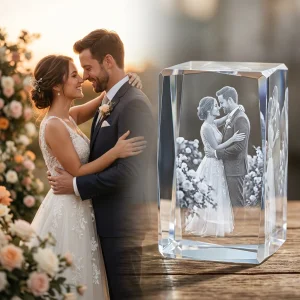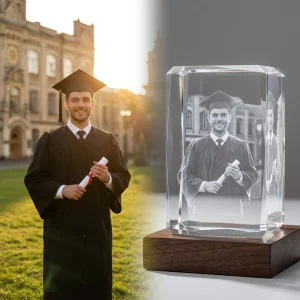
Laser-Engraved Optical Crystal: The Technical Process Behind Permanent Graduation Keepsakes
How Sub-Surface Laser Engraving Works Inside Optical Crystal
Sub-Surface Laser Engraving (SSLE) relies on non-linear optical absorption to mark the interior of solid crystal without damaging the exterior. Standard laser cutting machines use thermal energy to melt or burn a material surface. Optical crystal requires a different physics engine.
K9 optical crystal, a high-purity borosilicate crown glass, possesses an extremely low absorption coefficient for visible light. A 532nm green diode-pumped solid-state (DPSS) laser beam passes straight through the crystal exterior without leaving a mark. When two optical lenses converge that beam at a precise focal point inside the block, light energy density spikes beyond the optical breakdown threshold. The focal point briefly reaches temperatures above 1,000 degrees Celsius in a fraction of a microsecond.
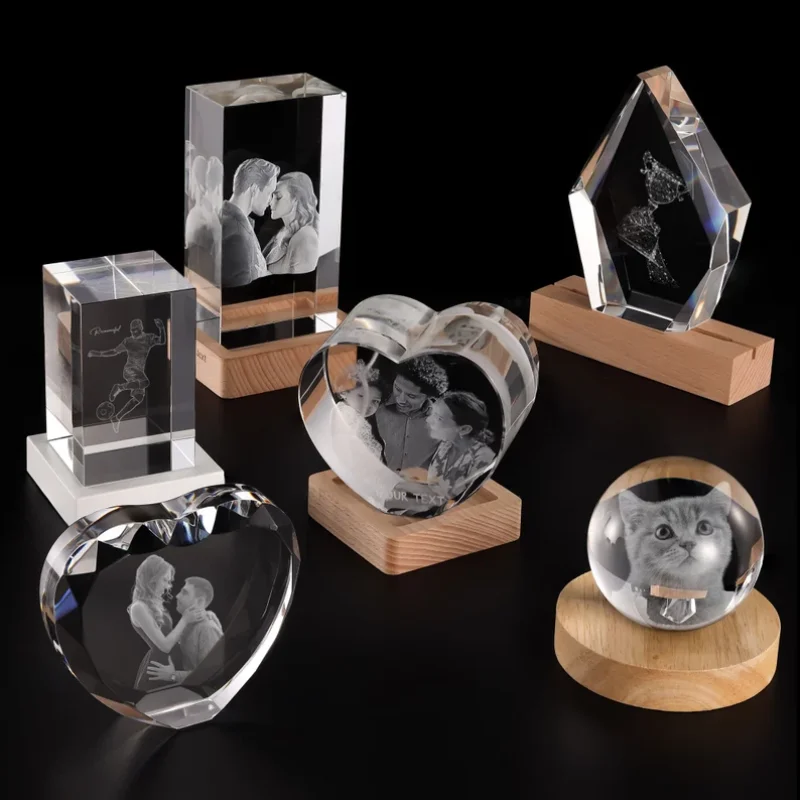
This localized thermal shock produces a controlled micro-fracture measuring between 0.02mm and 0.1mm in diameter. Each tiny fracture acts as a reflective prism. When ambient light hits these points, they glow bright white. Millions of these spatial points combine to form a high-definition 3D image suspended inside solid glass.
Manufacturing Workflow: From Photo File to 3D Point Cloud
Producing laser engraved crystal graduation gifts starts long before the laser fires. Transforming a standard 2D senior portrait or university crest into a clean interior etching demands rigorous data conversion.
First, engineers isolate the subject. Background elements are stripped away, and software algorithms analyze grayscale values to compute a 3D depth map. Dark hair, eyes, and skin tones require specialized contrast balancing. Without this step, the laser fails to create enough micro-fractures in dark areas, leaving the render looking hollow.
Next, software converts the depth map into a point cloud file. For clean detail on degree titles, student names, and realistic facial contours, point density settings must exceed 1,000,000 individual micro-cracks. Sparse point clouds under 400,000 points yield grainy, pixelated results.
The prepared file loads into a high-speed galvo-scanner machine. Dual motorized mirrors steer the 532nm green laser beam at speeds up to 3,000 points per second. Z-axis focal motors shift the focal depth in real time, building the image layer by layer from the deepest internal plane back toward the front face.
Comparing Sub-Surface Laser Etching with Surface Processing
Traditional glass etching techniques affect only the surface layer. Selecting personalized graduation keepsakes requires understanding how internal laser engraving differs from legacy methods like sandblasting or CO2 surface scoring.
| Method | Laser Wavelength / Tool | Process Location | Tactile Texture | Resolution Limit | Maintenance & Wear |
|---|---|---|---|---|---|
| Sub-Surface Laser Engraving (SSLE) | 532nm Green DPSS Laser | Inside crystal (0.5mm to 50mm depth) | Smooth polished outer glass | 1200+ DPI equivalent (>1M dots) | Zero wear; immune to dust, oil, and scratches |
| Surface Sandblasting | Aluminum Oxide Abrasive Grit | Exterior surface only | Rough, matte finish | 300 DPI (stencil physical limit) | Gathers finger oils and dust over time |
| CO2 Surface Engraving | 10.6µm CO2 Laser | Exterior glass surface | Micro-chipped surface fracture | 150–200 DPI (glass thermal fracture) | Prone to surface flaking under impact |
Crystal Selection and Edge Finishing Details
Not all glass holds internal laser etching cleanly. Cheap glass contains iron impurities, microscopic air bubbles, and internal strain lines. When a green laser strikes an impurity, energy absorbs prematurely, cracking the entire block.
Manufacturing high-clarity awards requires optical-grade K9 crystal billets. These billets undergo annealing processes lasting up to 48 hours to eliminate internal thermal stresses. Once cooled, automated diamond grinding wheels bevel the perimeter edges.
- Chamfered bevel edges: 3mm to 5mm angled cuts catch overhead light, bouncing photons back through the etched points.
- Hand polishing: Cerium oxide slurries remove microscopic grinding scratches, ensuring maximum optical transparency.
- Geometric stability: Thick rectangular blocks, arches, and icebergs provide stable focal planes without shifting the laser focal point.
Formatting Text and Diplomas for Crystal Engraving
Text formatting inside crystal demands specific typographic choices. Sans-serif fonts like Helvetica or clean serif fonts like Times New Roman render sharply when converted into vector lines, provided line thickness remains above 0.2mm.
When incorporating university seals alongside degree text, arrange elements on separate focal planes. Position the crest slightly deeper within the block at a depth of 25mm while placing the student's name, degree title, and graduation year 5mm closer to the front face. This spatial separation adds genuine physical depth that flat printing cannot replicate.
Avoiding Image Quality Pitfalls
Low-resolution source photos cause distinct manufacturing failures during sub-surface conversion. Files downloaded from social media platforms are heavily compressed, stripping out gradient information necessary to generate spatial depth.
For portrait renderings, submit original digital files with a minimum resolution of 300 DPI at 100% print size. Photos shot in harsh direct sunlight create hard shadows across facial features. In the point cloud conversion, those shadows turn into solid black voids without points, making face contours look deformed.
Stick to bright, evenly lit photographs. Uniform lighting allows the point-cloud software to calculate smooth, continuous micro-fracture densities across cheeks, foreheads, and clothing folds.
Can sub-surface laser engraving inside K9 crystal ever fade or turn yellow?
No. Micro-fractures created by a 532nm green laser are permanent mechanical changes inside the glass matrix. K9 optical crystal is inorganic and UV-stable, meaning it will not yellow, degrade, or fade over time when exposed to sunlight.
What is the ideal photo resolution for personalized graduation keepsakes in crystal?
Supply a photo with at least 300 DPI (dots per inch) resolution and clear contrast between the subject and background. Images shot directly on modern smartphone camera sensors typically provide more than enough pixel density for precise point-cloud processing.
How do you clean laser engraved crystal graduation gifts without damaging the image?
Because the image sits inside the glass, the exterior remains completely smooth. Clean the crystal block using a lint-free microfiber cloth and standard glass cleaner or isopropyl alcohol. Avoid abrasive scrubbers that might scratch the polished outer surfaces.
Why are green 532nm lasers used instead of standard red or CO2 lasers for crystal carving?
CO2 lasers operate at a 10.6µm wavelength, which glass absorbs instantly at the surface, causing surface fractures rather than internal points. Fiber lasers at 1064nm bypass the focal mechanics unpredictably. The 532nm green laser passes harmlessly through optical glass until focused tightly, allowing controlled internal micro-breakdown without outer surface damage.