Custom Engraved Crystal Awards to Honor Your Coach's Winning Season
Oliver sat at his desk at 11:00 PM with three sample trophy catalogs open across his laptop screen. Oakridge High just won its first state basketball championship in fourteen years. Coach Marcus spent eight months grinding through double sessions, reviewing game film past midnight, and drawing up a zero-second play that sealed the 68-66 victory. The booster club raised $450 for coach appreciation gifts. Oliver held a sample acrylic plaque sent by a local print shop. It was light. The fake wood backing flaked at the corners. Cheap. It looked like a supermarket clearance item. Oliver tossed it into the recycling bin. A championship season demands physical weight, optical clarity, and detailed precision that lasts decades on an office shelf.
He needed something permanent. A custom coach trophy built from K9 optical crystal was the only option capable of freezing that championship moment in glass.
Why K9 Optical Crystal Outperforms Standard Glass
Oliver skipped standard leaded glass and acrylics after reviewing raw material specs. Acrylic scratches when wiped with a standard cloth. Standard window glass contains iron impurities that yield a murky green edge. Leaded crystal carries weight, but high-temperature lasers cause stress fractures along lead lines, destroying micro-details.
K9 optical crystal solves these material failures. It's a high-grade borosilicate optical glass known for low bubble counts, extreme clarity, and a high refractive index of 1.517.
- Density: K9 crystal sits at 2.51 g/cm³, giving an 8-inch block a heavy 4.2-pound desk presence.
- Purity: Zero lead content prevents laser micro-fracture spidering during high-speed processing.
- Light Transmission: 99.2% clear glass ensures engraved elements catch ambient light without yellowing over time.
Dual-Laser Engraving: Inside and Outside the Block
Oliver wanted Coach Marcus's signature play, the Zone-3 Break, suspended in three dimensions inside the award, surrounded by crisp roster text on the exterior. Achieving this dual effect requires two distinct laser technologies operating at different light wavelengths.
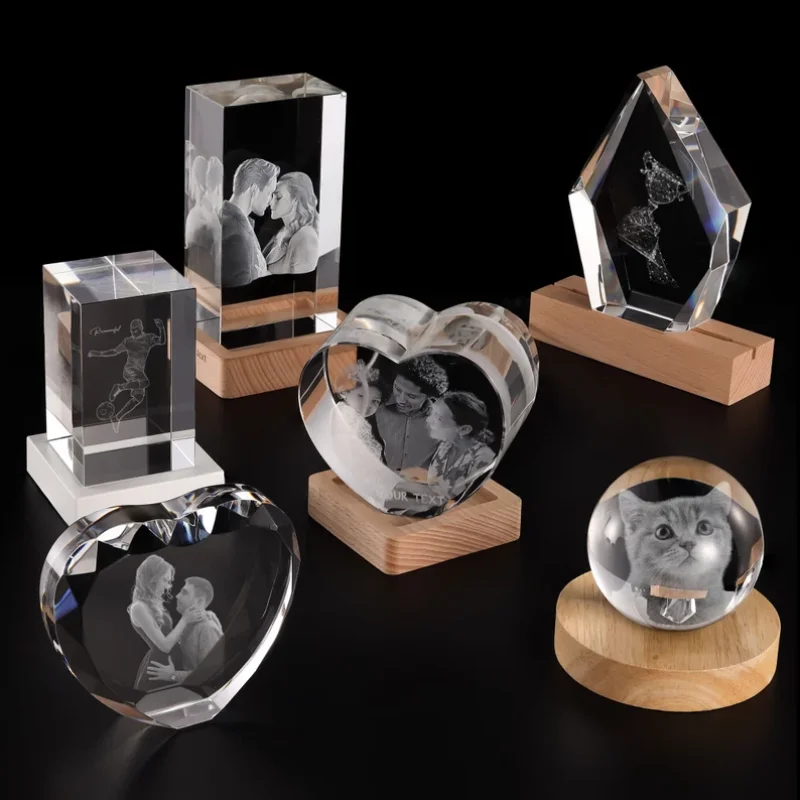
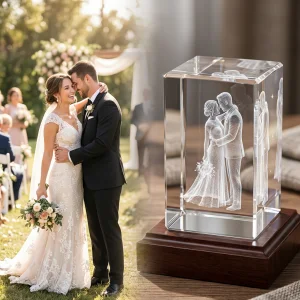
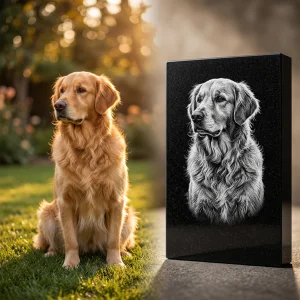
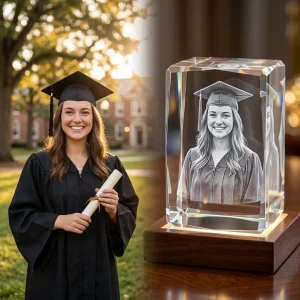
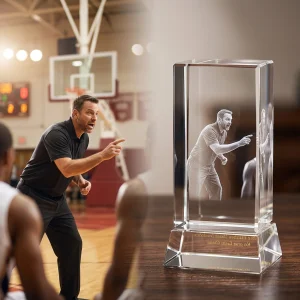
Sub-surface laser engraving (SSLE) handles interior 3D graphics. Technicians focus a 532 nm green diode-pumped solid-state laser straight through the exterior K9 surface without harming the outer skin. The focal point creates micro-fractures inside the crystal block at exact X, Y, and Z coordinates. By plotting 500,000 individual micro-dots, the laser renders a 3D volumetric model of a basketball playbook, a whistle, or a team photo floating inside the glass core.
Surface CO2 laser etching targets the exterior. Operating at a 10.6 µm wavelength, the CO2 laser micro-shatters the top layer of the glass. This turns smooth optical crystal into a frosted, high-contrast matte white surface. Oliver selected surface etching for the season record (22-4), the final championship score, and the 12-player roster lining the base of the block.
Design Limits: Fonts, Files, and Micro-Fractures
Ordering custom coach trophies requires technical discipline. Submitting bad art files leads to muddy engravings inside pure crystal.
Vector files (.SVG, .EPS, or 300 DPI high-resolution PNGs) are mandatory. When bitmap graphics fall below 300 DPI, laser software converts gray pixel noise into rogue micro-dots. That turns an internal play diagram into a blurry cloud.
Font sizes matter just as much. Inside dense K9 crystal, text rendered under 6pt fails. Micro-fractures merge together, bleeding characters into unreadable white blobs. Oliver set all roster names to 9pt Helvetica Bold and header titles to 18pt Garamond to maintain maximum contrast.
Step-by-Step Blueprint for Creating Your Award
Oliver executed his order through five deliberate steps to make sure the award arrived before the sports banquet:
- Extract the Vector Diagram: He scanned Coach Marcus's whiteboard play and converted the pen lines to a clean vector path file.
- Compile Roster Data: He verified player names, jersey numbers, and season stats in a spreadsheet before exporting to vector text.
- Select Block Geometry: Oliver chose a bevel-edged K9 optical rectangle measuring 8 inches high, 5 inches wide, and 2 inches deep.
- Match Lasers to Elements: He assigned the 3D playbook diagram to the 532 nm interior green laser engine and exterior text copy to the 10.6 µm CO2 unit.
- Add Base Lighting: He ordered a walnut base with built-in 6000K white LED lights to illuminate the internal micro-fractures from below.
At the athletic banquet, Oliver presented the velvet box to Coach Marcus. The coach lifted the 4.2-pound optical crystal block into the light and ran his thumb over the frosted roster text. Inside the core of the glass, his winning play floated in sharp three-dimensional detail. No scratches. No cheap acrylic weight. Just pure, permanent recognition.
What is the difference between SSLE and CO2 laser etching on crystal awards?
Sub-surface laser engraving (SSLE) uses a 532 nm green laser focused inside the glass to create 3D internal images without breaking the surface. Surface CO2 laser etching uses a 10.6 µm wavelength to micro-shatter the outer layer of the crystal, creating crisp matte-white text and border details on the exterior face.
Why should I choose K9 optical crystal over leaded glass for coach gifts?
K9 optical crystal is lead-free, offering high optical clarity (99.2% light transmission) and a refractive index of 1.517. Unlike leaded glass, which can develop spider-web fractures during laser processing due to lead impurities, K9 crystal withstands high-density laser micro-fracturing without losing structural integrity or clarity.
What artwork files and minimum font sizes are needed for custom crystal trophies?
Always submit artwork in vector formats (.SVG, .AI, .EPS) or high-resolution bitmapped images at a minimum of 300 DPI. Keep all text elements at 6pt font size or larger; fonts under 6pt cause adjacent micro-fractures to merge, rendering names and numbers unreadable.