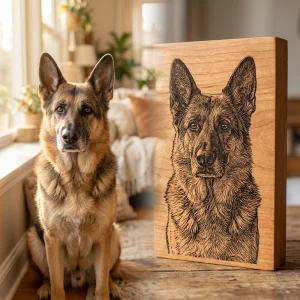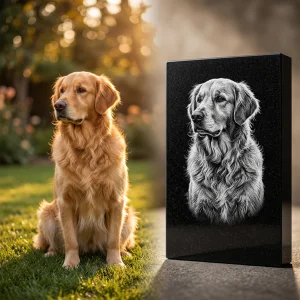
Laser Engraving Stone Pet Memorials: Technical Specs, Material Choice, and Photo Processing
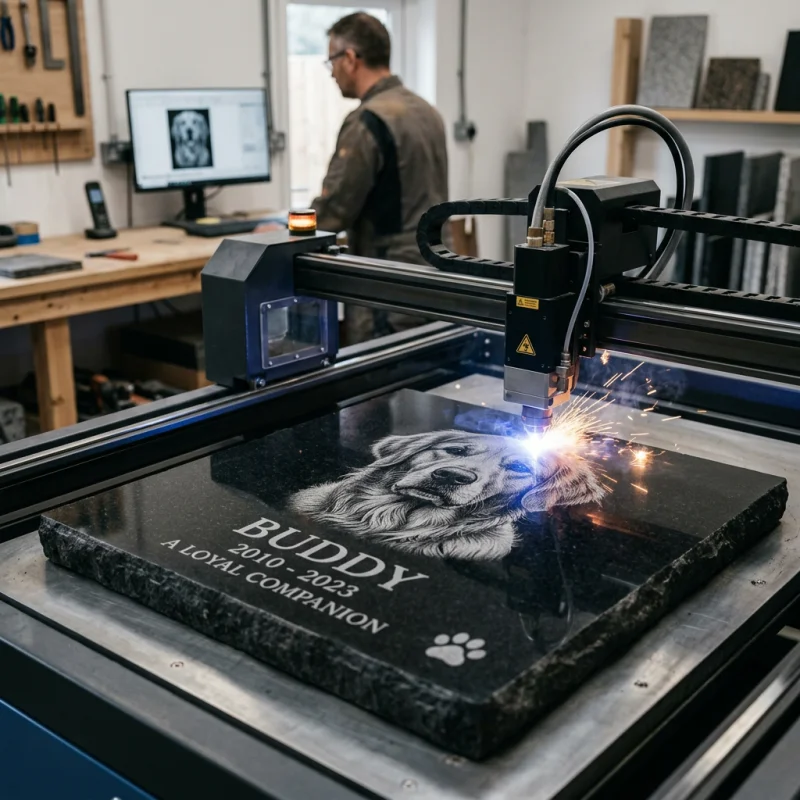
Creating lasting laser engraved pet memorials requires balancing laser optics with stone chemistry. Stone doesn't burn like wood or vaporize like acrylic. A CO2 laser marks stone through thermal shock, shattering micro-thin layers on the surface. Getting clean fur textures and clear text demands strict control over DPI, power density, and image dithering.
Material Selection: Absolute Black Granite vs. Natural Slate
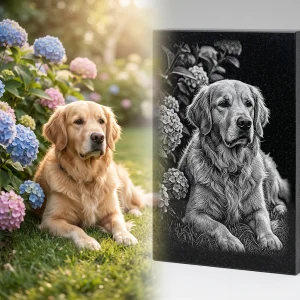
Absolute Black Granite delivers the highest image contrast. It contains minimal quartz vein inclusions and fine grain structure. When a 10.6 µm CO2 laser hits dark granite, thermal stress causes localized micro-spalling. The polished black surface fractures into microscopic white chips. This creates bright, permanent contrast without applying inks.
Natural slate behaves differently. Slate is a fine-grained, foliated metamorphic rock. It offers strong native contrast because the laser leaves a pale gray mark on dark slate. However, slate surfaces aren't perfectly flat. Cleft slate varies in surface height by up to 3 mm across a 12-inch slab. This height variation pushes the laser beam out of focus. Use a 2.5-inch focal length lens on uneven slate to maintain a wider depth of field. Switch to a 1.5-inch or 2.0-inch lens on flat granite pet memorial stone blanks to keep the laser focal spot down to 0.004 inches.
Image Preparation and Dithering Parameters
Raw photos fail on laser stone engravers. Dark fur blends into dark backgrounds, and laser dot overlap turns high-contrast areas into solid chalky blobs. Image pre-processing requires five distinct steps:
- Cropping and Isolation: Cut the pet portrait away from cluttered background elements. Fill the background with pure black (RGB 0, 0, 0).
- Grayscale Conversion: Convert the image to 8-bit grayscale. Adjust tone curves to boost midtone contrast by 15% to 20%.
- Inversion: Invert the grayscale image. Laser software treats white pixels as firing signals and black pixels as off signals. Bright fur must map to white pixels on screen so the laser fractures the dark granite surface to create white marks.
- Sharpening: Apply an Unsharp Mask filter (Radius: 1.5 pixels, Amount: 180%, Threshold: 0). High edge contrast prevents eye glints and whiskers from fading into surrounding fur.
- Dithering: Convert the image to a 1-bit bitmap using dithering algorithms. Use Stucki or Jarvis dithering at 300 DPI. Avoid Floyd-Steinberg dithering. Floyd-Steinberg creates worm-like dot patterns on hard stone surfaces.
CO2 Laser Settings and Parameter Matrix
Overpowering stone causes thermal saturation. Excess heat melts micro-cracks together, dulling image clarity and flaking off small details. Underpowering leaves faint gray marks that fade outdoors. The laser power must fracture the surface without heating the underlying stone substrate.
| Stone Type | Laser Power (W) | Speed (mm/s) | Resolution (DPI) | Pass Count | Focal Lens |
|---|---|---|---|---|---|
| Polished Black Granite | 40W CO2 | 250 | 300 | 1 Pass | 2.0 Inch |
| Polished Black Granite | 80W CO2 | 450 | 300 | 1 Pass | 2.0 Inch |
| Natural Cleft Slate | 50W CO2 | 300 | 254 | 1 Pass | 2.5 Inch |
| Natural Cleft Slate (Vector Text) | 80W CO2 | 120 | N/A (Vector) | 1 Pass | 2.0 Inch |
Weatherproofing and Outdoor Maintenance
Water ruins unsealed granite pet memorial stone engravings temporarily. Rain fills the micro-fractures created by the laser. Because light no longer refracts off empty micro-gaps, the white engraved lines turn dark black until the stone dries completely.
Fix this with a post-engraving paint fill or high-grade sealant:
- Clean residual stone dust out of the micro-cracks using compressed air and denatured alcohol.
- For granite, rub exterior-grade white titanium acrylic paint or litho ink into the etched image using a rubber squeegee.
- Wipe away surface haze immediately with a lint-free shop cloth dampened with rubbing alcohol. The paint remains trapped inside the laser micro-cracks.
- For slate, apply two light coats of a breathable siloxane masonry sealer. Siloxane prevents water absorption while stopping surface delamination during winter freeze-thaw cycles.
Material Limitations: Stones to Avoid
Laser engraving works poorly on specific stone types. Avoid using these materials for outdoor pet memorials:
Porous river rocks contain moisture trapped deep inside their internal structure. When hit with a focused 80W laser, internal water pockets vaporize instantly. The steam expansion shatters the rock shell, firing sharp stone shards across the machine bed. Sandstone and limestone present structural issues too. Both are bound by soft mineral cements that erode outdoors under acidic rainfall. Within three winters, freeze-thaw cycles cause sandstone layers to lift and flake apart, destroying fine line work and pet names.
How do I prevent my granite pet memorial stone from disappearing when wet?
Laser micro-fractures lose contrast when water fills the light-scattering surface gaps. Clean the raw engraving with denatured alcohol, then wipe outdoor white litho ink or exterior acrylic paint into the etched areas. Solvent sealing keeps water out of the micro-cracks so the image stays visible during rain.
What photo resolution works best for laser engraved pet memorials?
Process your photo files at 300 DPI at true 1:1 output size. Setting resolution higher than 300 DPI causes laser spot overlap on stone, creating excess heat that blows out fine detail. Settings below 200 DPI leave visible gap lines across smooth areas like pet fur and skin.
Can I engrave actual paw prints onto stone using a CO2 laser?
Yes. Scan paper ink prints at 600 DPI, clean up background smudge marks using graphics software, and trace the image into a clean vector file. Run your laser in vector engrave mode at 150 mm/s to cut sharp, deep borders into slate or polished granite surfaces.