Designing Luxury Executive Retirement Awards: Engineering Permanent Optical Crystal Keepsakes
Grace sat at her desk with three vendor catalogs open and a deadline three weeks away. Arthur, the firm's Chief Technology Officer, was retiring after 34 years of service. He spent his career designing high-precision satellite propulsion systems. Standard off-the-shelf trophies felt like an insult. Last year, the department bought a plastic-coated plaque for a retiring director. Within six months, the surface turned yellow under office fluorescent lighting. Another division chose cheap molded soda-lime glass. The internal stress caused hairline fractures across the engraved company logo before the party even started.
Grace needed luxury executive retirement gifts that matched Arthur's professional rigor. She wanted a heavy crystal award that would sit on a mahogany bookshelf for decades without clouding, scratching, or cracking.
Choosing K9 Optical Crystal Over Molded Glass
Grace eliminated soda-lime glass immediately. Soda-lime glass contains iron impurities that create a noticeable green tint along the cut edges. Worse, soda-lime glass harbors micro-bubbles and uneven internal residual stress from rapid cooling during manufacturing. When a high-energy laser hits those internal stress points, the glass snaps or develops spider-web micro-cracks around the engraving zone.
She selected raw K9 optical crystal. K9 is a high-grade borosilicate crown glass valued for high optical clarity and a refractive index of 1.5168. It contains less than 0.001% bubble volume and undergoes a controlled 48-hour annealing process. Annealing removes internal lattice stress, allowing laser energy to pass cleanly through the block without destabilizing surrounding material.
Subsurface Laser Engraving and Volumetric Point Clouds
Grace rejected surface etching. Sandblasting or surface laser ablation leaves rough grooves on the exterior of the block. Dust settles in the crevices. Fingerprints smear across the text, requiring constant polishing.
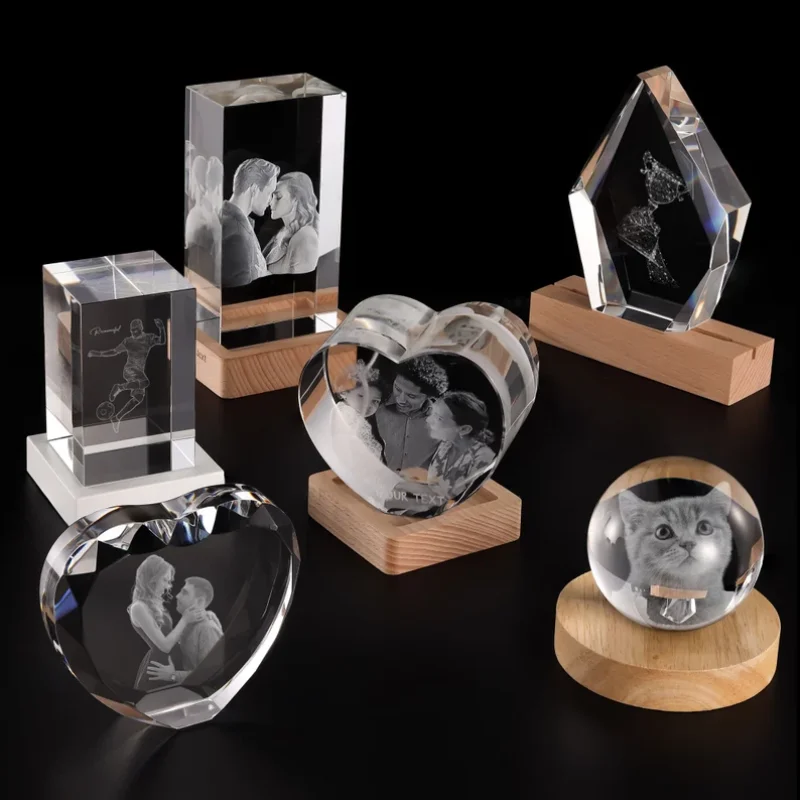
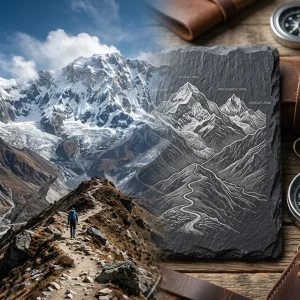
Instead, she specified 2D and 3D Subsurface Laser Engraving (SSLE). SSLE leaves the outer surface of the optical crystal smooth and untouched. The laser beam passes through the clear polished exterior, focusing exclusively at precise internal coordinates.
Equipment choice dictates the final sharpness. Cheap shops use standard 1064nm infrared lasers. Infrared light generates heat, cracking the crystal matrix around the mark. Grace insisted on a green 532nm Diode-Pumped Solid-State (DPSS) laser. Green light operates at a shorter wavelength, allowing energy absorption to occur instantly at a tight focal spot without generating heat in adjacent crystal layers.
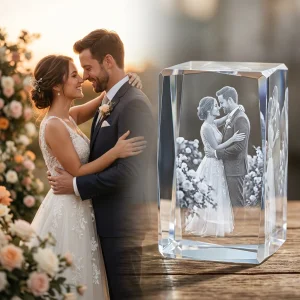
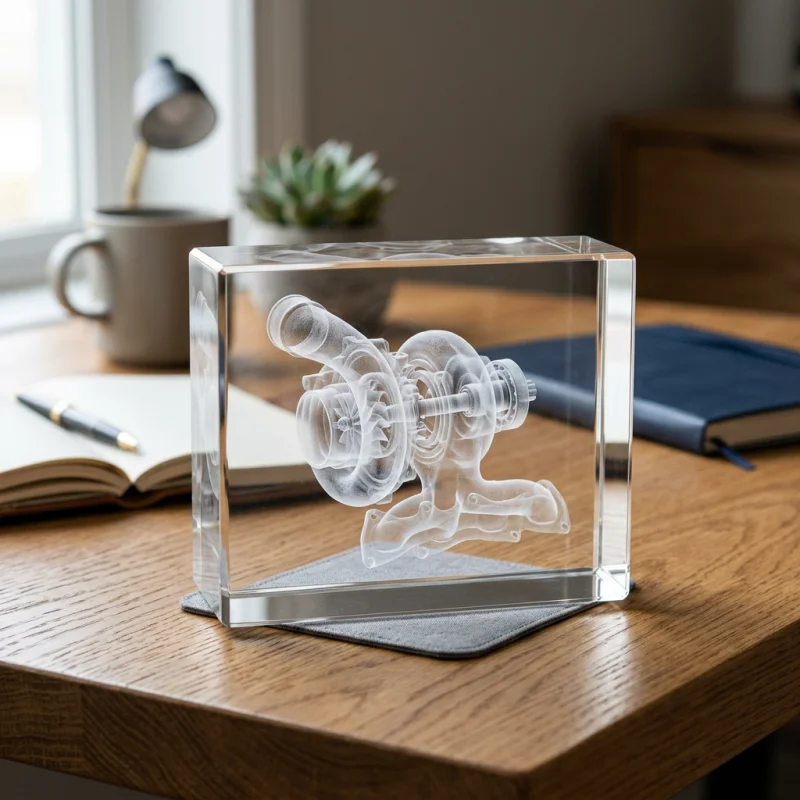
Instead of flat 2D layering, Grace opted for a high-density 3D volumetric point cloud. The system mapped Arthur's career milestones inside the block using over 800,000 discrete micro-fracture points. Each point acts as a small prism, scattering ambient light without weakening the structural integrity of the K9 crystal block.
Artwork Precision and Vector Parameters
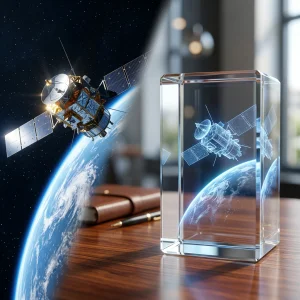
To turn Arthur's achievements into a permanent internal sculpture, Grace worked directly with the engraver's software parameters. She converted the firm's logo and Arthur's original satellite thruster schematic into high-resolution point maps.
Raster files fail in 3D crystal engraving. Bitmap pixels translate into jagged, uneven micro-bursts. Grace submitted pure vector files (.EPS) set to a spatial density of 1200 DPI.
The laser technician set focal depth parameters between 15mm and 45mm from the front face of the 60mm-thick block. Keeping focal points at least 10mm away from all outer edges prevents stress concentration near the hand-polished bevels. The resulting design created a suspended 3D engine model floating inside a solid 10-pound block.
Hand-Polished Edges and Long-Term Durability
The finished piece weighed 4.8 kilograms. Each face was hand-polished using cerium oxide slurry to achieve continuous surface flatness within one-quarter wavelength of light.
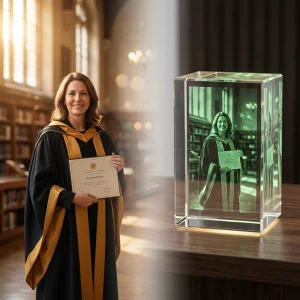
When Arthur received his award at the dinner, he held it up to the overhead light. The suspended 3D engine model caught the warm light, glowing white inside the clear K9 block. Because outer faces remained non-porous and smooth, oils wiped clean with a single pass of a cloth. Grace delivered executive retirement awards that mirrored the precision of the engineer they honored.
What is the difference between K9 optical crystal and standard glass executive retirement awards?
K9 optical crystal is a high-purity borosilicate crown glass treated through a precise 48-hour annealing process that eliminates internal stress and micro-bubbles. Standard soda-lime glass contains iron impurities that cause a greenish tint and high internal stress. Under laser engraving or temperature shifts, standard glass frequently develops surface micro-cracks, while K9 crystal remains completely clear and structurally sound.
Why is a green 532nm DPSS laser preferred over infrared lasers for subsurface crystal engraving?
A green 532nm DPSS laser operates at a shorter wavelength than a traditional 1064nm infrared laser. This shorter wavelength focuses light energy onto a much tighter spot with minimal thermal dissipation. The precision prevents heat-affected zones inside the optical block, producing sharp micro-fracture points that form smooth 3D images without cracking the surrounding K9 crystal.
How should artwork be prepared for high-density 3D subsurface laser engraving?
Artwork must be submitted in clean vector formats like SVG, AI, or EPS set to at least 1200 DPI vector point density. Vector curves allow specialized CAD software to generate 3D volumetric point clouds, translating lines and shapes into hundreds of thousands of individual coordinate points suspended inside the crystal block.