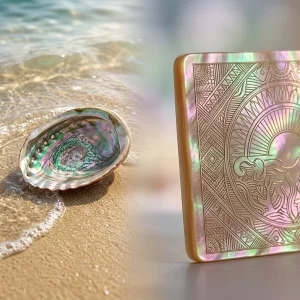
The Science of Shells: How Nacre Structure Affects Laser Precision
Nacre consists of 95% aragonite crystal and 5% organic biopolymers. Aragonite is a hard, brittle form of calcium carbonate ($CaCO_3$). The biopolymer binder contains conchiolin and chitin. Microscopic analysis reveals a strict brick-and-mortar layout. Polygonal aragonite platelets measure 10 to 20 micrometers across and 300 to 900 nanometers thick. These thin tiles stack in parallel sheets. Conchiolin fills the tiny 10 to 50-nanometer gaps between them, acting as a flexible shock absorber.
Iridescence relies entirely on light wave interference. Color doesn't come from pigments. Visible light passes into the transparent aragonite layers, bouncing off both the upper surface and the lower interface of each nano-platelet. Reflected light waves collide, amplifying specific wavelengths based on exact layer thickness. Laser beams interact with two completely different substances simultaneously: inorganic crystal and organic protein.
Material Variations Across Shell Species
Different shell inlay materials respond distinctively under a focused beam. Internal geometry controls how heat radiates away from the target spot.
Mother-of-pearl from Pinctada maxima or Pinctada margaritifera oysters produces dense, flat sheets between 2.0 mm and 4.0 mm thick. Aragonite layers stack in orderly parallel lines. This predictable arrangement allows steady, uniform heat dissipation along the surface plane.
Abalone (Haliotis species) features a distinctly different architecture. Commercial abalone veneer is thin, spanning 0.5 mm to 1.0 mm. Natural growth patterns in abalone create wavy, irregular layers held together by thicker conchiolin seams. These undulating curves trap light to produce deep greens and blues. They also trap thermal energy. Heat cannot travel smoothly along straight lines, concentrating laser energy in tight zones.
Freshwater mussel shell from the Unionidae family offers intermediate properties. Slabs range from 1.5 mm to 3.0 mm thick. Aragonite layers run wider and hold higher moisture contents in unheated states, causing beam scattering if the shell isn't thoroughly dry before mark processing.
Laser Absorption and Thermal Mechanics
Processing shell requires matching laser wavelengths to material absorption rates. Raw calcium carbonate reflects visible light efficiently while absorbing far-infrared and ultraviolet light.
CO2 lasers emitting at 10,600 nm target the carbonate bonds directly. The energy converts to thermal motion instantly, vaporizing surface material. Fiber lasers (1064 nm) pass directly through pale mother-of-pearl without marking unless pulsed at high peak power. UV galvo systems operating at 355 nm use cold ablation. They split chemical bonds inside the conchiolin binder without generating heat spikes, preserving surrounding crisp detail.
Mastering how to laser engrave shells depends on controlling beam dwell time. Continuous thermal exposure cooks the organic glue before the crystalline structure can cleanly vaporize.
| Shell Material | Average Thickness | Aragonite Layer Thickness | Conchiolin Ratio | Ideal Wavelength | Thermal Tolerance |
|---|---|---|---|---|---|
| White Mother-of-Pearl | 2.0 – 4.0 mm | 400 – 600 nm | ~ 3.5% | 10,600 nm / 355 nm | High (~ 320°C) |
| Paua / Abalone Shell | 0.5 – 1.0 mm | 300 – 500 nm (wavy) | ~ 6.0% | 355 nm / 455 nm | Low (~ 220°C) |
| Freshwater Mussel | 1.5 – 3.0 mm | 500 – 800 nm | ~ 4.5% | 10,600 nm | Moderate (~ 280°C) |
Limitations, Material Vulnerabilities, and Failure Modes
Natural shell composites fail under predictable thermal conditions. Exceeding exact physical limits ruins the blank.
Conchiolin breaks down at temperatures between 220°C and 300°C. When a laser rests on a spot too long, burning protein turns into gas trapped between gas-impermeable aragonite plates. High gas pressure causes delamination—the shell sheets shear apart, causing the surface to flake into loose scales.
Phase transformation presents another obstacle. Aragonite shifts into calcite at 400°C. Further heating beyond 600°C converts the material into calcium oxide (quicklime). This transforms iridescent shell into a soft, chalky white smudge. Optical interference disappears because the ordered nano-layers crumble into powder.
Thin abalone veneers crack under heat shock. Cold-worked shell holds internal mechanical strain. Rapid localized heating causes sharp thermal expansion, driving micro-fractures through the structural matrix.
Unsuitable materials include unpolished outer shell coats (periostracum), fossilized shell where minerals replaced organic binders, and uncured damp blanks. Avoid these for laser work.
Precision Processing for Shell Personalization
Executing clean laser engraving mother of pearl demands low linear energy density. High speed paired with low power settings prevents burn scars.
Set CO2 lasers to 8–12% power on a 40-watt source, moving at 300 to 500 mm/s. Keep pulse frequency around 20 to 30 kHz to avoid deep point heating. Three light passes deliver cleaner depths than a single heavy pass.
- Air assist is essential. High-pressure air blows away vaporized conchiolin ash before it settles on adjacent cold nacre.
- Settled ash absorbs next-pass laser pulses, causing dark yellow burns along vector edges.
- Wet paper masking tape placed on top absorbs thermal splash and stops heat rings from forming around micro-logos.
Why does mother-of-pearl turn chalky and white during laser engraving?
Heat converts the organized aragonite crystal structure into calcium oxide powder while burning out the conchiolin binder. Reduce laser power, increase travel speed, and use multiple light passes to keep material temperatures below 220°C.
What laser wavelength works best for thin abalone shell veneers?
UV galvo lasers running at 355 nm yield clean cuts because they break molecular bonds chemically without high heat. For CO2 lasers on 0.5mm abalone, apply wet masking paper, use low power, and run continuous high-pressure air assist.
Can you cut completely through thick shell blanks using a laser engraver?
Cutting shell over 1.5mm thick with a laser damages surrounding material. Continuous heat accumulation over multiple pass layers causes delamination, edge charring, and stress cracks. Use diamond CNC router bits or waterjets to cut thick profiles, reserving the laser for light surface engraving.
Does water masking affect the final iridescence of personalized shell items?
Water masking preserves surface iridescence. It prevents heat oxidation and stops airborne resin ash from sticking to unengraved areas. Once finished, rinse the surface with water to reveal clean, undamaged aragonite layers.