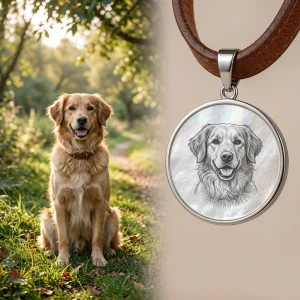
Custom Shell Collar Charms: Commemorating Your Dog's Adoption Anniversary
Leo stared at the pitted brass tag dangling from Buster's leather collar. Three years of trail runs, lake swims, and backyard squirrel chases had worn the original stamped contact info into a smooth, unreadable smear. Next Tuesday marked Buster's third gotcha day—the anniversary of bringing the rescue hound home from the county shelter. Leo wanted a keepsake that wouldn't tarnish, peel, or look like mass-produced plastic. He wanted something distinct, durable, and personal.
His search led him to natural shell blanks. Iridescent mother-of-pearl offered an organic luster that metal couldn't match. Turning delicate nacre into a daily collar charm required specific material choices and exact laser calibration to avoid ruining the shell.
Selecting White Mother-of-Pearl vs. Dark Freshwater Shell
Natural shell consists of microscopic aragonite tiles held together by biopolymers. That structure creates iridescence, but choosing the wrong shell stock causes micro-fracturing under stress.
For dog collar charms, thickness matters far more than surface area. Standard jewelry cabochons run 0.5 mm thick, which snaps under slight lateral tension. A custom pet charm needs a solid shell thickness of at least 1.2 mm to survive the mechanical friction of daily collar wear.
- White Mother-of-Pearl: Features a pale, sun-reflective base that produces dark gray or dark brown line work when laser engraved. High-contrast line detail renders clearly on white shell, making it ideal for detailed portrait art.
- Dark Freshwater Shell: Offers deep charcoal, peacock green, and purple undertones. Darker shell bases require inverted artwork vectors so that light-engraved lines pop against the dark backdrop.
Leo selected a 1.5 mm thick disc of solid Australian white mother-of-pearl. Its pale surface offered maximum contrast for Buster's dark feature lines.
Photo Preparation and Laser Parameter Optimization
Engraving raw shell requires precise control over heat generation. Natural nacre reacts poorly to thermal shock. High heat snaps microscopic bonds, causing surface flaking, scorched margins, and dull patches across the surface.
Leo picked a clean photo of Buster resting his chin on the couch. He converted the high-resolution photo into a simplified vector file. Gradients and soft shadows were stripped away, leaving clean single-pass line art that captured Buster's droopy left ear and prominent snout line.
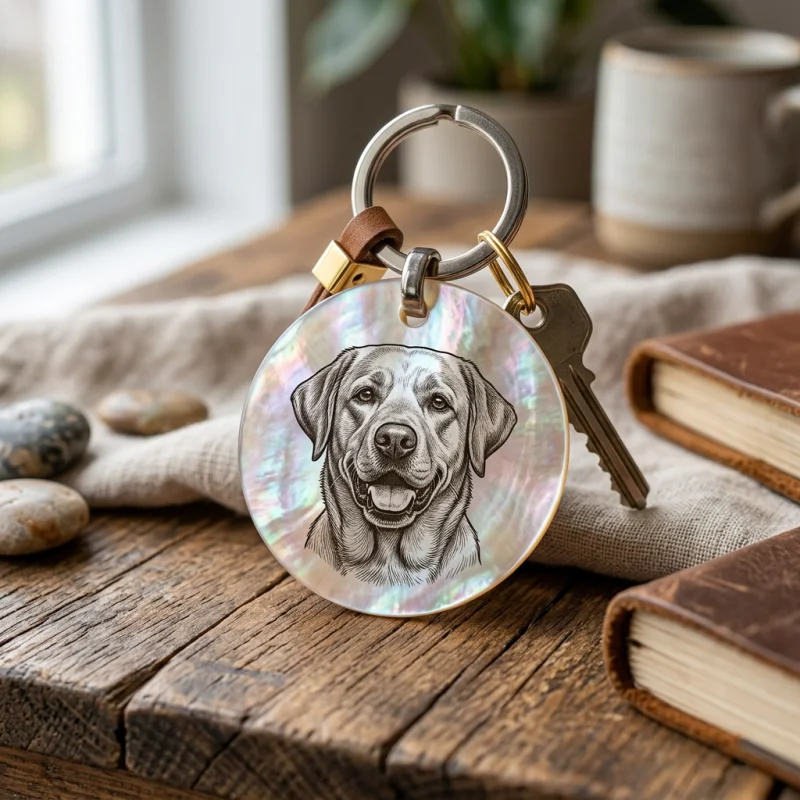
Preventing cracks while crafting a laser engraved dog portrait tag demands specific laser parameters:
- Laser Type: A 355nm UV laser provides cold light processing that breaks organic bonds without heat buildup. Alternatively, a low-wattage CO2 laser set between 3 to 5 watts power avoids scorching fragile nacre layers.
- Marking Speed: Keep travel speed high at 300 mm/s. Fast passes prevent localized heat accumulation along dense vector clusters.
- Pass Count: Execute two to three low-power passes rather than a single heavy pass. This technique darkens the line art gradually without weakening the mineral core.
This exact tuning generates a sharp laser engraved shell charm that retains the iridescent shine of the surrounding shell background.
Bezel Hardware and Protective Resin Sealing
A raw shell disc hanging directly from a split ring won't last. The mineral structure is brittle along its edges, making drill holes vulnerable to snapping under sudden tension. Encasing the shell disc inside a protective metal frame provides essential lateral support.
Leo evaluated two common metal options for the casing:
- Marine-Grade 316L Stainless Steel: Outstanding resistance to moisture, salt, and abrasion. Steel doesn't oxidize or turn green when exposed to dog slobber, damp fur, or grass resin.
- Brass Enclosures: Soft metal that oxidizes quickly in wet environments. Brass leaves dark metallic stains on light coat fur and dulls rapidly without polish.
Leo chose a heavy-duty 316L stainless steel bezel with a raised protective outer rim. He mounted the shell insert inside the steel bezel using clear marine-grade epoxy resin.
To guard the exposed laser micro-grooves from ambient moisture, oil, and mud, he applied a coat of optical-grade UV clear resin over the face. The resin cures rock-hard under UV light, smoothing out the surface while sealing the porous nacre against moisture intrusion.
Real-World Wear and Important Limitations
Leo attached the completed laser engraved shell charm to Buster's leather collar ring. Out on their morning walk, the sunlight caught the white nacre, showing off the dark line drawing of Buster's face inside its polished steel frame.
Even with protective resin coatings and steel frames, shell charms have mechanical limits. Shell material ranks around 3.5 on the Mohs hardness scale. It's a calcium carbonate composite, not tempered steel.
Raw or resin-coated shell charms shouldn't stay on aggressive chewers or dogs left unsupervised during rough play. If two dogs play by grabbing each other's collars, bite force will crush the internal shell core. Take the charm off before crate time, heavy brush runs, or dog park wrestling sessions. To clean the tag, wipe it down once a week using a soft cloth, warm water, and mild soap.
Can a laser engraved shell charm handle wet weather and swimming?
Yes, provided the shell insert is housed inside a stainless steel bezel and sealed with an optical resin topcoat. The resin barrier prevents water from penetrating the raw engraved lines, while marine-grade 316L steel resists rust caused by lakes, rain, or tap water.
What type of photo works best for a laser engraved dog portrait tag?
High-contrast photos taken in direct daylight produce the best results. Close-up shots focusing on your dog's face work far better than full-body photos. Images should be converted into clean vector line art, removing shadows, gradients, and cluttered background elements before processing.
Is mother-of-pearl strong enough for everyday wear on a dog collar?
It is durable enough for normal daily walks and house wear if the shell is at least 1.2 mm thick and enclosed within a metal bezel. However, it isn't indestructible. Remove the tag during rough dog park play, hunting trips through heavy underbrush, or crate stays to avoid impact damage.