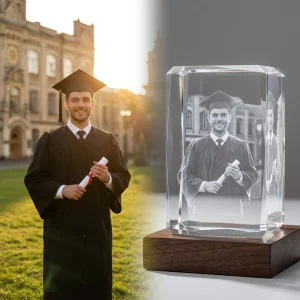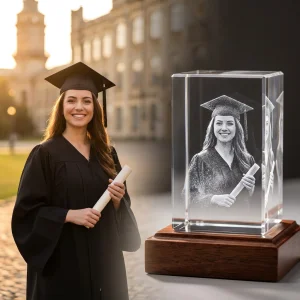
Science of Sub-Surface Laser Engraving: Transforming Graduation Photos into 3D Glass Keepsakes
Sub-Surface Laser Engraving (SSLE) burns microscopic points inside a solid block of optical glass without damaging the polished exterior walls. The technology relies on a targeted green diode laser running at a 532-nanometer wavelength. Standard lasers absorb energy at the outer surface, cutting or burning the exterior skin. A green 532nm beam passes cleanly through transparent optical media until it reaches a pre-calculated focal point inside the block. At that precise coordinate, high peak power density causes localized non-linear absorption. The sudden thermal pulse micro-fractures the glass internal matrix, producing a visible white dot roughly 20 to 50 microns across.
Tens of thousands of these micro-fractures create a three-dimensional point cloud. When light hits these internal fractures, it scatters. The result is an opaque image suspended inside transparent glass.
Optical Crystal vs. Standard Soda-Lime Glass
Not all glass supports sub-surface engraving. Common soda-lime window glass contains high levels of iron oxide, giving it a greenish edge tint. Soda-lime glass also contains microscopic gas bubbles, tension lines, and structural impurities. Focused laser energy striking an internal air bubble in soda-lime glass causes uncontrolled spiderweb fractures or shatters the entire block.
Precision SSLE requires K9 optical crystal, a high-purity borosilicate glass equivalent to BK7. K9 crystal undergoes rigorous annealing to relieve internal mechanical stress. It offers high clarity with an optical refractive index of 1.5168 and minimal inclusions.

Technical Parameters of SSLE Production
Creating a high-definition 3D crystal graduation gift requires strict control over physical laser parameters, point density, and material properties. The table below lists standard operational parameters for high-precision sub-surface engraving.
| Craft Parameter | Specification Value | Technical Function |
|---|---|---|
| Laser Wavelength | 532 nm (Green Diode / Frequency-Doubled Nd:YAG) | Passes through clear glass without surface absorption; focuses internally. |
| Substrate Material | K9 Optical Crystal (Lead-Free Borosilicate) | Provides high purity, zero internal bubbles, and uniform thermal resistance. |
| Point Cloud Density | 300,000 – 800,000 dots per block | Determines image detail, opacity gradient, and internal structural contrast. |
| Focal Accuracy Tolerance | ±0.01 mm | Ensures micro-fractures register at exact X, Y, Z spatial coordinates. |
| Pulse Frequency | 2,000 – 5,000 Hz | Controls production throughput without overheating the local glass matrix. |
| Resolution Standard | 300 DPI depth map conversion | Translates 2D pixel grey values into accurate depth-coordinate points. |
Converting 2D Portraits to 3D Spatial Maps
A standard graduation portrait is a flat grid of RGB pixels. Converting it into a 3D crystal graduation gift demands mathematical surface reconstruction. Specialty CAD software processes the portrait by isolating the subject's face, neck, and hair from the background.
Algorithms map facial features against standard anatomical depth templates. The software calculates relative depth: the tip of the nose extends forward along the Z-axis, while cheekbones recede and ears push back further. Dark shadows and light highlights convert into spatial offsets. Once the depth map is rendered, the system breaks the 3D surface model into a point cloud. Every single dot receives exact X, Y, and Z positional coordinates inside the crystal volume. High-end laser systems pulse up to 5,000 times per second, building the point cloud line by line, layer by layer, from back to front.
Choosing the Ideal Photo for Engraving
SSLE lasers do not print colored ink. They produce tiny white fractures. Dark areas in your photograph translate to empty spaces inside the glass; bright areas translate to dense clusters of micro-fractures. Selecting an ideal portrait ensures a clean laser engraved graduation keepsake.
- Direct key lighting: Choose photos with clear front lighting. Shadows across half the face create empty zones in the point cloud, leaving half the 3D portrait looking hollow.
- High contrast between subject and background: Black graduation gowns blend into dark background foliage. Select shots where the gown, hair, and cap stand out clearly against the backdrop.
- Sharp focus: Blurry phone snaps produce fuzzy point clouds. Eyes, teeth, and hair textures should be crisp at 100% zoom.
- Subject limit: Standard rectangular blocks (60x60x100mm) render best with one or two faces. Attempting to fit a group photo of ten graduates into a single crystal dilutes dot density, turning distinct faces into unreadable speckles.
Limitations, Material Incompatibilities, and Care
Sub-surface laser engraving has hard physical boundaries. Understanding these prevents disappointed expectations and damaged keepsakes.
Low-contrast, underexposed, or low-resolution digital images cannot generate detailed depth maps. If an input image lacks pixel definition around the jawline or eyes, the conversion software fills gaps with generic depth estimates. This creates flattened, muddy features. Flat gray lighting results in a uniform dot density that lacks distinct highlights.
Never subject K9 optical crystal blocks to sudden thermal swings. Pouring warm water over a freezing block or leaving the crystal inside a parked car in direct summer heat causes rapid internal expansion. The laser-etched micro-fractures act as stress points. Under thermal shock, these internal points can connect, creating visible crack lines that ruin the piece.
Avoid harsh chemical solvents like ammonia or acetone when cleaning etched optical glass. Clean the exterior surfaces using a dry or slightly damp microfiber cloth. For persistent fingerprint oils, a single drop of mild dish soap mixed with distilled water restores surface clarity.
Sizing, Layouts, and Illumination
Standard crystal sizes for a single graduate portrait range from 50x50x80mm up to 80x80x120mm. A vertical orientation suits individual headshots, accommodating the cap, tassel, and top of the gown.
Custom text adds context to a laser engraved graduation keepsake. Keep text elements on a flat 2D plane offset slightly below or behind the main 3D portrait. Limit custom lines to student name, degree title, and graduation year. Sans-serif fonts at minimum 10-point height ensure legible laser-fractured characters.
Because micro-fractures rely on scattered light, ambient room lighting can look washed out. Base lighting fixes this issue. Position the crystal on an LED light base equipped with cool white light-emitting diodes. Rays enter through the polished bottom face, striking the internal point cloud directly. The micro-fractures catch the light, projecting a bright, high-contrast 3D image against the dark room.
Can color photos be engraved inside the crystal block in full color?
No. Sub-surface laser engraving relies on micro-fractures created inside the crystal matrix. These fractures appear opaque white when light strikes them. Color cannot be injected inside solid glass blocks; the resulting image is rendered strictly as a grayscale point cloud made of light-scattering points.
Will the laser engraved image inside the glass fade over time?
Never. Because the point cloud consists of permanent physical micro-cracks trapped inside inert K9 optical crystal, the image cannot fade, scratch, rub off, or yellow. So long as the glass block remains intact and free from catastrophic thermal shocks, the internal image lasts indefinitely.
What photo file formats and resolutions yield the best engraving results?
Submit uncompressed JPEG, PNG, or TIFF files with a minimum resolution of 1000x1000 pixels. High-resolution photos shot with clear front illumination allow the point-cloud software to calculate depth maps accurately down to a resolution standard of 300 DPI.