Preserving Maya's Graduation Inside K9 Optical Crystal
Julian had four browser tabs open on his laptop at 11:00 PM. His daughter Maya graduated with her Master of Science in Aerospace Engineering next Friday, and every gift idea felt disposable. Paper prints fade under office fluorescent lights. Acrylic blocks scratch easily. Silver frames collect tarnish while sitting on a bookshelf. He looked at a digital photo of Maya outside the hall: cap angled slightly left, tassel against her cheek, degree folder in hand. It was a milestone locked in flat pixels.
He wanted a physical object with weight and clarity. That search led him to a custom laser engraved crystal, specifically designed to capture three-dimensional detail inside optical glass.

Comparing Crystal Formats: Cubes, Icebergs, and Diamonds
Choosing the material was only the first step. Julian had to select a shape that matched the geometry of a cap-and-gown portrait. Three main formats dominate 3d crystal graduation gifts:
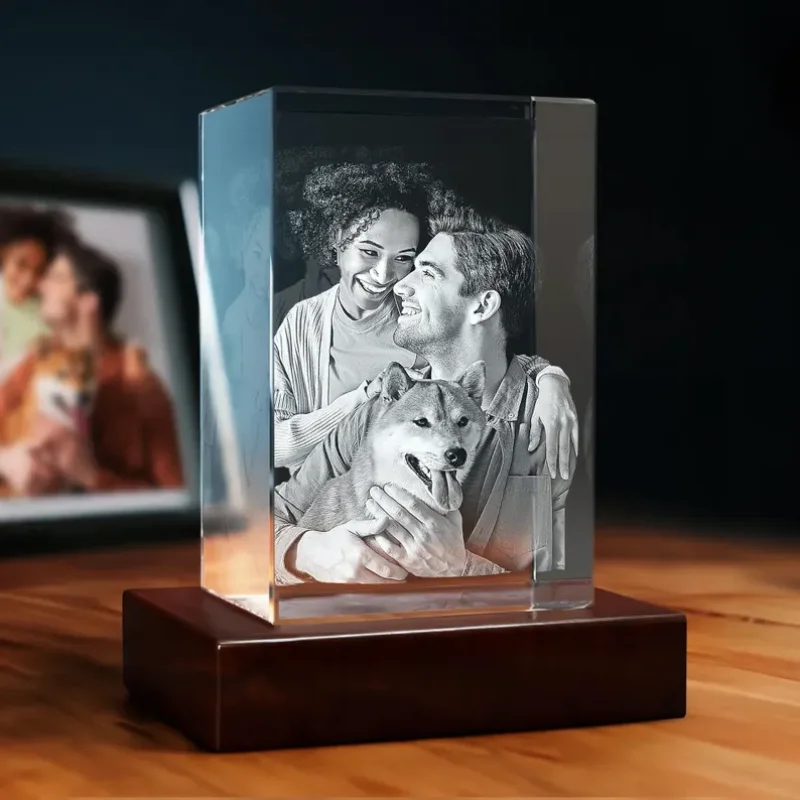
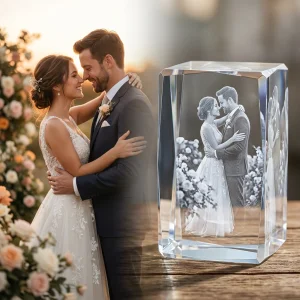
- The 3D Photo Cube: Solid volume with thick profile depth. It offers 180-degree parallax viewing, letting you see the depth of shoulders, cap brims, and fabric folds when turning the block.
- The Iceberg Plaque: Fractured, hand-polished jagged edges along the top perimeter. These raw cuts catch ambient room light, directing focus toward the smooth center portrait.
- The Faceted Diamond: Geometric jewel cuts around the border. The facets refract light into subtle spectrums, framing the white interior engraving against sharp angles.
Julian picked a 3.1 x 3.1 x 4.7 inch vertical photo cube. The tall rectangular proportions fit Maya's full-length standing pose.
Translating 2D Portraits into 3D Point Clouds
A flat photograph cannot instantly jump inside a piece of glass. When Julian uploaded the digital JPEG, CAD artists converted the 2D image into a spatial point cloud. Specialized software calculates depth based on contrast, lighting gradients, and anatomical proportions.
Single photographs lack rear visual data. To build the back and sides of Maya's portrait, CAD technicians manually map key facial coordinates:
- Nose bridge height relative to eye plane
- Outward angle of the mortarboard cap
- Tassel curve along the jawline
- Fabric folds in the academic gown
Photo quality directly affects point density. Dark, heavy shadows under a mortarboard brim give the depth software less data. Pitch-black pixels reduce dot density, leaving sparse patches inside the glass. Julian swapped his initial night photo for a crisp afternoon shot. The bright sunlight gave the software sharp feature lines, generating a dense cloud of over 500,000 individual spatial points.
The Physics of Subsurface 532nm Green Lasers
How does an image get inside a solid block without cracking the outer walls?
The answer rests in laser physics. Subsurface glass engravers use a 532-nanometer diode-pumped solid-state (DPSS) green laser. This specific wavelength travels straight through transparent optical glass without scorching the exterior surface.
Computer-controlled lenses converge the laser beam onto precise X, Y, and Z coordinates inside the block. At the exact focal point, energy density spikes. Thermal shock creates a microscopic vapor bubble (a controlled micro-fracture under 100 microns wide) that reflects ambient light as a solid white dot. Operating at thousands of pulses per minute, the DPSS green laser plots every dot in the point cloud without leaving a trace on the outer walls.
Why Lead-Free K9 Glass Prevents Internal Cracking
Material chemistry dictates laser results. Traditional leaded crystal contains lead oxide to increase weight and prism dispersion. However, lead weakens internal glass elasticity. When targeted by a high-frequency laser pulse, leaded crystal cracks along structural stress lines, turning small dots into large, cloudy fractures.
Precision engravers use optical-grade K9 borosilicate glass for three physical reasons:
- Lead-free purity: Stops runaway structural fractures, keeping every internal micro-dot isolated and distinct.
- Refractive index of 1.516: Bends light cleanly through the block, sharpening the visible rendering.
- Low inclusion density: Eliminates internal air bubbles so the clear background stays dark under focused lighting.
Subsurface Engraving Versus Surface Sandblasting
Julian considered traditional surface-engraved glass plaques before picking subsurface crystal. The operational differences change how the object ages over time:
Sandblasting forces abrasive silicon carbide grit against the outer glass face. This process carves physical grooves on the exterior surface. Over years of display, airborne dust, skin oils, and cleaning chemical residue settle into those surface cuts. Cleaning requires specialized soft brushes to remove trapped grime.
Subsurface engraving keeps all outer faces factory-smooth. Because the 3D point cloud rests completely encapsulated inside K9 glass, dust cannot reach the image. Maintenance requires a simple wipe with a microfiber cloth, clearing fingerprints off the outer faces without touching the portrait inside.
Practical Tips for Photo Selection and Crystal Sizing
Getting clean depth resolution in a customized crystal requires attention to photo angles and physical dimensions:
- Subject Angle: A three-quarter turn of the head creates stronger depth perception than a flat, straight-on profile. The angled posture gives the CAD software clear Z-axis spacing between the nose tip, cheekbone, and ears.
- Lighting Setup: Choose photos with clear frontal key lighting. Strong backlighting throws facial features into shadow, lowering laser point density.
- Proportional Sizing: Compact 2x2x3 inch cubes work best for tight head-and-shoulder crops. Full-body cap-and-gown shots need blocks at least 3x3x5 inches or larger so details like diploma lettering remain crisp.
When Julian's package arrived, he opened the box and placed the K9 cube onto a black wooden base with built-in white LEDs. Upward light passed through the base, making Maya's cap, tassel, and smile stand out in vivid, dimensional contrast within the clear crystal block.
Will subsurface laser engraved crystal fade or turn yellow over time?
No. K9 optical crystal is UV-stable glass, not plastic, acrylic, or resin. The internal image consists of permanent micro-fractures inside the glass matrix, meaning it will never fade, yellow, or degrade when exposed to direct sunlight.
Can you convert a standard flat smartphone photo into a 3D crystal portrait?
Yes. CAD artists process standard 2D JPEG or PNG files using depth-mapping software. They construct a 3D point cloud by estimating facial features, hair volume, and clothing contours. High-resolution photos with clear lighting produce the densest, most detailed 3D results.
How do you clean and maintain a custom laser engraved crystal?
Maintenance requires simple surface wiping. Because the image sits safely beneath the exterior walls, dust cannot reach it. Wipe fingerprints off the outer glass faces using standard glass cleaner or an isopropyl alcohol wipe with a soft microfiber cloth.