Designing a Timeless Optical Crystal Award for Executive Retirements: A Technical Guide for HR Leaders
Leo stared at three sample awards sitting on his desk. The company retirement dinner was six weeks away, and Arthur, the Senior Vice President of Operations, was retiring after 32 years of service. One sample, an acrylic block, already showed hairline scratches from being shifted across the desk. Another, made of standard leaded crystal, had a greenish cast under office fluorescent lights and contained two small air bubbles trapped near its base. Leo picked up the third sample. It felt light, cheap, and disposable.
Arthur had overseen the construction of seven manufacturing plants and expanded logistics into four continents. Giving him a lightweight award with printed surface lettering felt like an insult. Leo needed a solid piece of optical glass, mathematically pure, with artwork suspended inside the crystal where light could catch every edge.

Choosing K9 Optical Crystal Over Leaded Glass
Why do standard trophies look cloudy after a few years? Glass quality varies significantly based on chemical composition. Traditional decorative glass relies on lead oxide—often up to 24%—to add weight and softness for hand-cutting. Lead oxide lowers optical clarity and introduces a faint yellow or green tint under indoor light fixtures. Leaded crystal also suffers from internal micro-bubbles formed during cooling.
Leo turned his focus to K9 optical crystal. K9 is a high-purity borosilicate crown glass valued in optical lens manufacturing for camera lenses and telescopes. Its key mechanical and optical properties include:
- Refractive Index: High refractive index of 1.516, maximizing light refraction and brilliance.
- Zero Inclusions: Melted under controlled temperatures to eliminate air bubbles and internal stress lines completely.
- High Clarity: Exceptional light transmission with zero color cast, appearing completely clear from every angle.
- Surface Hardness: Exceptional scratch resistance compared to acrylics or soft leaded glass, maintaining clear polished bevels indefinitely.
K9 crystal weighed heavy in the hands. The physical mass matched the gravity of Arthur's 32-year tenure.
Sub-Surface Laser Engraving: 532 nm Green Laser Technology
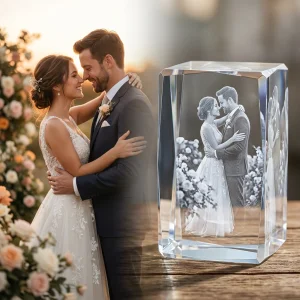
Surface engraving, like sandblasting or chemical etching, damages the exterior face of glass. Over decades, those micro-grooves collect skin oils, dust, and polishing chemicals. Sub-Surface Laser Engraving (SSLE) solves this problem by leaving the outer glass surface intact and smooth.
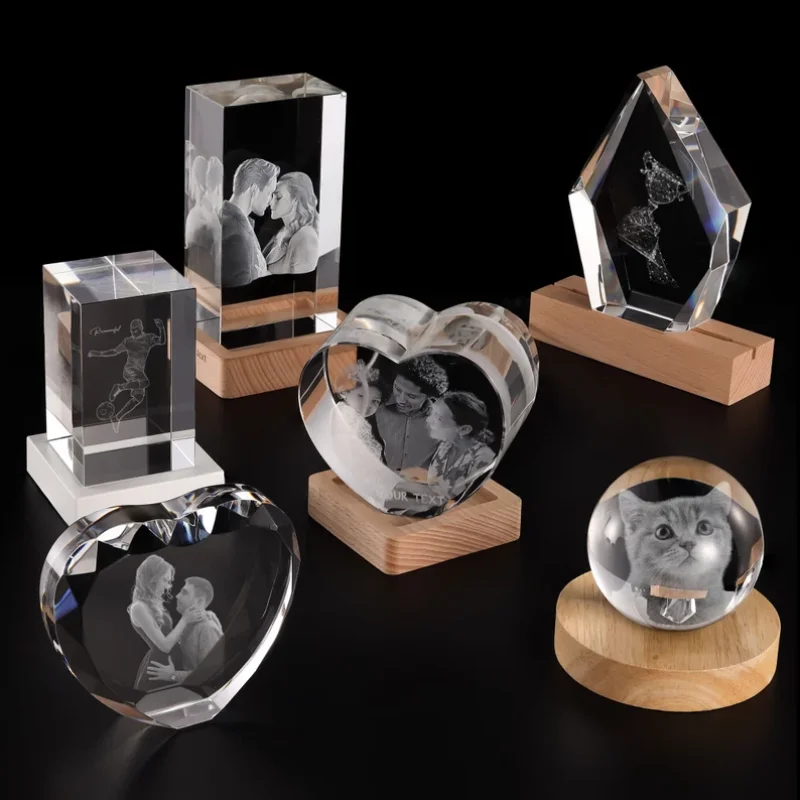
The technical magic happens inside the block. SSLE systems use a high-frequency green laser operating at a 532-nanometer wavelength. Green light passes straight through clear optical crystal without heating or marring the exterior surface. When the laser computer focuses two beams at an exact three-dimensional coordinate inside the crystal, the combined energy causes a localized thermal explosion. This creates a controlled micro-fracture measuring less than 100 microns across.
By pulsing the laser thousands of times per second, the machine maps out hundreds of thousands of microscopic white points suspended inside the glass. These dots reflect ambient room light, making the internal design glow sharply without ink, paint, or chemical dyes.
2D Inner Logos vs 3D Volumetric Point-Cloud Models
Leo evaluated two design directions for Arthur's award. A 2D render converts a flat vector logo into a floating plane of laser dots inside the crystal. It looks clean, but it lacks depth when viewed from the side.
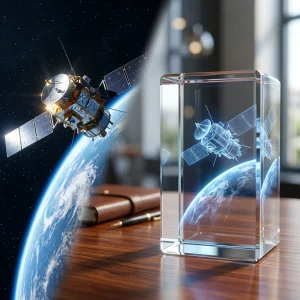
Instead, Leo chose a 3D volumetric point-cloud model. The engineering team sent CAD files of the original flagship distribution center that Arthur built in 1998. Specialized CAD software converted the building’s solid surfaces into a dense 3D point cloud. When viewed from the front, the laser-engraved building displayed architectural depth, column detail, and structural lines. When turned sideways, the viewer could look through the windows and inner halls of the miniature building floating in glass.
Key Dimensional Constraints and Artwork Requirements
Not every graphic or crystal shape yields clear results. Leo worked with the production engineers to fix two design issues before firing the laser.
First, ultra-thin crystal shapes restrict the z-axis focal depth. A block with a thickness under 30 millimeters forces a 3D model to flatten out, distorting perspective angles. Leo selected a monolithic crystal block measuring 200 mm tall, 120 mm wide, and 60 mm deep. The 60-millimeter depth allowed ample clearance for the 3D facility render to sit centered with 15 millimeters of clear glass buffer on all sides.
Second, raster files like JPEGs or lower-resolution PNGs cause severe engraving errors. Raster images force the laser software to guess depth based on pixel greyscale values, leading to noisy, pixelated dot clusters. The production facility required original vector files (.AI or .EPS) for text logos, and solid 3D CAD files (.OBJ or .STL) for the volumetric facility model. Clean vector paths guarantee that laser focal points maintain uniform spacing and sharp contrast.
Selecting Monolithic Pedestals and Mounting Bases
A crystal award needs proper ground contrast to maximize light refraction. Placing clear optical crystal directly on a light wood desk lets light wash through the bottom, diminishing the visual sharpness of internal laser dots.
Leo paired the clear K9 block with a bevel-edged black optical crystal pedestal base. Black optical glass absorbs downward light paths, creating high contrast against the bright white micro-fractures inside the primary block. A precision UV-cured optical adhesive bonded the main rectangular block to the black base. This adhesive cures under ultraviolet light to achieve the exact refraction index of glass, creating a permanent structural bond that looks entirely invisible.
Production Timeline and Planning Checklist
Ordering custom executive optical crystal requires structured lead time. Quality controls cannot be rushed during the multi-pass annealing or high-density laser engraving phases.
Leo followed a four-week fulfillment schedule:
- Week 1 (Asset Conversion): Gathering vector logos, converting facility CAD models into 3D point-cloud files, and drafting engraving text proofs.
- Week 2 (Digital Proofing): Adjusting focal depth, verifying dot density algorithms, and approving 360-degree digital renders.
- Week 3 (Engraving & Hand Finishing): Executing 532 nm green laser engraving, hand-polishing bevels, and inspecting under 10x magnification for surface micro-cracks or inclusions.
- Week 4 (Packaging & Delivery): Fitting the completed award into a custom foam-padded presentation box lined with black satin fabric.
On the night of the retirement gala, Arthur opened the satin-lined box. When he lifted the heavy block toward the ambient light, the floating miniature of the facility he built three decades ago caught the room lights sharply. The smooth outer glass felt cool and flawless to his touch. Leo knew the piece would spend the next thirty years sitting on Arthur's library shelf, crystal clear and untarnished.
Frequently Asked Questions
What is the difference between K9 optical crystal and standard glass awards?
K9 optical crystal is a high-grade borosilicate crown glass manufactured without lead or air inclusions. It offers higher light clarity, scratch resistance, and a light refractive index of 1.516. Standard trophy glass often contains lead or impurities, which introduce air bubbles, internal distortion, and a faint greenish tint.
What file formats are required for 3D sub-surface laser engraving?
For two-dimensional logos and text, vector formats such as .AI, .EPS, or vector-based .PDF are required. For three-dimensional volumetric shapes, custom models require CAD or 3D vector files such as .OBJ, .STL, or .3DS. Standard bitmap images like JPEG or PNG lead to blurry, pixelated laser dots.
Can 3D sub-surface laser engraving wear off or fade over time?
No. Sub-surface laser engraving creates micro-fractures suspended entirely inside the solid crystal block. Because the outer surface of the glass remains smooth and unbroken, the internal engraving cannot be scratched, worn down, faded by sunlight, or affected by cleaning chemicals.
How much lead time is needed to order a custom executive optical crystal award?
Standard production lead time ranges between 3 and 4 weeks. This timeframe allows for 3D CAD modeling, digital point-cloud rendering, laser engraving, optical adhesive bonding, quality control inspection under magnification, and secure satin-lined box packaging.