Inside the Prism: How Lasers Capture 3D Images Inside Crystal
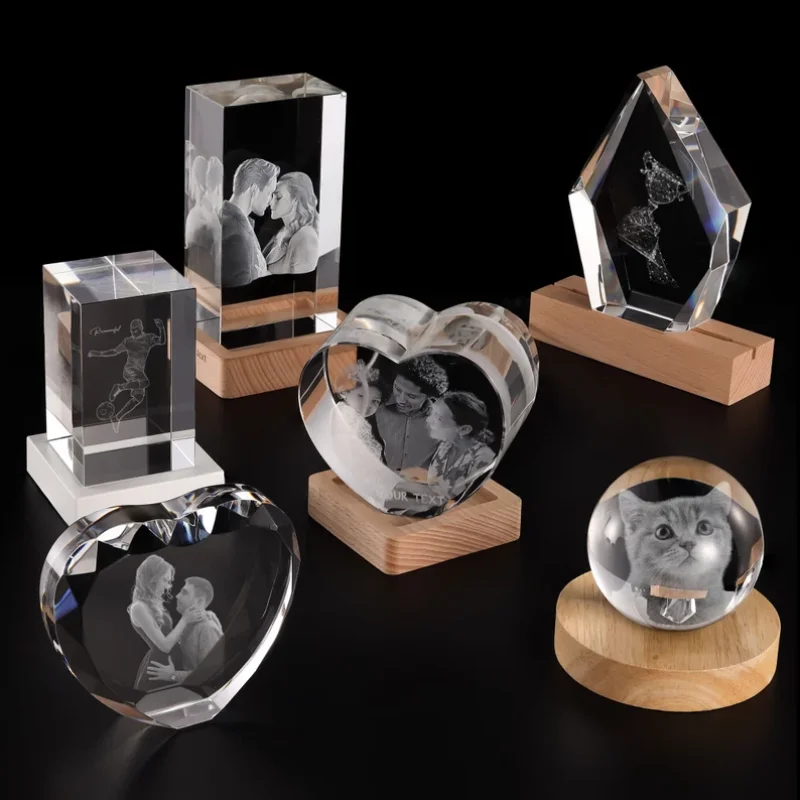
Shoot a high-energy laser through solid glass and logic dictates it should leave a burn mark along its path. Sub-surface laser engraving defies this expectation by relying on non-linear optical absorption. Using frequency-doubled Nd:YAG lasers emitting at a 532-nanometer green wavelength, light passes through clear glass without heating the surface. Energy travels straight through the material until it hits a specific target coordinate inside.
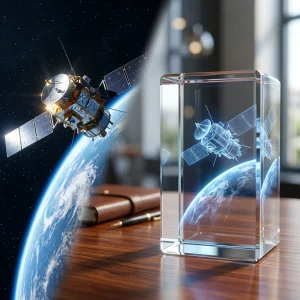
Focusing lenses make this trick possible. They concentrate the laser beam down to a focal spot diameter between 15 and 25 micrometers. Outside this tight convergence zone, energy density stays below the damage threshold of the glass. Inside the focal spot, power density spikes above 500 Megawatts per square centimeter. Light intensity at that coordinate strips bound electrons from atoms, creating a localized micro-plasma. The resulting shockwave creates a controlled micro-fracture called a voxel—measuring roughly 30 to 80 microns wide. The outer surface remains smooth to the touch.
The Chemistry of Glass Selection
Executing clean inside glass laser etching requires pristine raw material. Standard soda-lime float glass, commonly used in windows or drinkware, fails instantly under sub-surface laser pulses. Cheap glass harbors microscopic air pockets, iron oxide contaminations, and uneven mechanical tension. When a nanosecond laser pulse hits a microscopic impurity, thermal expansion propagates uncontrollably. The crystal shatters internally, turning high-detail point clouds into webbed fractures.
High-precision keepsakes require optical-grade K9 crystal. K9 is a specialized borosilicate crown glass manufactured with strict purity standards. It features a refractive index of 1.5168 and exceptional internal homogeneity. Low dispersion ensures that converging laser rays bend predictably without premature distortion. When executing K9 crystal laser engraving, every micro-fracture stays contained within a tight 30-to-80-micron zone, preserving sharpness across millions of individual points.
Technical Specifications and Operating Parameters
Precise control over pulse timing and power output determines whether an image appears crisp or blurry. The following parameters govern the sub-surface laser process.
| Parameter | Standard Value | Operational Impact |
|---|---|---|
| Laser Wavelength | 532 nm (Frequency-doubled Nd:YAG) | Passes through clear crystal with near-zero linear absorption. |
| Pulse Duration | 3 to 8 nanoseconds | Confines heat to avoid structural glass fractures. |
| Focal Spot Diameter | 15 to 25 microns | Defines the physical resolution of individual 3D voxels. |
| Peak Power Density | > 500 MW/cm² | Exceeds the optical breakdown threshold strictly at the focal point. |
| Voxel Diameter | 30 to 80 microns | Determines point density and micro-fracture visibility. |
| Material Index of Refraction | 1.5168 (K9 Crystal) | Ensures predictable light refraction through block depth. |
Laser Path Geometry and Shadow Effects
Sub-surface engraving operates under strict physical geometry. Each voxel produced inside the crystal becomes a microscopic fracture that scatters light. This scatter disrupts laser pulses attempting to pass through that same point later in the sequence. If a laser attempts to strike behind an existing voxel, light scatters early, leaving a blank spot or a malformed point. Engineers refer to this limitation as optical shadowing.
Software algorithms prevent shadowing by calculating laser paths from back to front, relative to the objective lens. The laser fires at the deepest plane inside the block first. It works forward layer by layer, rising from bottom to top. This pathing leaves clear glass between the focal lens and target coordinates for every single pulse.
Physical Limits and Design Constraints
Material boundaries impose strict rules on 3D laser design:
- Edge clearance: Voxels must stay at least 2.0 millimeters away from any outer face. Engraving too close to an edge concentrates internal tension, leading to exterior surface cracks or corner chipping.
- Voxel density limits: Packing points too tightly creates continuous fracture planes. Keeping point spacing above 100 microns prevents internal stresses from merging into large cracks.
- Depth limits: Crystal blocks thicker than 150 millimeters suffer from beam quality degradation. As light travels deeper through glass, minor optical variations soften the focal spot, reducing power density.
- Monochrome output: Micro-fractures reflect ambient light white. Color variations are impossible inside the glass matrix itself; color effects require external LED base lighting.
Careful handling maintains visual quality over time. Avoid dropping crystal blocks or subjecting them to rapid temperature changes above 40 degrees Celsius per minute. Sudden thermal shocks expand micro-fractures, clouding internal details.
Why does K9 crystal laser engraving require green lasers instead of CO2 or fiber lasers?
CO2 lasers emit at a 10,600-nanometer wavelength, which glass absorbs instantly at its surface, making internal targeting impossible. Fiber lasers operate at 1,064 nanometers, passing through glass without absorbing efficiently enough to cause optical breakdown without extreme power. Green 532-nanometer lasers offer the ideal middle ground: high transmission through clear crystal and efficient non-linear absorption at focused high power densities.
Can sub-surface laser engraving produce colored images inside glass?
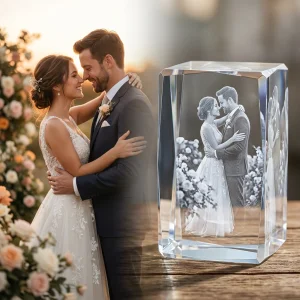
No. Sub-surface micro-fractures alter the physical structure of the crystal, creating tiny white points that scatter ambient light. Because no pigments, inks, or dyes enter the sealed glass, the internal image remains monochrome white. Displaying images with color relies on external base lighting equipped with RGB LEDs.
Will the 3D image inside the crystal fade or degrade over time?
The image is permanent. Micro-fractures represent physical changes in the crystal structure that cannot heal, fade, or shift under normal conditions. Keep the block out of extreme thermal shock environments to prevent stress fractures from expanding across voxels.
How does inside glass laser etching differ from traditional surface glass etching?
Traditional surface etching uses sandblasting, acid baths, or surface lasers to physically erode the exterior face of the glass. Sub-surface laser etching focuses energy straight through the outer face, leaving the exterior completely smooth while forming a three-dimensional point cloud entirely inside the material.