The Physics of Sub-Surface Laser Engraving: K9 Crystal vs. Standard Glass
Put a standard window pane under a focused sub-surface laser beam and it shatters into stress lines. Swap that window glass for a block of synthetic optical K9 crystal and the beam passes through cleanly, leaving thousands of precise micro-fractures floating in mid-air. It's a stark contrast. The difference between failure and a sharp image comes down to atomic purity, refractive index, and residual thermal stress.
Chemical Composition and Optical Homogeneity
Standard window glass looks clear until you look at the edge of a thick sheet. That signature green color comes from iron oxide contaminants ($Fe^{2+}$ and $Fe^{3+}$) present in commercial quartz sand. Common soda-lime float glass contains roughly 70% silicon dioxide ($SiO_2$), 15% sodium oxide ($Na_2O$), and 9% calcium oxide ($CaO$). Factory glassworks melt these raw materials in gas-fired furnaces at 1,500°C. Microscopic gas pockets, chemical bands, and metallic inclusions remain trapped inside the matrix during rapid cooling.
Optical K9 crystal belongs to the borosilicate crown glass family, equivalent to optical glass standard BK7. Glassmakers synthesize it using refined silica ($SiO_2$), boron trioxide ($B_2O_3$), potassium oxide ($K_2O$), and sodium oxide ($Na_2O$). Lead oxide is omitted entirely from the formulation. Synthesizing K9 involves melting raw elements inside platinum-lined crucibles. This removes dissolved gases and filters out micro-inclusions down to sub-micron scales. The liquid optical batch cools into a material with flat internal homogeneity across all three spatial dimensions.
How 532 nm Green Lasers Create Sub-Surface Voxels
Sub-surface laser engraving relies on non-linear optical absorption. Surface lasers use infrared wavelengths like 1,064 nm or 10,600 nm to burn or abrade material from the outside inward. Sub-surface devices utilize frequency-doubled diode-pumped solid-state (DPSS) lasers operating at a precise 532 nm green light wavelength.
Green light passes straight through polished optical K9 crystal with over 92% light transmission. Light enters the exterior face without heating the optical surface. Dynamic mirrors direct thousands of short laser pulses per second through an expanding lens assembly, forcing the light cone down to a tight focal spot inside the crystal block. Beam radius shrinks to less than 30 micrometers at that target point.
Energy density spikes instantly at the focal coordinate. When peak power exceeds the breakdown threshold of the glass—around $10^{10}$ watts per square centimeter—localized multiphoton ionization occurs. Electrons strip away from their parent atoms for a fraction of a nanosecond. This micro-explosion produces a thermal shockwave, leaving behind a permanent micro-fracture between 50 and 100 microns wide. Optical engineers term this individual dot a voxel.
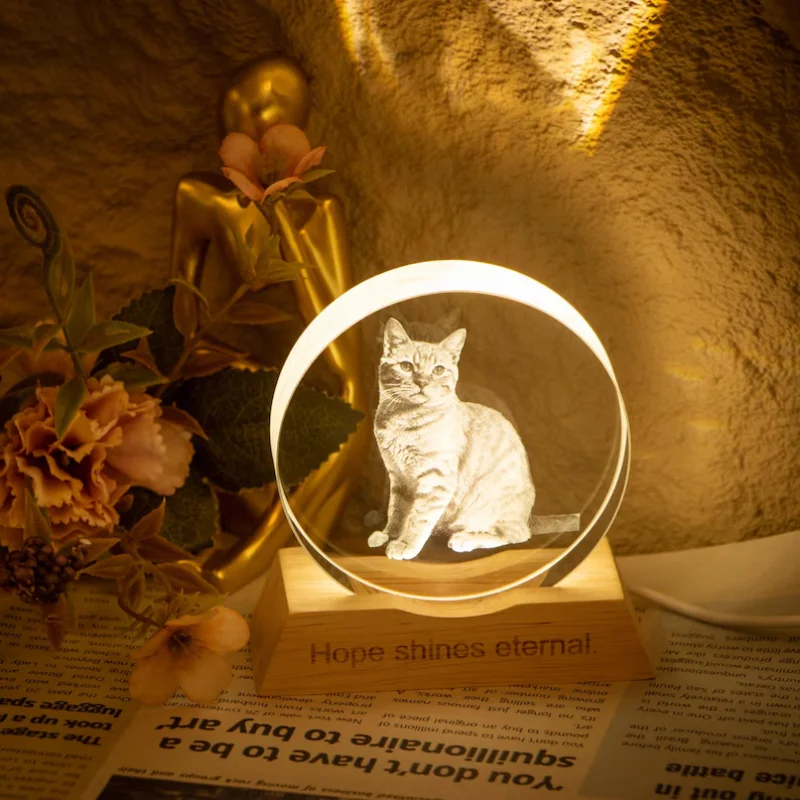
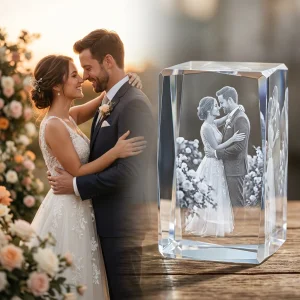
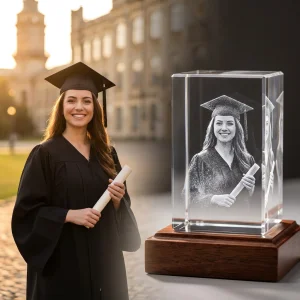
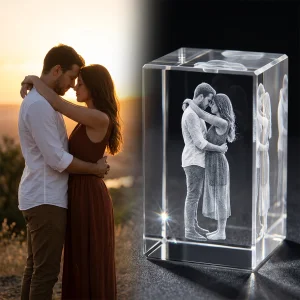
System software controls position across three axes. It doesn't burn the exterior skin. Every voxel inside a finished 3D laser photo crystal acts as a tiny white scatter point for ambient light while the surrounding glass stays clear.
Material Specifications Comparison
Comparing physical and optical properties shows why optical K9 crystal remains the preferred substrate for internal laser engraving.
| Parameter / Metric | Optical K9 Crystal | Soda-Lime Float Glass | Tempered Architectural Glass |
|---|---|---|---|
| Material Classification | Borosilicate Crown (BK7 equivalent) | Soda-Lime-Silica | Toughened Soda-Lime |
| Light Transmission (532 nm) | > 92.2% | 85.0% - 88.0% | 83.0% - 86.0% |
| Refractive Index ($n_d$) | 1.5163 | 1.5200 | 1.5210 |
| Abbe Dispersion Value ($v_d$) | 64.17 | 58.50 | 57.00 |
| Iron Content ($Fe_2O_3$) | < 0.005% | 0.08% - 0.12% | 0.08% - 0.12% |
| Density | 2.51 g/cm³ | 2.50 g/cm³ | 2.50 g/cm³ |
| Internal Strain Retardation | < 10 nm/cm | 40 - 60 nm/cm | > 500 nm/cm (High Stress) |
| Laser Engraving Suitability | High precision; stable | Surface cracking; unstable | Catastrophic shattering |
Why Standard and Tempered Glass Shatter Under Lasers
Why do everyday glass cups or float glass panes crack when targeted by internal lasers?
Float glass cools quickly on molten tin beds during high-speed manufacturing. Rapid cooling locks in high structural strain gradients between the surface skin and core layers. Microscopic iron particles in cheap glass absorb 532 nm green light prematurely. The beam loses energy before reaching its intended focus, scattering heat along the entry channel. Uneven thermal expansion causes erratic stress fractures along the entire light path.
Tempered architectural glass behaves even worse under focused light. Factories heat float glass sheets to 620°C then blast them with cold air jets. Surface layers freeze in compressed form while the core contracts inside, building thousands of pounds of locked tensile energy. A single laser-induced voxel inside a tempered block releases that stored energy immediately. Fracture lines cascade outward, causing the entire block to explode into tiny fragments.
Optical K9 crystal undergoes rigorous fine annealing. Glassmakers cool the hot crystal inside computerized kilns at rates slower than 1°C per hour across several days. Slow cooling reduces residual strain retardation below 10 nanometers per centimeter. Unstressed glass matrices absorb localized voxel micro-explosions easily without spreading spider-web cracks.
Limitations and Care Guidelines for K9 Crystal
Optical K9 crystal excels in optical clarity, though the material carries distinct physical limits. Understanding these factors prevents damage to engraved keepsakes over time.
- Scratch Hardness: K9 rates 5.5 on the Mohs hardness scale. Metal keys, quartz dust, and ceramic surfaces can scratch unpolished bevels. Always place blocks on felt pads or padded surfaces.
- Thermal Shock Limits: Rapid temperature shifts exceeding 50°C per minute cause voxel micro-fractures to expand. Keep engraved items away from direct sunlight, outdoor cold drafts, and high-wattage halogen display lamps.
- Chemical Sensitivity: Household ammonia cleaners, hydrofluoric acid solutions, and strong alkalis cloud the polished optical faces. Clean K9 crystal using isopropyl alcohol or micro-fiber cloths dampened with distilled water.
- Substrate Mass: Density sits at 2.51 g/cm³. Large display blocks get heavy fast. You'll need sturdy shelving and stable display bases for a 100mm cube, which weighs 2.51 kilograms (5.53 lbs).
How to Identify Authentic Optical K9 Crystal
Low-cost manufacturers often sub in standard high-iron glass cut to look like optical blocks. Testing personalized awards or photo blocks requires a few physical checks.
Inspect the block edges under natural daylight against a sheet of pure white paper. Authentic optical K9 crystal displays colorless, water-clear edges. Cheap float glass displays a distinct green or blue tint. Touch a corner with a soft tool. Unstressed K9 crystal rings with a clear pitch due to consistent acoustic velocity across its un-strained lattice. Stressed window glass produces a flat thud.
Examine internal image points using a 10x magnification loupe. A true 3D laser photo crystal exhibits uniform, spherical micro-cracks with clear boundaries. Sub-standard substrates show long hairline stress cracks radiating out from individual voxel points. Superior optical clarity ensures bright light reflection and clean image projection across the entire block.
What is the difference between optical K9 crystal and standard glass?
Optical K9 crystal is a high-purity borosilicate crown glass formulated with zero lead and ultra-low iron content (<0.005%). Standard float glass contains roughly 0.1% iron oxide, creating a green tint and lower light transmission. K9 crystal offers a 92.2% light transmission rate and homogenous internal structure, allowing lasers to pass through cleanly without causing thermal shock or cracking.
Can you laser engrave standard window glass on the inside?
No. Standard window glass contains high internal stress gradients and metallic inclusions that absorb laser energy along the beam path. Attempting sub-surface laser engraving on soda-lime glass results in surface cracking, cloudiness, or total structural failure of the pane. Sub-surface 3D engraving requires the strain-free, annealed structure of optical K9 crystal.
How long do internal 3D laser photo crystal engravings last?
Internal 3D laser photo crystal engravings are permanent. Because voxels are tiny structural micro-fractures suspended inside the sealed optical matrix, they cannot fade, oxidize, or wear away over time. Provided the crystal is kept away from extreme thermal shock (temperature swings over 50°C per minute) and severe physical impacts, the internal image will remain crystal clear indefinitely.