The Science of Nacre: How Microscopic Shell Structures React to Laser Heat
Structural Architecture of Aragonite and Conchiolin
Nacre relies on a micro-architectural design built over millions of years of mollusk evolution. Its structure resembles a microscopic brick wall. Polygonal aragonite (CaCO3) tiles form the bricks, each measuring 300 to 500 nanometers thick and 5 to 15 micrometers wide. An organic biopolymer matrix composed of conchiolin protein acts as the mortar, occupying a layer roughly 20 to 30 nanometers thin between tiles.
Light hits these transparent aragonite layers at varying depths. As light waves bounce off the top surfaces and internal interfaces of the aragonite stack, they undergo thin-film interference. Visible wavelengths between 380 and 750 nanometers amplify or cancel each other based on the viewing angle. This interaction creates the shifting iridescence found on natural pearl shell blanks.
Thermal Shock and Micro-Fracturing
Standard CO2 lasers operate at a far-infrared wavelength of 10.6 micrometers. Glass, organics, and calcium carbonate absorb this wavelength as raw heat. When a 10.6-micrometer beam hits nacre, it triggers rapid photothermal conversion.
Conchiolin protein scorches instantly at elevated temperatures. Moisture trapped inside the matrix vaporizes, generating immediate steam expansion. Aragonite crystals can't stretch under pressure. Instead, localized thermal stress causes micro-fracturing across the substrate.
Heat pushes the aragonite tiles apart, creating severe delamination laser heat damage. The laser leaves jagged edges, white chalking, and flaking shell layers rather than a clean mark. Continuous wave lasers cook the shell faster than heat can conduct away, destroying the optical iridescence.
Cold Ablation: UV Laser Shell Engraving
Ultraviolet light changes the fundamental mechanism of material removal. Operating at 355 nanometers, a UV laser delivers high-energy photons directly into the chemical bonds of the shell.
This process relies on photochemical cold ablation. Photons break the molecular bonds within the conchiolin protein matrix and aragonite surface without generating massive heat accumulation. The power density targets a tight focal spot below 20 micrometers in diameter.
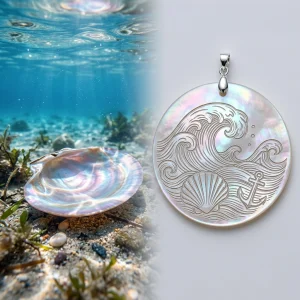
Pulse frequencies set between 30 kHz and 80 kHz deliver tiny, controlled bursts of energy. Each pulse lasts only nanoseconds or picoseconds. Vaporized organic material escapes cleanly while leaving adjacent aragonite plates intact. High-precision UV laser shell engraving keeps the delicate iridescent finish intact around the engraved graphics, producing crisp, non-charred contrast.
Laser Processing Parameters Compared
Operators must balance spot size, pulse duration, and average power to prevent structural collapse. The table below outlines technical specifications for processing marine mother of pearl blanks.
| Specification Parameter | CO2 Laser (10.6 µm) | UV Laser (355 nm) |
|---|---|---|
| Processing Mechanism | Photothermal (Heat Vaporization) | Photochemical (Cold Ablation) |
| Average Power Output | 25 - 40 W | 5 - 15 W |
| Pulse Frequency Range | 5 - 20 kHz | 30 - 80 kHz |
| Focal Spot Diameter | 100 - 150 µm | 15 - 25 µm |
| Heat Affected Zone (HAZ) | > 200 µm (Extensive) | < 10 µm (Minimal) |
| Surface Finish Quality | Chalky, Delaminated, Flaking | Crisp, High-Contrast, Smooth |
Material Limitations and Processing Avoidance
Laser marking on natural nacre has strict physical boundaries. Thin mother of pearl veneers under 0.3 millimeters thick snap easily under internal tension. Shells with existing hairline cracks or thickness variations exceeding 0.05 millimeters will splinter under the beam.
Excessive power density converts aragonite directly into calcium oxide, commonly known as quicklime. This produces an unstable white powder that wipes away, erasing detailed artwork. Shells harvested from freshwater mussels contain higher bound water levels than marine Pinctada species, making them prone to explosive steam pockets.
Post-engraving handling requires specific limits:
- Avoid ultrasonic cleaning tanks; ultrasonic frequencies shatter the weakened biomineral bonds.
- Skip acidic polishing compounds or citrus solutions. Acids dissolve calcium carbonate on contact.
- Do not flex thin shell veneers after engraving. Structural strength drops by up to 40% along deep vector lines.
- Store finished items away from direct heat sources above 80°C to keep the conchiolin matrix stable.
Why does mother of pearl turn chalky and white under a CO2 laser?
High thermal energy from the CO2 laser beam burns away the organic conchiolin binder while heating calcium carbonate above 600°C. This chemical reaction converts aragonite into calcium oxide powder, destroying the structured layers that reflect light.
What is the optimal substrate thickness for personalized gift engraving?
Mother of pearl blanks measuring between 0.5 mm and 1.2 mm yield the best results. Thicknesses below 0.4 mm deform from material stress, whereas pieces thicker than 1.5 mm often feature internal grain shifts that cause inconsistent absorption.
Can compressed air assist stop thermal cracking during engraving?
Dry, low-pressure air assist at 15 to 20 PSI clears vaporized organic soot without shocking the material. Water cooling should never be used during active firing because rapid temperature changes induce catastrophic thermal shock.