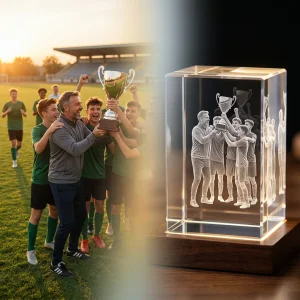
Honoring Coach Dave: Crafting a Custom 3D Laser-Engraved Crystal Keepsake
Jack sat in his idling SUV outside the sports complex, staring at a crumpled paper envelope. Twenty-two soccer parents had handed him cash over the last fortnight. He had $330 sitting in his lap and a deadline four days away: the end-of-season award banquet.
Every previous year ended with the same forgettable items. A signed soccer ball that slowly deflated in a closet. A printed certificate in a cheap plastic frame. A custom travel mug with text that flaked off after four washes. Coach Dave had spent nine months standing in freezing rain, breaking down match footage at 1:00 AM, and coaching the U14 squad to their first regional trophy. Handing him another generic trophy felt wrong.
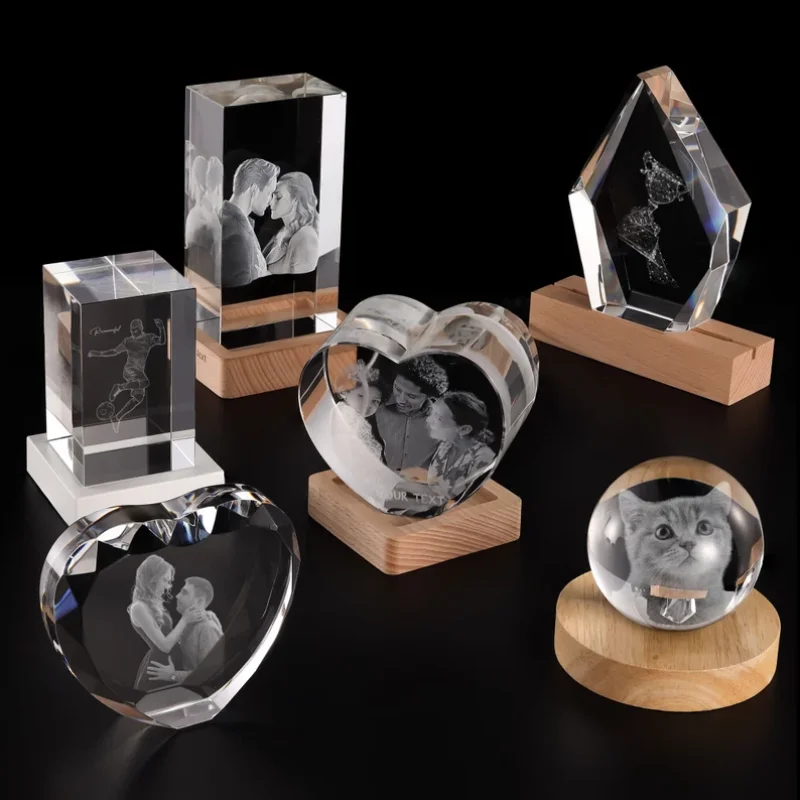
Jack wanted something heavy. Something permanent. He began researching solid glass recognition pieces, which led him straight to a custom 3D laser engraved crystal block.
The Technical Difference Between Glass Types
Jack quickly learned that raw glass quality dictates whether an engraved portrait looks razor-sharp or cloud-covered. Cheaper trophy makers use leaded crystal. Lead softens glass for hand-cutting traditional tableware, but it ruins internal laser engraving. Lead molecules refract light unevenly. When high-frequency laser beams hit leaded glass, micro-fractures split irregularly. You end up with jagged internal cracks and a milky haze.
High-end recognition pieces use K9 optical crystal instead. K9 glass is lead-free, ultra-pure borosilicate crown glass. It boasts high optical clarity, a refractive index of 1.516, and zero visible internal bubbles. When green laser light passes through K9 glass, the beam travels straight without scattering until it reaches the exact focal coordinate targeted by rendering software.
How 2D Photos Turn into Internal 3D Point Clouds
Jack had a high-resolution team photo taken after the championship match. Coach Dave stood in the center, lifting the trophy alongside twenty-two cheering players. How could a flat JPEG image turn into a volumetric sculpture suspended inside solid glass?
The process starts with spatial mapping software. CAD technicians extract subject outlines from the 2D photograph. Using facial topology mapping and manual depth adjustment, artists build a full 3D mesh model. They recreate nose bridges, cheekbone contours, and shoulder angles in three dimensions. The software then converts this geometric mesh into a cloud of precise coordinate points.
Next comes the physical laser process. The engraving system fires a green diode-pumped solid-state laser operating at a 532-nanometer wavelength. This specific light frequency penetrates clear glass cleanly without heating the surface. Optics focus two laser pulses simultaneously inside the block. The precise point where those beams intersect creates a localized thermal shock. This micro-fracture (measuring under 50 microns across) turns clear glass into a microscopic opaque dot.
The laser pulsing repeats up to 5,000 times per second. Step by step, the system places 500,000 to 2,000,000 individual micro-fractures inside the K9 block. The exterior surface remains cool, smooth, and untouched. Inside, a suspended white image appears, glowing under ambient light.
Selecting the Right Source Image for Engraving
Not every digital file creates a crisp 3D photo crystal keepsake. Jack reviewed three different photos before picking his final submission.
Image resolution matters. The source image needs a minimum resolution of 300 DPI at actual print size. A 1080p screenshot taken from a compressed social media video will result in blurry, pixelated facial features inside the glass.
Contrast plays an equally decisive role. Dark uniforms set against dark backdrops give depth mapping software very little geometric data. Ideal photos feature distinct light sources, crisp edge highlights, and strong tonal separation. Jack selected a raw camera file taken outdoors at midday. Sunlight separated player jerseys cleanly from the turf behind them.
You can also engrave custom graphics beyond photos. Jack uploaded a clean scan of Coach Dave's favorite trick play, scribbled on a clipboard during the final tournament minute. The software converted the black ink lines into a sharp vector layer, placing the handwritten diagram right beneath the team portrait.
Surface Etching vs. Sub-Surface Laser Rendering
Jack compared two main production styles before placing the order:
- Traditional Surface Etching (Sandblasting): Removes material from the exterior glass surface. Creates a shallow, frosted texture. Feels rough to the touch and scratches easily over time. Dust collects in the etched grooves. Limited strictly to flat, two-dimensional shapes.
- Sub-Surface Laser Rendering: Leaves all outer faces mirror-smooth. Preserves structural integrity. The inner image never fades, yellows, or collects surface dirt. Displays true volumetric depth as you turn the glass block in your hand.
Sub-surface internal rendering was the obvious choice for a long-term award.
Sizing, Formatting, and Display Hardware
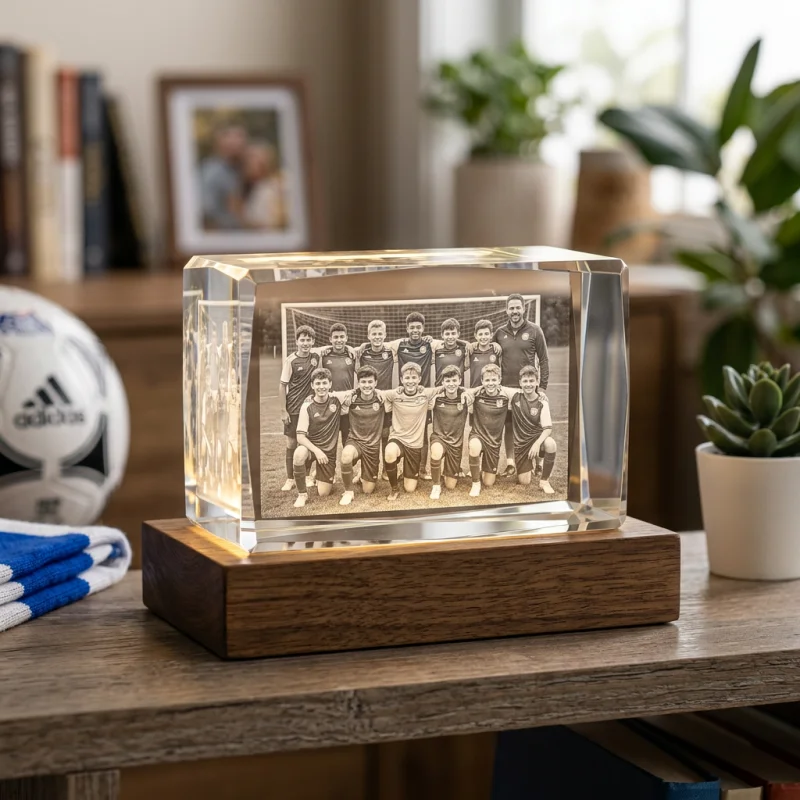
Jack picked a solid rectangular K9 optical crystal pedestal measuring 5 inches by 7 inches by 3 inches, weighing nearly four pounds. Its substantial weight gave it an immediate feel of craftsmanship.
To maximize visual impact on a desk, proper lighting is essential. Sub-surface micro-fractures scatter light internally. When white LED illumination hits the base of the crystal, the internal point cloud lights up instantly.
Jack added a fitted dark walnut wood base equipped with low-heat edge LEDs. Powered by a discreet USB cable, the base directs a 6000K daylight-white beam straight up through the polished bottom face of the glass. The result? Coach Dave's team sculpture popped with vivid clarity—even in a dimly lit room.
At the banquet, Jack handed Coach Dave the heavy box. When Dave lifted the crystal from its velvet-lined display case and flipped the LED switch, the room went quiet. Suspended in crystal was the exact moment his team hoisted the cup, complete with every smile, jersey stripe, and handwritten play detail preserved inside K9 glass.
What photo file resolution works best for a 3D photo crystal keepsake?
For crisp details, upload high-resolution JPEG, PNG, or raw camera files with a minimum resolution of 300 DPI. Avoid heavily compressed social media photos or cropped low-res screenshots, as low point counts create blurry facial details during depth mapping.
Can you engrave handwritten coaching plays or logos alongside team photos?
Yes. Custom vector logos, season records, signatures, and handwritten playbook diagrams can be converted into high-precision laser point layers. Designers combine these vector lines with the 3D photo mesh before firing the 532nm green laser.
Why is K9 optical crystal superior to traditional leaded glass for laser gifts?
K9 optical crystal is completely lead-free, offering high optical purity and uniform light refraction. Leaded glass causes laser light to scatter unpredictably, producing cloudy streaks and unwanted surface fractures instead of clean sub-surface point clouds.