Engineered Wood for Laser Engraving: Plywood, MDF, HDF Compared
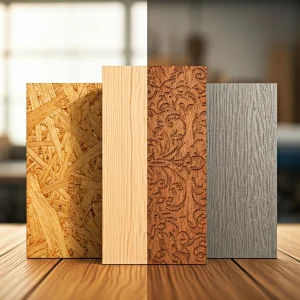
When laser engraving, material choice dictates your project's final look and feel. Engineered wood products, including plywood, MDF, and HDF, offer distinct characteristics for laser processing. Understanding their composition and how they react to a laser helps you pick the right one for your design.Plywood: Layered Versatility
Plywood consists of multiple thin sheets of wood veneer, bonded together with adhesives. Each layer's grain runs perpendicular to the next, giving plywood strength and stability. Engraving results on plywood vary significantly. The quality of the veneer dictates how smoothly the laser carves. Lower-grade plywood may have internal voids or knots, causing inconsistent engraving depth and appearance. Glue types also matter; urea-formaldehyde glues, common in many plywoods, can off-gas noxious fumes when lased and often create a poor, sticky engraving residue. Better quality plywood often uses less problematic glues like soy-based or phenol-formaldehyde, though even these require good ventilation. Because of the distinct wood grain, engraved areas show texture.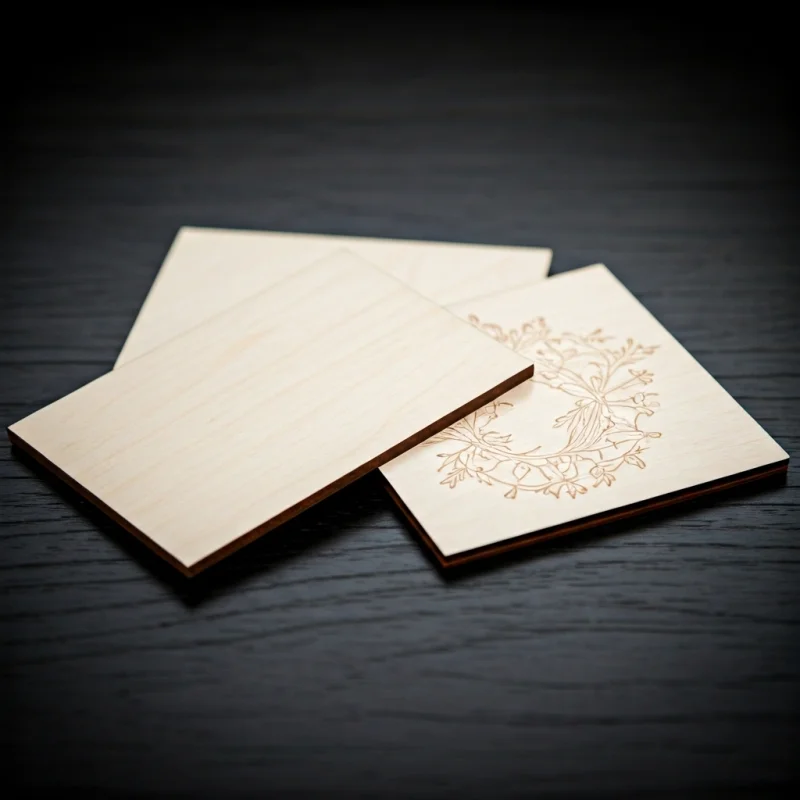
MDF: Consistency and Detail
Medium Density Fiberboard (MDF) is an engineered wood product made from wood fibers, typically defibrated softwoods, combined with resin binders and compressed under heat and pressure. It's uniform throughout, lacking the grain structure or voids found in natural wood or plywood. MDF offers very consistent engraving. Its homogeneous composition means the laser doesn't encounter varying densities, producing crisp lines and smooth, uniform fills. It's excellent for intricate details and fine text. The primary drawbacks are a distinct burnt smell during processing and the generation of fine, powdery dust. Laser-cut edges on MDF also appear significantly darker than the surface. Due to its uniform density, MDF often requires lower power and faster speeds than solid wood or even some plywoods for engraving, reducing processing time.HDF: Denser, Stronger Performance
High Density Fiberboard (HDF) is similar to MDF but manufactured with higher pressure and more wood fibers per cubic foot. This results in a denser, stronger, and harder board. HDF behaves much like MDF under a laser, but its increased density means it may require slightly more laser power for equivalent engraving depth or cutting speed. It retains the smooth, consistent engraving characteristics of MDF, providing excellent detail. The trade-offs are similar: burnt smell, fine dust, and dark edges. However, HDF's durability can be advantageous for applications requiring thinner profiles or greater structural integrity than MDF.Parameter Comparison: Plywood, MDF, HDF
Here's a breakdown of how these materials compare for laser engraving:| Parameter | Plywood (Birch, Poplar) | MDF (Medium Density Fiberboard) | HDF (High Density Fiberboard) |
|---|---|---|---|
| Composition | Layered wood veneers, adhesive | Compressed wood fibers, resin binder | Compressed wood fibers, high resin, high pressure |
| Engraving Consistency | Variable (grain, voids, glue) | Very High (homogeneous) | Very High (homogeneous) |
| Edge Appearance | Light to moderately dark, subtle grain | Dark, clean, crisp | Dark, very crisp, often harder |
| Common Glues/Binders | Urea-formaldehyde, soy, phenol | Urea-formaldehyde, MDI (methylene diphenyl diisocyanate) | Urea-formaldehyde, MDI |
| Fume & Dust Production | Moderate fumes (glue-dependent), wood dust | High fumes (burnt wood/binder), fine dust | High fumes (burnt wood/binder), fine dust |
| Typical Cost (per sheet) | Moderate to High | Low to Moderate | Moderate |
| Laser Power Needs (Relative) | Moderate to High | Low to Moderate | Moderate to High |
Limitations and Considerations
Working with engineered wood demands attention to safety and material specificities. Fumes from glues, particularly urea-formaldehyde, can be irritating and potentially harmful. Adequate ventilation with an exhaust system is always mandatory. The fine dust produced by MDF and HDF is a respiratory irritant; use proper dust collection. Laser-burnt edges are an inherent characteristic of these materials. While you can clean off some residue, a darkened edge generally remains. For projects needing a pristine, light edge, engineered woods might not be suitable. None of these materials are naturally weather-resistant without sealing, so they are not good for outdoor use unless protected. Choosing between plywood, MDF, and HDF means balancing cost, desired consistency, and finish. For consistent, intricate engraving, MDF or HDF are strong candidates. If you want natural wood grain texture and don't mind some variation, plywood might fit. Each offers distinct advantages for various laser engraving applications.FAQ: Engineered Wood Laser Engraving
Which engineered wood is safest for laser work regarding fumes?
There isn't a universally "safe" engineered wood, as all will produce some level of smoke and fumes during laser processing. However, avoiding plywoods known to use urea-formaldehyde (UF) glues, which release formaldehyde gas when heated, is a good step. Many MDF and HDF products also contain UF. Look for products labeled "No added Formaldehyde" (NAF) or those using alternative binders like MDI (methylene diphenyl diisocyanate), which still requires ventilation but typically produces less problematic fumes than UF. Always ensure robust ventilation and fume extraction.
Can I paint or finish laser-engraved MDF?
Yes, you can paint or finish laser-engraved MDF. The consistent surface of MDF takes paint very well, creating a smooth finish. However, the laser-darkened edges will remain dark unless you prime and paint them thoroughly. Sanding the edges lightly before painting can help adhesion and appearance. For best results, use a primer designed for wood products before applying your final paint coat.
What general laser power settings should I consider for 3mm HDF?
General laser power settings for 3mm HDF vary significantly based on your laser's wattage, tube type (CO2 being common), lens focal length, and desired effect (engraving depth vs. cutting). For detailed engraving on a typical 60W CO2 laser, you might start with 20-25% power at 200-300 mm/s. For cutting 3mm HDF, a 60W laser might require 60-70% power at 8-12 mm/s, possibly with multiple passes. Always perform small test cuts and engravings on scrap material first to dial in the optimal settings for your specific machine and HDF batch.