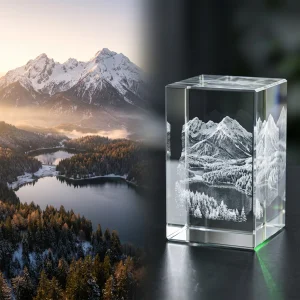
Inside the Subsurface Laser: How Green Lasers Magic 3D Images into Solid Crystal
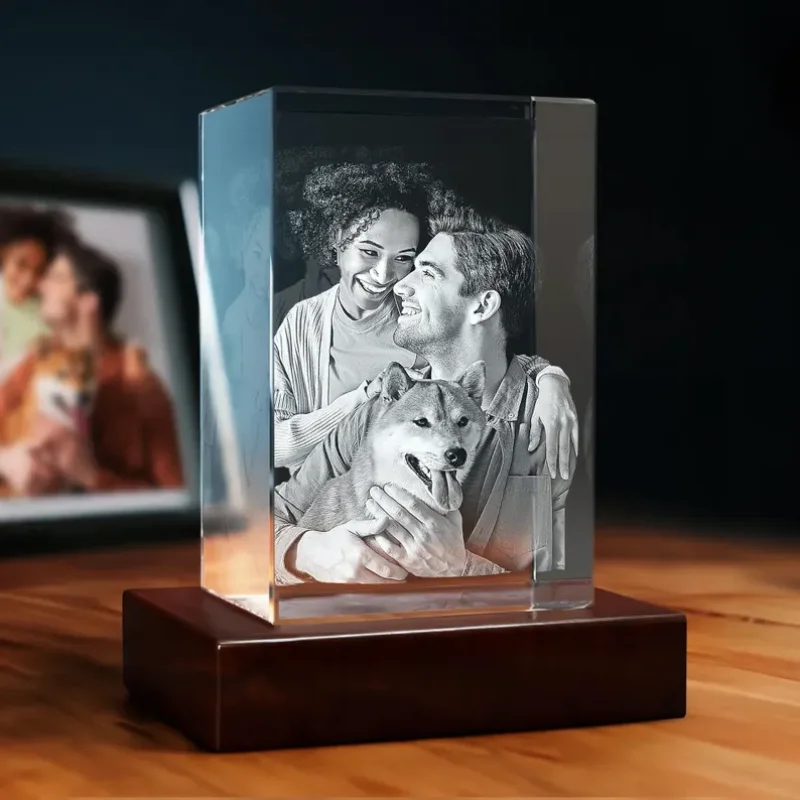
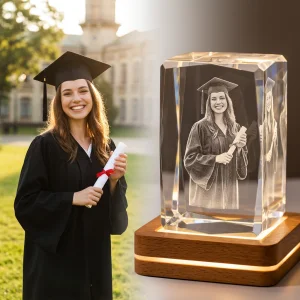
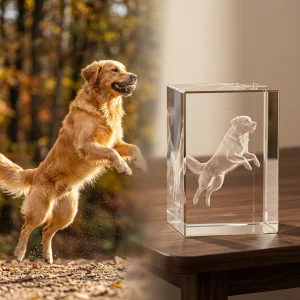
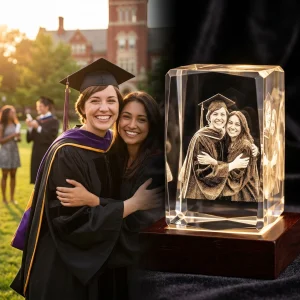
A solid block of glass sits under a high-power laser. A faint green light flashes thousands of times per minute. Outside, the glass surface remains completely smooth, cool, and polished. Inside, a detailed three-dimensional portrait suspended in mid-air materializes dot by dot. This process is called Subsurface Laser Engraving (SSLE). It doesn't rely on mechanical carving tools. Instead, it relies on quantum optics, extreme energy densities, and tight mechanical tolerances.
The Wavelength Problem: Why CO2 Lasers Fail Inside Glass
Standard industrial CO2 lasers emit radiation at a wavelength of 10,600 nanometers. Infrared light at this wavelength is absorbed instantly by silica-based glass. When a CO2 beam hits a crystal block, energy gets trapped at the surface skin. Molecular bonds heat instantly, causing thermal expansion, micro-chipping, and surface cracking. For internal glass laser engraving, carbon dioxide systems are physically incapable of penetrating the outer surface.
Subsurface systems use diode-pumped solid-state (DPSS) lasers emitting at 532 nanometers. This bright green light sits directly in the visible spectrum. High-grade K9 optical crystal boasts an optical transmittance rating above 99% at this specific wavelength. Photons pass through the exterior without transferring energy to the molecular matrix. The glass stays cold. Light travels through cleanly until it encounters the targeted focal region.
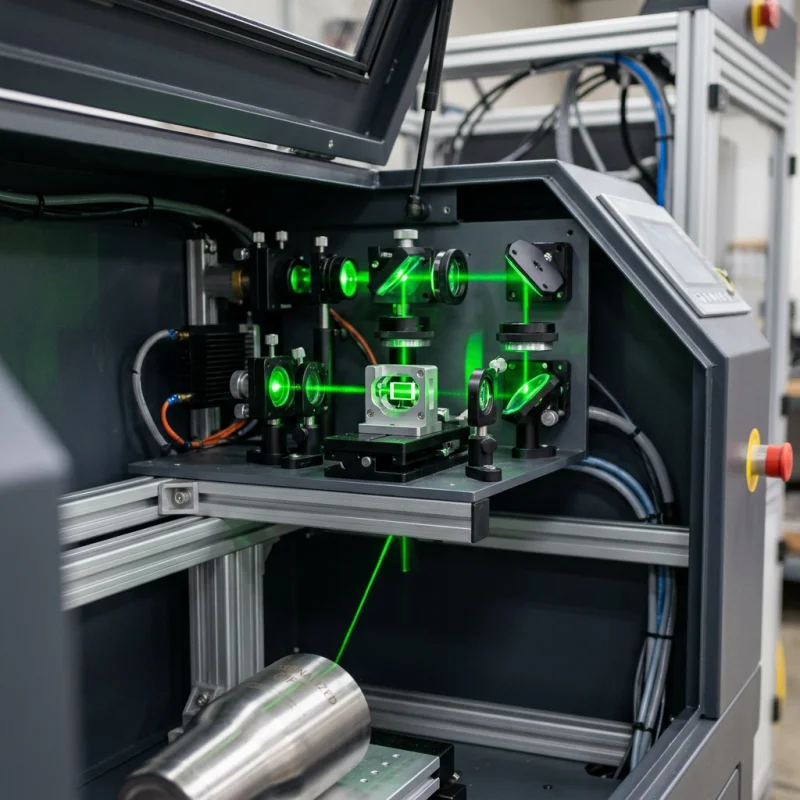
Non-Linear Optical Absorption and Micro-Explosions
How does transparent light suddenly etch solid glass at a single interior point? The answer lies in beam convergence and multiphoton absorption.
A specialized objective lens with a high numerical aperture forces the wide 532 nm laser beam down to a tight focal spot. Outside the focal area, power density remains low, allowing light to pass freely. At the exact focal point, the beam shrinks to a diameter under 10 micrometers. Power density spikes past 1010 watts per square centimeter.
At this extreme photon density, the crystal loses its linear transparency. Non-linear optical absorption takes over. The glass absorbs multiple photons simultaneously, breaking molecular bonds and stripping electrons from silicon dioxide atoms. This creates a tiny pocket of localized plasma heated to thousands of degrees Celsius.
The entire pulse lasts between 1 and 10 nanoseconds. This burst creates a controlled micro-explosion—a microscopic spherical void surrounded by micro-cracks measuring 20 to 50 micrometers wide. When the pulse ends, the plasma cools instantly. The micro-crack remains permanently frozen inside the material.
Understanding how 3D laser crystals are made requires looking at these single dots as pixels. By firing 500 to 3,000 pulses per second while moving the focal point along three axes (X, Y, and Z), the machine constructs a complete point cloud. Hundreds of thousands of tiny fractures combine to reflect and refract ambient light, creating the illusion of a solid 3D object inside clear glass.
Laser Technology Specifications Comparison
Engineers calibrate laser systems based on specific optical and physical parameters. The table below compares internal green DPSS systems against standard surface CO2 engravers.
| Technical Parameter | 532 nm Green DPSS (Subsurface) | 10,600 nm CO2 (Surface) |
|---|---|---|
| Laser Wavelength | 532 nm (Visible Green) | 10,600 nm (Far Infrared) |
| Pulse Duration | 1 to 10 nanoseconds | Continuous Wave / Microseconds |
| Peak Power Density | > 1010 W/cm² | 104 – 106 W/cm² |
| Absorption Mechanism | Non-linear multiphoton ionization | Linear thermal absorption |
| Fracture Size Range | 20 to 50 microns (Internal) | 150 to 500 microns (Surface) |
| Optical Glass Transmittance | > 99% (Passes through clean) | 0% (Absorbed on outer skin) |
Precision Mechanics and Refractive Calibration
Focusing a high-power laser beam inside glass is complicated by refraction. Snell's Law dictates that light bends when transitioning from air into a denser medium. K9 optical crystal has a refractive index of approximately 1.52.
Because glass bends light inward, the physical position of the laser focal point shifts deeper than its position in open air. Motion control software must compensate for this shift continuously along the Z-axis. Failing to adjust for refraction distorts the 3D model, stretching height coordinates and warping spatial depth.
Galvanometer scanning mirrors position the beam along X and Y axes, while motor-driven expansion lenses shift the Z-axis focus. Precision galvo motors adjust focal positions thousands of times every minute with positioning tolerances under 5 micrometers.
Calibration errors cause physical damage. Placing a micro-explosion closer than 1.5 millimeters to any outer surface risks structural failure. High pressure generated by expanding plasma can't be contained by thin glass walls, resulting in a surface blow-out that chips or shatters the crystal block. Beam quality must also be maintained. Astigmatism in the laser beam creates oblong, irregular micro-cracks that scatter light unevenly and ruin image sharpness.
Material Limitations, Glass Choices, and Care Requirements
Subsurface laser etching demands strict material standards. You can't produce clear internal engravings in standard consumer glass or plastic resins.
Soda-lime window glass, bottle glass, and cheap stemware contain microscopic air pockets, iron oxide contaminations, and internal stress strains. When focused 532 nm pulses hit impurities inside common glass, stress fractures propagate uncontrollably across the entire block, causing catastrophic shattering. Plastics like acrylic simply melt into discolored blobs because polymer chains collapse under thermal shock instead of fracturing cleanly.
Only high-purity K9 optical glass or synthetic fused quartz work consistently. K9 glass undergoes extensive annealing to eliminate internal stresses, ensuring uniform refractive indices across every cubic millimeter.
Dot density has strict physical limits. Spacing micro-explosions closer than 30 micrometers creates overlapping crack lines. Overlap weakens the glass matrix, causing neighboring fractures to merge into a single cloud of white damage. Engraving software must maintain optimum point pitch to protect structural integrity while preserving optical detail.
Finished crystals require simple maintenance to preserve clear visibility. Keep the optical glass away from sudden thermal shocks. Placing a cold crystal under hot water expands micro-fractures, clouding internal details. Clean exterior surfaces with a lint-free microfiber cloth and isopropyl alcohol to keep finger oils from distorting light entering the etched interior.
How close to the edge can an internal laser etch without breaking the glass?
Safety margins require keeping micro-fractures at least 1.5 to 2.0 millimeters away from any outer polished surface. Placing dots closer reduces surrounding material strength, causing the plasma pressure from micro-explosions to crack through the exterior wall and ruin the crystal.
Can you etch color images inside 3D photo crystals?
No. Internal glass laser engraving produces monochrome points of light-scattering micro-fractures. The white appearance comes from natural ambient light reflecting off microscopic crack surfaces. Colors are produced externally by mounting the finished crystal on an LED light base that projects colored light up through the polished base.
Does internal laser engraving degrade or fade over time?
The internal image is permanently frozen in the molecular matrix of the glass. Because micro-fractures are physical structural changes inside a stable optical crystal, the image won't fade, yellow, or degrade unless the crystal itself is exposed to severe thermal shocks or physical breakage.