Preserving Graduation Achievements in 3D Subsurface Laser Engraved Crystal
Mason sat at his kitchen table late Tuesday night, scrolling through 400 photos on his laptop screen. His daughter Maya had spent six years working toward her degree in robotics. Graduation was ten days away. He wanted a present that felt substantial, something that could sit on her future office desk for thirty years without deteriorating. Standard paper prints buckle inside humid frames. Acrylic blocks scratch easily and yellow when exposed to sunlight.
He chose a custom 3d laser photo embedded inside optical crystal glass. The clarity of the finished product comes down to material selection. High-grade K9 optical crystal glass features minimal bubble inclusions and high light refraction. Inferior glass contains microscopic air pockets and trace iron impurities that cause micro-fractures to spread uncontrollably under thermal shock. K9 glass undergoes continuous annealing, producing an internally uniform block capable of holding tight laser focal points.
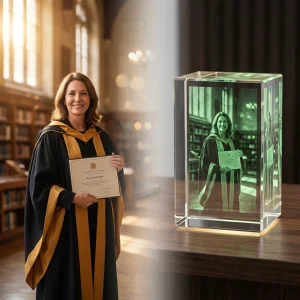
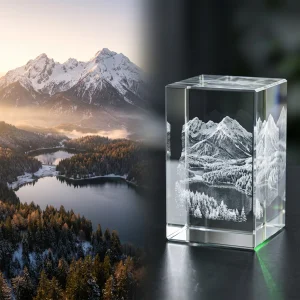
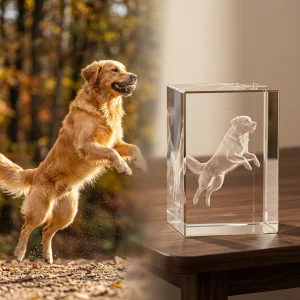
Subsurface engraving relies on a 532nm green diode laser focused beneath the surface. The outer faces of the glass remain untouched. When the laser pulses, light energy passes through the polished crystal exterior and converges at precise focal coordinates inside the block. Every single light pulse generates a tiny thermal shock point measuring under 0.05 millimeters. By plotting over one million micro-dots into a dense point cloud, the machine builds a realistic 3D model of facial structure, gown folds, and cap tassel threads inside the glass core.
Preparing Smartphone Photos for 3D Laser Processing
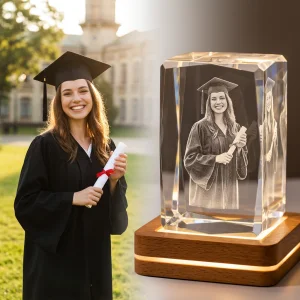
Mason picked a photo taken outdoors right after Maya's thesis defense. She held her diploma binder while wearing her black mortarboard cap. However, bright afternoon light created heavy shadows over her forehead and eyes.
Raw smartphone photos require digital optimization before laser mapping begins. Processing software analyzes 2D pixels to calculate relative depth profiles for the face, hair, and clothing:
- Dynamic contrast adjustments: Shadows under the mortarboard brim get lightened by 20% to 30% to highlight eye detail.
- Background elimination: Busy campus backgrounds, trees, and passersby are removed to isolate the graduate.
- Volumetric heightmapping: Software maps Z-axis values based on facial geometry, bridge of the nose position, and cheekbone height.
- Noise reduction: Low-resolution files get processed to remove compression artifacts before micro-dot generation.
Photos shot at a slight three-quarter angle give conversion software more visual data for generating natural facial depth. Direct front-facing portraits work well too, provided there is contrast between dark graduation robes and the background.
Bevel-Edged Blocks versus Faceted Iceberg Shapes
Selecting the crystal shape changes how light interacts with the internal image. Mason compared two standard options for Maya's gift:
Bevel-edged rectangular blocks feature straight vertical faces with polished 45-degree corner edges. This clean geometry functions like a rigid frame, ideal for formal cap-and-gown portraits. Parallel crystal faces keep internal light paths clean and prevent visual distortion from side angles.
Faceted iceberg crystals feature irregular chiseled edges across the top and sides. The random facets scatter ambient room light across the glass core, adding sparkle to wider horizontal group shots or casual poses.
Mason selected a five-by-seven-inch rectangular block weighing nearly four pounds. Its weight felt substantial, and the clean edges suited a professional office environment.
Selecting the Correct LED Base
A k9 optical crystal photo needs upward illumination to make the micro-dot cloud stand out clearly. Micro-fractures inside the crystal appear faint grey under normal room lighting without a light source directly underneath.
Warm white LED bases operating at 3000K direct clean light straight through the bottom face. The warm spectrum accentuates density differences in the point cloud, giving skin tones and soft features natural definition.
RGB bases cycle between blue, red, green, and purple light. Colored illumination shifts visual contrast and alters how light scatters through dense micro-fracture areas, making fine features harder to see. For clear display of detailed faces, solid warm white illumination delivers consistent contrast.
What photo resolution is needed for a custom 3d laser photo in crystal?
An image file with at least 1000x1000 pixels at 300 DPI provides enough pixel data for software conversion. High-resolution files shot on smartphones or modern cameras work well as long as face details are crisp and well-lit.
Can standard smartphone pictures be converted into a k9 optical crystal photo?
Yes. Technicians use volumetric rendering software to convert flat smartphone photos into 3D heightmaps. Contrast adjustment and background removal isolate the subject before generating the laser point-cloud file.
How long does subsurface laser photo engraving last?
Subsurface laser micro-fractures inside optical crystal never fade, yellow, or degrade. Because the points are sealed entirely inside the solid glass, environmental factors like moisture and UV sunlight cannot reach or alter the image.
Should I pick a warm white base or an RGB changing base for my crystal?
Warm white LED bases operating around 3000K offer the clearest visual contrast for human faces and small text. RGB bases introduce color shifts that obscure fine micro-dot details in high-density portrait engravings.