Subsurface Laser Engraving: K9 Optical Crystal vs. Soda-Lime Glass
The Physics of Inside-Glass Laser Marking
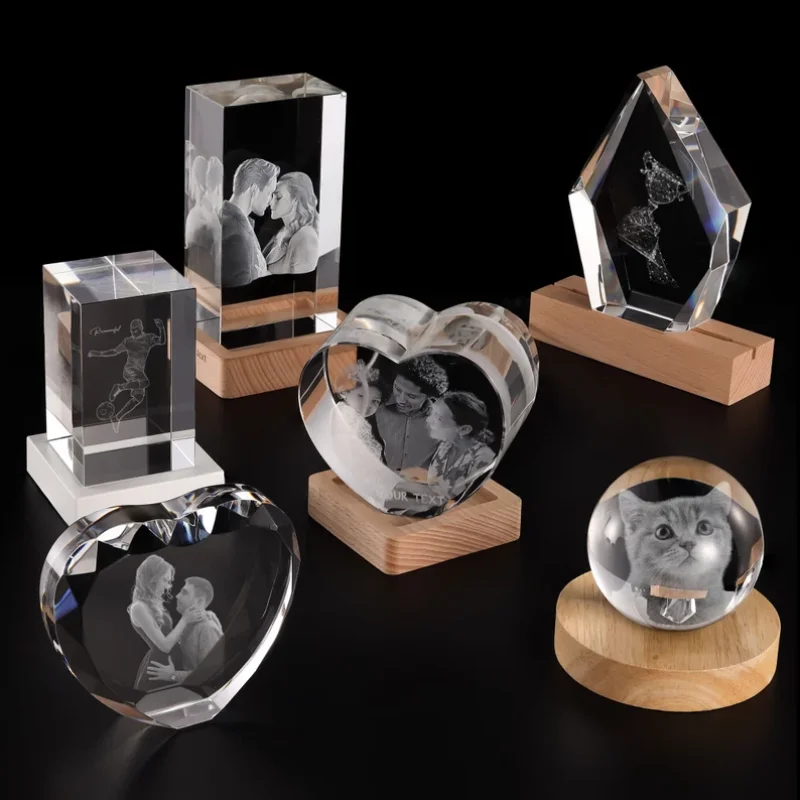
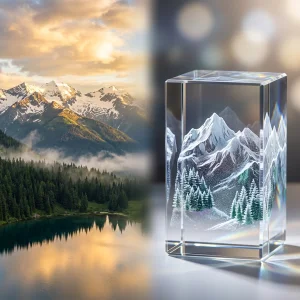
Subsurface laser engraving relies on focusing a green frequency-doubled Nd:YAG or fiber laser (532 nm wavelength) beneath a material's surface. At the focal point, energy density reaches gigawatts per square centimeter. This concentrated light creates a tiny localized shockwave, vaporizing a microscopic spot inside the substrate without scratching the outer polished surfaces. Tens of thousands of these micro-fractures assemble into a suspended three-dimensional point cloud image.
Targeting an internal focal point requires high optical clarity. If the material contains microscopic impurities, variable refractive indexes, or high absorption coefficients at 532 nm, laser light scatters before reaching the target depth. The spot loses focus, internal stress builds, and the substrate cracks.
Optical Purity and Light Transmittance
Soda-lime float glass is manufactured for windows, bottles, and display cases. Its recipe uses silica sand, soda ash, and limestone. It contains residual iron oxide contaminants, usually around 0.05% to 0.1% by weight. Iron oxide gives window glass its characteristic green tint along the edges. This green cast absorbs green laser energy across the optical path rather than letting it pass cleanly to the focal spot.
K9 optical crystal is a high-grade crown glass equivalent to BK7. Standardized raw materials like purified silicon dioxide and boron trioxide yield a substrate with an iron content below 0.001%. Light transmittance exceeds 92% across the visible spectrum.
When comparing K9 crystal vs soda lime glass, inclusion density determines image resolution. Grade A K9 optical crystal allows zero micro-bubbles or seed inclusions larger than 0.05 mm per cubic meter. In contrast, standard soda-lime float glass contains thousands of sub-millimeter gas bubbles and microscopic striae (density variations) per cubic centimeter. When a 532 nm laser hits an internal bubble in soda-lime glass, the light refracts unevenly. Instead of a tight 20-micrometer point crack, you get a foggy, blown-out fracture measuring 200 micrometers or more.
Thermal Coefficients and Stress Propagation
Laser micro-fracturing generates severe local thermal spikes. Temperatures inside the micro-explosion briefly surpass 1,000°C before rapidly quenching. How the surrounding lattice handles this thermal shock dictates whether the point cloud stays sharp or turns into a web of runaway cracks.
Soda-lime glass has a coefficient of thermal expansion (CTE) of approximately 9.0 × 10⁻⁶ / K. K9 optical crystal has a lower CTE of 7.5 × 10⁻⁶ / K. Under rapid heating, soda-lime expands faster and unevenly.
Internal residual stress aggravates this thermal shock. Float glass cools rapidly during factory manufacturing, leaving high residual tensile stress frozen inside the pane. Subsurface engraving triggers catastrophic stress relief. A single laser pulse in soda-lime glass often unleashes spider-web micro-cracks that crawl through the block hours after production.
K9 crystal undergoes precise annealing—a cooling cycle lasting up to 48 hours—reducing internal strain optical retardation below 10 nanometers per centimeter. This controlled structure contains each laser point precisely where it was fired.
Technical Specifications Comparison
The table below summarizes the key material parameters governing subsurface engraving performance.
| Parameter | K9 Optical Crystal (Grade A) | Standard Soda-Lime Float Glass |
|---|---|---|
| Refractive Index (n_d) | 1.5168 | 1.5200 |
| Abbe Number (V_d) | 64.17 (Low dispersion) | 58.50 (Moderate dispersion) |
| Light Transmittance (532 nm) | > 92.5% | 85.0% - 88.0% |
| Coefficient of Thermal Expansion (CTE) | 7.5 × 10⁻⁶ / K | 9.0 × 10⁻⁶ / K |
| Iron Content (Fe₂O₃) | < 0.001% | 0.05% - 0.10% |
| Max Inclusion Size Allowed | < 0.05 mm (Grade A) | 0.20 mm - 0.50 mm |
| Annealing Residual Stress | < 10 nm/cm | > 50 nm/cm |
| Laser Damage Threshold (532 nm) | > 5 GW/cm² | < 1.2 GW/cm² |
Limitations, Drawbacks, and Materials to Avoid
K9 crystal is superior for internal laser marking, but it isn't indestructible. It lacks high thermal shock resistance compared to fused silica or borosilicate laboratory glassware like Pyrex. Rapid temperature shifts exceeding 60°C can crack finished crystal blocks. Never wash subsurface engraved items in hot dishwashers or leave them in direct sunlight inside locked vehicles.
Mechanical fragility is another factor. K9 lacks the tempered surface layer present in architectural safety glass. A drop onto hard tile flooring from waist height shatters the block or chips its hand-polished bevels.
Certain applications should avoid K9 optical crystal entirely:
- Outdoor architectural displays subject to freezing rain and extreme solar heat.
- High-impact mechanical components or industrial sight glasses.
- Drinkware requiring daily automated high-temperature washing.
For subsurface engraving, avoid soda-lime glass completely. Acrylic and polycarbonate substrates also perform poorly. They melt, scorch, and release hazardous gases when hit with 532 nm laser pulses.
Verifying Crystal Purity for Custom Engraving
Low-quality glass blanks sold as crystal ruin print detail. You can check material quality before ordering or engraving high-density 3D models using three physical tests.
Inspect the raw edges under daylight. Look straight through a bevel. Real K9 optical crystal stays clear or exhibits a faint blue-white tone. If the edge looks deep forest green, you hold soda-lime glass.
Check for internal strain using cross-polarized filters. Place the unengraved blank between two polarized film sheets held at 90 degrees to each other. Pure, fully annealed K9 crystal passes light uniformly without rainbow halos. Bright patterns reveal frozen mechanical strain that will split open under laser exposure.
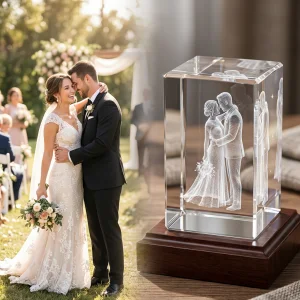
Test point density on a test block. A 3D portrait engraved in Grade A K9 optical crystal maintains sharp point separation down to 30 micrometers apart. In cheap glass, points blur into foggy white patches due to internal beam scattering.
Why does regular soda-lime glass fracture when laser engraved below the surface?
Soda-lime glass contains high levels of iron oxide and internal gas inclusions that absorb green laser light before it reaches the focal point. This unwanted absorption causes localized overheating. Combined with a high thermal expansion coefficient and high residual manufacturing stress, the sudden shock wave causes the glass to crack along internal strain lines.
How can you visually tell the difference between K9 optical crystal and soda-lime glass?
Examine the raw polished edge of the block under natural light. Soda-lime glass shows a dark green edge tint caused by iron contamination. K9 optical crystal is virtually colorless, showing a clear or pale ice-blue edge. K9 is also denser, noticeably heavier in hand, and offers superior optical clarity without internal waves or distortions.
What laser wavelength is used for 3D subsurface crystal engraving?
Subsurface crystal engraving uses a 532 nm green laser. This specific wavelength passes through optical-grade crystal with minimal light loss, focusing tightly inside the material to create precise micro-fractures without burning or damaging the outer polished surface.