5 Executive Recognition Awards Crafted with Sub-Surface Crystal Glass Laser Engraving
Enterprise HR teams face a specific procurement challenge when ordering 10-, 20-, or 30-year executive service awards. Acrylic trophies turn yellow after five years on a sunlit desk. Surface-etched glass accumulates dust inside its shallow cut lines, making logos look dull. Routine handling often chips raised exterior edges. Sub-surface crystal glass laser engraving solves these physical vulnerabilities. The process seals three-dimensional graphics permanently inside solid glass blocks. Outer walls stay completely smooth, flat, and resistant to environmental wear.
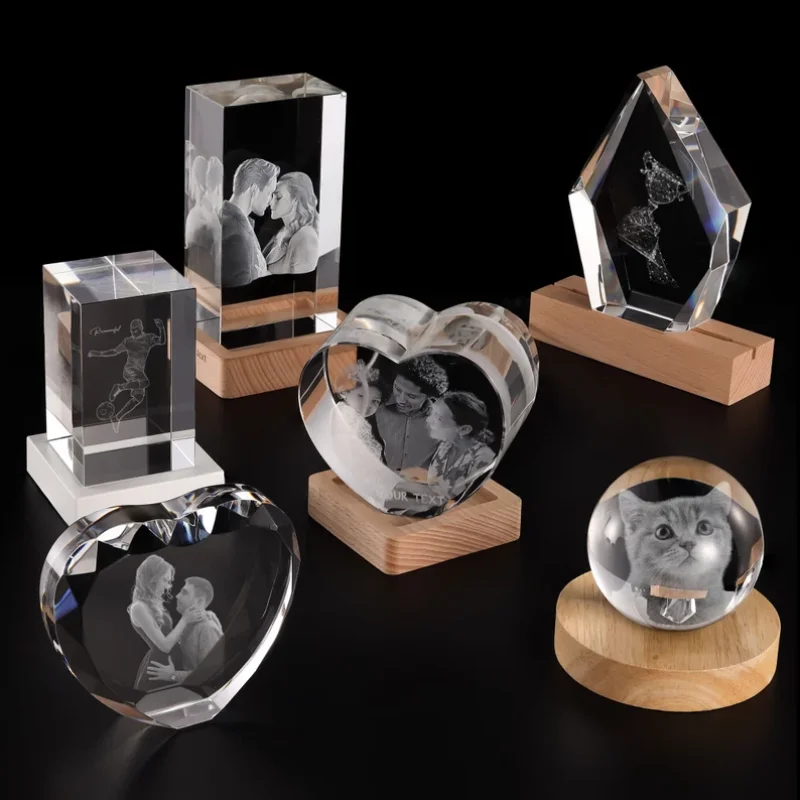
When selecting corporate milestone awards for senior leadership, buyers must balance material longevity with aesthetic precision. Below is a quick overview of five recommended K9 optical crystal awards before we examine the underlying laser optics and procurement specifications:
- The Monolithic 3D Architectural Block: Best for 25-year tenure milestones and founder retirements.
- The Beveled Executive Pillar: Suited for C-suite promotions and long-tenured Vice Presidents.
- The Tilted Corner-Cut Cube: Ideal for global division heads and international expansion leaders.
- The Horizontal Panorama Block: Designed for Chief Technology Officers and R&D patent holders.
- The Tapered Obelisk Award: Tailored for hall of fame inductions and lifetime service recognitions.
Technical Procurement Criteria: K9 Optics and Green Laser Wavelengths
Buying sub-surface laser keepsakes requires clear technical specifications. Not all glass blocks accept internal laser points without fracturing unpredictably.
Material Standards: K9 Optical Crystal vs. Soda-Lime Glass
Always specify K9 optical crystal in your RFP documents. K9 is a high-purity borosilicate crown glass valued for its refractive clarity, high bubble-free rating, and low inclusion count. It absorbs localized thermal stress cleanly. Cheap soda-lime plate glass contains iron impurities, microscopic air pockets, and unreleased internal tension. Firing an internal laser into soda-lime glass causes uncontrolled web-cracking or total glass failure. Premium K9 crystal blocks undergo slow cooling over several days to relieve internal strain, ensuring pristine transparency around the interior focal point.
Laser Physics: 532nm Wavelength and Focal Depth
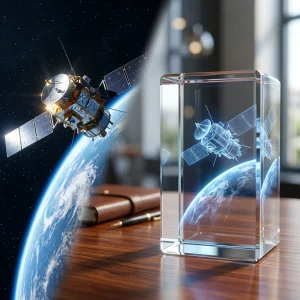
Sub-surface engraving uses a frequency-doubled Nd:YAG laser firing at a 532-nanometer green light wavelength. Standard glass is transparent to infrared lasers, letting light pass straight through without reacting. Green laser light behaves differently. Lenses converge the beam to a pinpoint focal position inside glass blocks ranging from 50mm to 100mm thick. Energy density at that exact coordinate triggers non-linear optical breakdown. This forms a single micro-fracture measuring between 20 and 50 microns. Energy density at the outer faces remains far below the damage threshold, leaving exterior surfaces untouched. Software guides the laser to build images from the deepest internal layer upward. This sequence stops shallow dots from blocking incoming light aimed at deeper target planes.
Resolution Parameters and Color Limits
Designers compile internal artwork into point clouds containing 500,000 to 2,500,000 individual micro-fractures. Resolution reaches up to 1,000 dots per inch (DPI). High point density generates realistic gradient shading and sharp text rendering down to 6-point font sizes.
Color capability has hard physical limits. Micro-fractures reflect ambient white light; they appear as bright, frosted white dots suspended in the glass. Sub-surface lasers cannot produce red, blue, green, or gold pigments inside a sealed crystal mass. Suppliers offering full-color internal graphics are using surface UV printing or laminated plastic sheets, which lack the permanent durability of true sub-surface laser micro-cracks.
1. The Monolithic 3D Architectural Block
This design uses an 80mm x 80mm x 150mm solid block of K9 crystal weighing 3.2 pounds. Hand-polished side faces meet at clean 2mm bevels to reduce corner chipping during handling.
- Appearance & Texture: Substantial weight, cold glass exterior, perfectly smooth faces. The internal graphic sits suspended in liquid-like transparency.
- Personalization Options: 3D CAD renders of corporate headquarters, industrial sites, or flagship product designs, paired with suspended floating typography detailing name, title, and service dates.
- Best Suited For: CEO retirements, 25-year executive milestones, and major organizational acquisitions.
- Why Choose It: Heavy mass conveys institutional longevity. It serves as an impressive desktop centerpiece that will never scratch, tarnish, or oxidize.
2. The Beveled Executive Pillar
Standing 200mm tall with a 60mm x 60mm footprint, this vertical column features 5mm chamfered edges that refract ambient room lighting across six distinct optical angles.
- Appearance & Texture: Tall architectural profile with crisp angular reflections. Smooth outer glass protects delicate interior details from office dust.
- Personalization Options: High-density 3D volumetric corporate logos positioned near the top face, with vertical timelines and achievement metrics engraved along the central Z-axis.
- Best Suited For: C-suite executive promotions, retiring Senior Vice Presidents, and long-standing board members.
- Why Choose It: The tall footprint matches executive shelving units. Vertical text layouts offer room for long lists of specific career achievements without visual crowding.
3. The Tilted Corner-Cut Cube
A 100mm x 100mm x 100mm crystal cube resting on a precision-ground corner facet. It tilts the entire glass mass at a fixed 45-degree angle without needing an external metal base.
- Appearance & Texture: Dynamic geometric stance. Light enters from angled upper faces, making the interior point cloud glow intensely under overhead office LEDs.
- Personalization Options: 3D globe models showing regional facility networks, longitude lines, and floating executive signature replicas.
- Best Suited For: International division heads, supply chain leaders, and 20-year global service honors.
- Why Choose It: The angled presentation maximizes light capture. It turns standard corporate service data into a compelling geometric sculpture.
4. The Horizontal Panorama Block
A wide glass slab measuring 150mm wide, 50mm deep, and 100mm tall. Its wide face provides an expanded canvas for horizontal graphic layouts.
- Appearance & Texture: Low center of gravity with a wide viewing area. Smooth polished surfaces wipe clean in seconds.
- Personalization Options: Complex engineering schematics, patent diagrams, or historical product evolution models mapped across separate depth planes inside the 50mm glass thickness.
- Best Suited For: Chief Technology Officers, VP of Engineering, and R&D directors celebrating career innovation awards.
- Why Choose It: Low height fits directly under desktop monitor displays. Executives see their core technical accomplishments every time they sit at their desk.
5. The Tapered Obelisk Award
A classic monument silhouette measuring 70mm x 70mm at the base, tapering smoothly to 40mm x 40mm at the top with a total height of 220mm.
- Appearance & Texture: Six polished flat planes create prismatic light splits along the tapered edges. The internal focal zone remains optically clear.
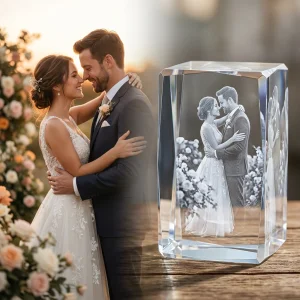
- Personalization Options: 3D volumetric half-bust portraits created from flat 2D headshots, hovering over engraved service years and key contribution metrics.
- Best Suited For: Corporate hall of fame inductions, retiring board chairs, and 30-year lifetime service awards.
- Why Choose It: Converting flat photos into 3D glass portraits creates a permanent historical record. It eliminates photo fading caused by direct sunlight exposure in executive suites.
How does sub-surface laser engraving create 3D images inside solid glass without breaking the surface?
The system uses a 532nm green laser directed through precise optical lenses. Green light passes through clear outer glass surfaces without heating them. When the laser converges at a calculated focal point inside the block, energy density reaches a threshold that triggers non-linear optical breakdown. This forms a tiny micro-fracture between 20 and 50 microns wide. Pulsing the laser thousands of times per second while moving the crystal along X, Y, and Z axes builds a dense 3D point cloud inside the solid crystal block.
Can sub-surface crystal glass laser engraving produce full-color logos or text?
No. Internal laser micro-fractures change the physical glass structure, producing tiny frosted dots that reflect surrounding white light. Because no inks, chemicals, or dyes enter the solid crystal block, sub-surface graphics are always monochrome white. Suppliers offering colored elements use external surface UV printing or attached color bases, which sit outside the sealed laser zone.
What file formats are required to produce 3D sub-surface laser awards?
Flat artwork like company logos, signatures, and text requires high-resolution vector files in EPS, AI, or SVG formats. Engraving software converts these vectors into flat internal point coordinate planes. For true 3D objects, buildings, or executive portraits, suppliers require 3D models in CAD formats such as OBJ, STL, or STEP. Translation software converts those volumetric surfaces into thousands of X-Y-Z points tailored to the award block dimensions.
Why should HR buyers specify K9 optical crystal awards over standard glass trophies?
K9 optical crystal awards offer superior clarity, a high refractive index, and freedom from internal air bubbles or iron impurities. Standard soda-lime plate glass holds internal stress and chemical variations that lead to web-cracking or glass breakage under laser focus. K9 crystal undergoes long thermal annealing during manufacturing. This leaves the internal structure stress-free and stable enough to hold millions of laser micro-fractures without losing structural strength.