Leo's Search for a Lasting Keepsake: The Science Behind Sub-Surface 3D Crystal Engraving
Leo stared at his phone screen for twenty minutes. His younger sister, Maya, stood on the campus green holding her mechanical engineering diploma, laughing as her mortarboard tilted sideways. Her graduation ceremony was seven days away, and Leo had zero gifts ready.
Standard options felt tired. Paper certificates end up stored in vinyl tubes. Silver-plated pens collect dust inside desk drawers. Flat photo prints fade under sunlight. Maya had spent four brutal years conquering fluid mechanics and linear algebra. A flimsy plastic picture frame wasn't going to cut it.
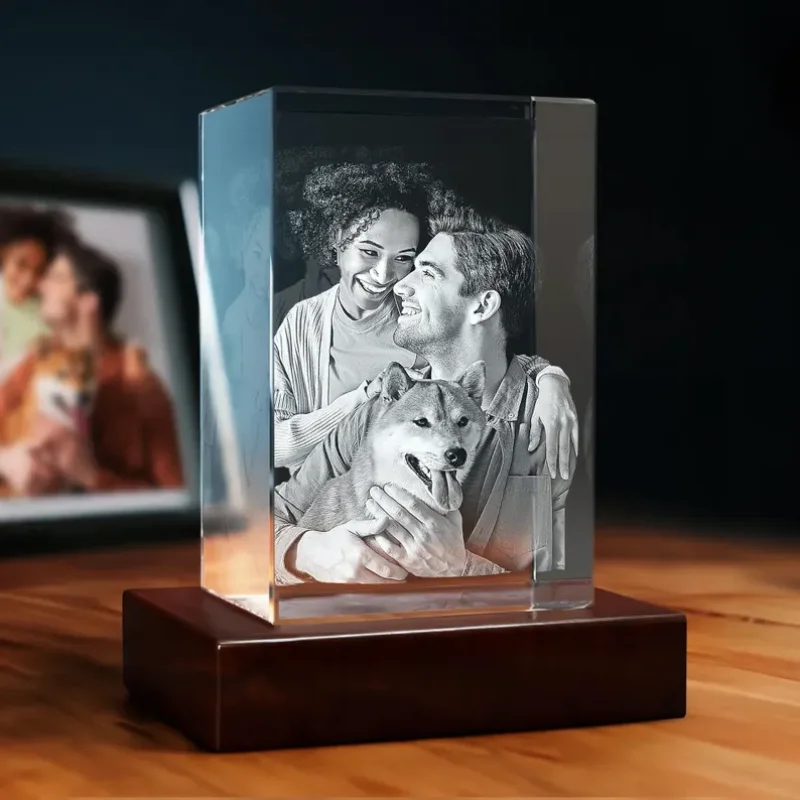
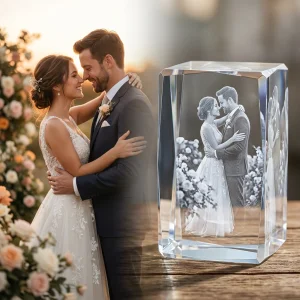
Leo wanted something heavy, permanent, and visually striking. He stumbled upon a customized 3d photo crystal graduation gift online. The sample images showed realistic volumetric portraits suspended inside solid glass blocks. No surface etchings. No ink. Just a floating three-dimensional figure locked inside clear crystal. Intrigued by the manufacturing process, Leo looked into how craftsmen turn a flat JPEG into a subsurface glass sculpture.
K9 Optical Crystal vs. Standard Soda-Lime Glass
Not all glass block keepsakes are built the same. Cheaper alternatives use common soda-lime glass—the same material found in beverage bottles and windowpanes. Soda-lime glass carries a distinct greenish tint due to iron impurities. It also contains microscopic air pockets and offers a lower refractive index around 1.50.
High-end photo cubes rely exclusively on optical K9 crystal. Named after the German classification Kron-Schott-9, this borosilicate crown glass undergoes rigorous refining to eliminate impurities. Here is how the two materials compare side by side:
- Refractive Index: K9 crystal reaches 1.517, bending light sharply to highlight internal details. Soda-lime glass sits near 1.500, producing duller optical refraction.
- Purity: K9 crystal is rated near-zero inclusion. You won't find tiny air bubbles or dark speckles blocking the view.
- Color Neutrality: Optical K9 crystal stays ultra-clear, whereas standard glass shows green edges when viewed from the side.
- Durability: K9 achieves a 6 on the Mohs hardness scale, resisting scratches from dust and everyday handling.
From 2D Cap-and-Gown Snapshot to 3D Point-Cloud
Leo picked a crisp portrait of Maya in her cap and gown. But how does a flat 2D photograph become a three-dimensional model?
The transformation starts with spatial depth mapping. Technicians run the photo through conversion software to isolate the subject from the background. The software analyzes lighting highlights, contour shadows, and facial structure to build a digital relief map. It estimates the depth of Maya's nose, the curve of her jawline, and the folds of her graduation robe.
Next, the system generates a point-cloud coordinate model. Instead of solid vectors, the portrait breaks down into 500,000 to 2,000,000 individual geometric points mapped along X, Y, and Z axes. This coordinate file tells the laser marking machine precisely where to fire inside the blank K9 crystal block.
Subsurface Laser Optics: 532nm Green Lasers at Work
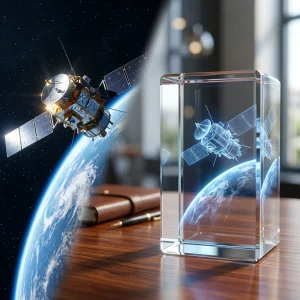
Engraving inside a sealed crystal block without scratching the exterior sounds impossible. The secret lies in a 532-nanometer Diode-Pumped Solid-State (DPSS) green laser.
Standard CO2 lasers burn glass surfaces because raw glass absorbs infrared light. Green DPSS light passes right through clear K9 crystal without heating the entry face. The machine's lens array focuses the green laser beam beneath the polished surface at a controlled subsurface focal depth.
At the exact focal point, energy density spikes dramatically. The intense energy creates a tiny micro-fracture inside the glass lattice, forming a microscopic white dot less than 50 microns across. By pulsing at high frequencies reaching several thousand hertz, the machine builds the entire dot-matrix image point by point in under three minutes. The outer walls stay smooth to the touch.
Image Requirements and Material Limits
Before submitting his order, Leo evaluated his snapshot against production standards. Not every photo yields a clean subsurface render.
Source files need a minimum resolution of 300 DPI at true scale. Low-resolution social media downloads produce faint, blurry point clouds. Contrast matters just as much. Dark black hair overlapping a dark background makes depth separation difficult. Maya’s portrait worked because bright afternoon sunlight separated her black gown from the brick hall behind her.
Environmental limits also exist. While K9 crystal tolerates normal indoor conditions, sudden thermal shock can cause tension cracks. Placing a cold crystal directly on a heating vent or under extreme temperature swings forces internal micro-fractures to expand. Room temperature display on a desk or bookshelf keeps the glass stable indefinitely.
Selecting Shapes and Adding Light Bases
Leo compared three distinct formats for his sister's gift:
- 3D Photo Cubes: Thick rectangular or square geometry. Offers deep volumetric space, allowing full 180-degree profile rotations.
- Light-Base Plaques: Wide vertical glass plates with beveled edges. Fits portraits paired with custom text, such as degree names and graduation dates.
- Glass Paperweights: Compact dome or flat oval shapes. Functional desktop accessories tailored for home offices.
Leo selected a 5x8x5 centimeter laser engraved k9 crystal rectangular cube. He added a black wooden base fitted with bright multi-spectrum RGB LEDs.
Without illumination, subsurface engravings look faint under dim indoor lighting. When placed over an LED base, white light travels upward through the bottom face. The internal micro-fractures refract the light upward, making Maya's portrait glow brightly against a dark room.
The Result on Graduation Day
At dinner after the commencement ceremony, Leo handed Maya a black velvet presentation box. She opened the magnetic latch, lifted out the solid crystal block, and placed it onto the light base.
She flipped the switch. Her 3D portrait lit up inside the crystal, showing her gown, smile, and mortarboard in sharp, suspended detail. Her hard-earned engineering degree now had a permanent, physical centerpiece for her new office desk.
Can any smartphone photo be converted into a 3D crystal portrait?
Yes, provided the image has sharp focus, clear lighting, and a minimum resolution of 300 DPI. High-contrast photos where the subject stands out from the background produce the crispest 3D depth maps.
What makes K9 crystal superior to standard glass paperweights?
K9 crystal is a high-purity optical borosilicate glass with a 1.517 refractive index. It offers superior optical clarity, zero green tint, high scratch resistance, and an air-bubble-free internal structure compared to standard soda-lime glass.
How does the green laser engrave inside the crystal without marking the outside?
The 532nm DPSS green laser passes through clear K9 crystal without altering the surface. Lenses focus the laser beam beneath the outer face, concentrating energy at a precise subsurface focal depth to create controlled micro-fractures inside the glass lattice.