Freezing Mid-Air Action: How to Turn High-Speed Pet Photos into Sub-Surface 3D Crystal Engravings
Olivia sat at her kitchen counter scrolling through hundreds of photos on her laptop screen. Her German Shorthaired Pointer, Copper, was captured mid-leap catching a plastic disc at the park. His muscles were taut, his ears blew back against the wind, and drops of muddy park water hung suspended beneath his outstretched paws. She printed the shot on metallic photo paper last year. It sat flat inside a walnut frame, losing the raw physical explosion of movement that made the moment special.
Flat prints couldn't capture the depth of Copper's chest or the distance his back legs pushed off the turf. Olivia wanted a physical keepsake that matched his three-dimensional energy. That search led her to optical crystal blocks etched from the inside out using high-precision green lasers.

Evaluating Action Photos: Shutter Speed and Fur Contrast
Not every high-speed action shot converts cleanly into a solid glass block. Olivia reviewed candidate photos with an engraving technician before placing her order for a customized laser engraved dog photo.
Shutter speed dictates pixel sharpness. Motion captured at 1/250 second looks acceptable on a phone display. Under 3D point-cloud mapping software, minor leg blur smudges the laser coordinates into a cloudy haze. The source image requires a shutter speed of 1/1000 second or faster. At 1/2000 second, individual fur locks around the neck and fine water droplets near the paws remain sharp enough for depth extraction.
Dark coats present a separate challenge. Copper has dark liver patches and a heavily speckled coat. Extremely low-contrast black or dark brown fur absorbs light, causing camera sensors to register the ribcage and legs as a single flat shadow mass.
Technicians fix dark coat issues before etching by tweaking image parameters:
- Lifting shadow tones by +15 to +25 EV to isolate hidden anatomical lines.
- Boosting local contrast along the belly, snout, and shoulder muscles.
- Separating dark paws from background grass using manual edge isolation masks.
K9 Optical Glass Standards: The Physics of Pure Crystal
Olivia discovered that glass purity determines whether the internal image pops or looks murky. Premium 3d crystal pet photo keepsakes rely on K9 optical crystal, a high-purity borosilicate crown glass engineered for optical lenses and prisms.
K9 glass contains under 0.01% iron oxide. Low iron removes the greenish tint common in standard float glass. Its high clarity rating ensures zero internal air pockets or structural inclusions down to a 10-micron scale.
Refractive stability matters just as much. K9 crystal measures roughly 1.5168 on the refractive index scale. This uniform density allows a focused laser beam to pass through outer crystal walls without bending off-target. The beam travels unimpeded until it hits its designated focal coordinate inside the block.
Converting 2D Pixels into 1,000,000 Coordinate Points
A standard JPEG image holds no Z-axis depth data. To turn Olivia's flat picture into a volumetric model, digital artists process the file through specialized depth-mapping software.
The designer constructs a spatial point cloud, plotting X (width), Y (height), and Z (depth) coordinates across the dog's body. The software assigns higher point density to intricate features like the eyes, snout, nostrils, and tensed leg muscles.
A standard 4x3x3 inch crystal block requires between 800,000 and 1,200,000 individual points. Fewer than 500,000 points leaves the pet looking faint and hollow. Exceeding 1,500,000 points risks overlapping micro-bursts, which creates unwanted internal stress cracks.
Sub-Surface Micro-Fracturing with 532nm Green Lasers
The manufacturing setup looks like an advanced optics laboratory. The polished crystal block sits on a stabilized CNC stage. A diode-pumped solid-state laser fires rapid pulses of green light at a 532-nanometer wavelength through the outer glass surface.
K9 optical glass is transparent to 532nm green light at ambient energy levels. The laser passes through the glass without scratching, heating, or marking the outer surfaces.
At the exact focal point inside the block, converging lenses concentrate light energy to a tight focal spot under 50 microns wide. Energy density spikes instantly. A microscopic thermal explosion occurs, creating an opaque white fracture point that catches ambient light.
The laser pulses at rates up to 4,000 dots per second. Working from the back layer of the crystal toward the front, the laser builds Copper's leaping form dot by dot inside solid glass.
Choosing the Right Glass Geometry for Movement
Olivia had to pick a crystal shape that complemented Copper's airborne posture. Matching the geometry to the pet's motion path keeps the final display visually balanced.
- Horizontal Rectangles: Best for full-sprint runs, dock diving leaps, and agility dog dashes across open ground.
- Vertical Rectangles: Ideal for high frisbee catches, sitting alert poses, or dogs jumping straight up.
- Cubes: Designed for tight chest-up portraits, dramatic headshots, or compact cat pounces.
Because Copper was stretched horizontally mid-air across the camera frame, Olivia chose a wide 5x7 inch horizontal block.
Illuminating Internal Laser Points with LED Bases
Sub-surface crystal engravings do not generate their own light. They rely on external light entering the block to illuminate the internal point cloud.
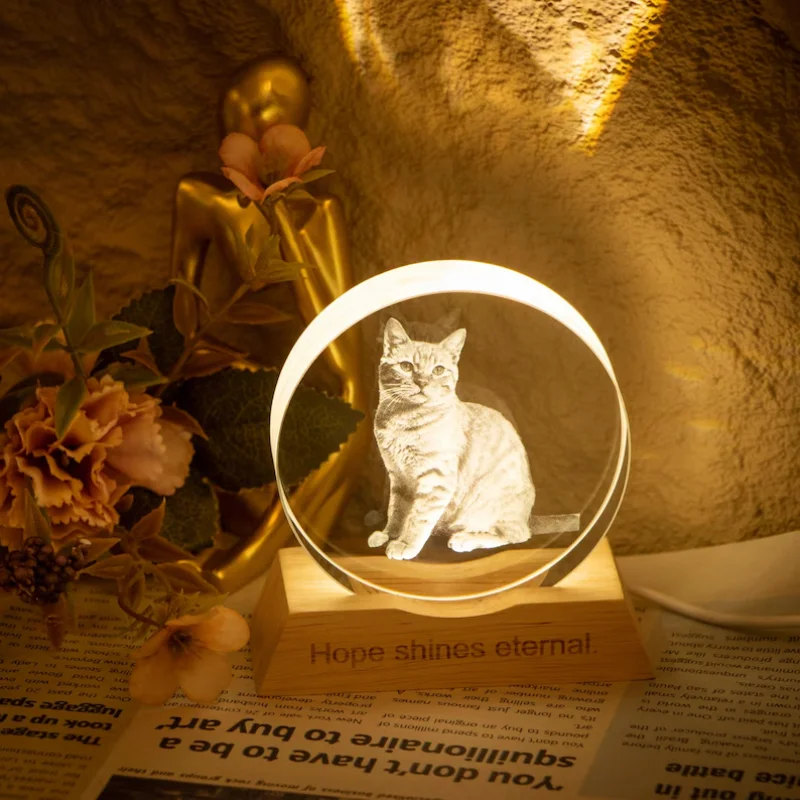
Olivia paired her block with a fitted wooden base containing a strip of focused 6000K cool-white LEDs. Cool white light strikes the 532nm micro-fractures, reflecting bright white highlights that mirror sunlight hitting Copper's coat.
Placing the crystal block on a shelf with the LED base turned on made the laser points pop against the dark room. The mid-air leap frozen inside solid glass became the focal point of her living space.
Can low-resolution phone photos be used for a 3D crystal engraving?
Yes, as long as the pet subject is sharp and well-lit. While high-resolution camera files yield fine detail, software algorithms can upscale phone photos if motion blur is minimal and dark shadows do not hide the pet's features.
What happens if my dog has pure black fur with no visible highlights?
Solid black fur requires pre-etching adjustments. Production artists adjust dark shadow channels to reveal hidden muscle contours and coat texture before generating the 3D point cloud, preventing the final block from looking like a flat silhouette.
Will the sub-surface laser engraving fade or change color over time?
No. Micro-fractures inside K9 optical crystal are physical structural changes within the glass matrix. They will not fade, turn yellow, or degrade when exposed to direct sunlight or indoor lighting.
How do I clean my optical crystal block without damaging the image?
Because the image is completely encased inside the glass, the exterior surfaces remain smooth. Clean the block using a microfiber cloth and standard streak-free glass cleaner or isopropyl alcohol.