Preserving Memory in Glass: How Sarah Transformed an Aging Photo into a 3D Crystal Memorial
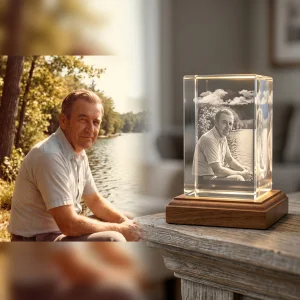
Sarah stared at the grainy 3.5x5 inch photo resting on her dining table. Her grandfather, Arthur, grinned back at her from a faded porch chair in 1982. The photo paper was yellowing at the edges. Sun damage had already muted the deep blues of his favorite flannel shirt. She had tried framing it, but light kept stripping the color away month after month. Acrylic frames felt cheap, scratching every time she dusted the living room credenza. She wanted something heavy. Something permanent. She needed a laser engraved crystal memorial that would lock his image inside solid glass, safe from moisture, fingerprints, and UV light.
Paper prints rot. Digital files get buried in hard drives. Glass holds steady for centuries, provided you choose the right material and laser process.
K9 Optical Glass vs. Standard Soda-Lime Glass
Not all glass blocks work for sub-surface engraving. Common household items like windowpanes, standard picture frames, and glass bottles use soda-lime glass. Soda-lime contains high levels of iron oxide. That iron gives the glass a greenish tint along the edges and introduces tiny air pockets that scatter light unpredictably.
Sarah chose K9 optical crystal instead. K9 glass is a high-grade borosilicate optical glass known for extreme purity. Standard specifications include:
- Refractive Index: 1.516
- Internal Clarity: Zero visible bubbles or striations under 10x magnification
- Iron Content: Less than 0.01%
- Mohs Hardness: 6.0
Light travels through K9 crystal without distortion. The lack of green tint lets pure light pass directly into the inner focal plane. That optical clarity ensures every laser focal point stands out against a dark backdrop.
From 2D Snapshot to 3D Point-Cloud Engine
Arthur’s photo was over forty years old. Its resolution sat at roughly 150 DPI after scanning. A direct transfer would produce a flat, blurry etching.
Converting a flat photo into a laser etched crystal photo requires two main steps: depth mapping and point-cloud generation. Software artists extract depth cues from shadows, skin folds, and lighting gradients. They construct a 3D mesh map defining the distance of Arthur's nose, chin, and shoulders relative to the background.
Next comes point-cloud conversion. Software converts the 3D mesh into millions of individual spatial coordinates: X, Y, and Z. Each point represents a microscopic fracture inside the glass.
To etch these points, technicians use a 532nm green DPSS (Diode-Pumped Solid-State) laser. Green light passes straight through the exterior surface of K9 crystal without marking it. The glass fractures only at the precise spot where the concentrated laser beam converges inside the block.
Precision matters. The laser equipment operates under strict parameters:
- Pulse Rate: 3,000 to 5,000 Hertz
- Wavelength: 532 nanometers (green spectrum)
- Focal Spot Diameter: 20 to 30 microns
- Point Density: 400,000 to 1,200,000 dots per block
If pulse frequency runs too high or power spikes beyond tolerance limits, thermal stress causes micro-fractures to spiderweb together. This creates heat fractures that cloud the subject's face. Controlled pulse timing keeps every dot isolated, creating sharp lines and realistic shading.
5 Laser-Engraved Crystal Display Blocks for Home Decor
Sarah evaluated five distinct block designs to complement her living room decor.
1. Classic Rectangular Block
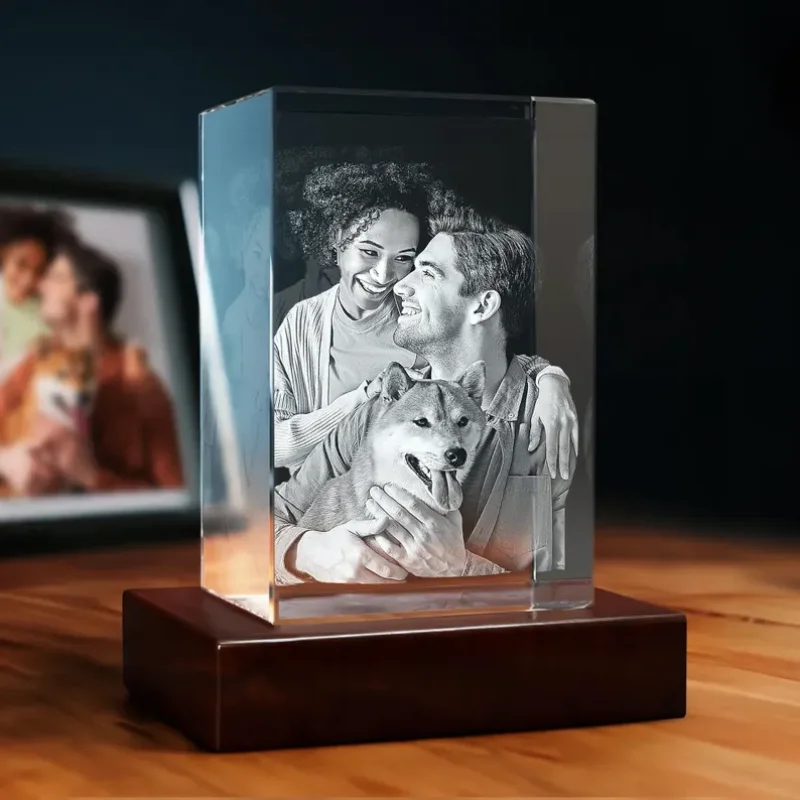
This block measures 10 x 15 x 6 cm for mantle displays. The flat, wide front face provides a direct viewing plane free of optical distortion. Sarah placed this shape on her oak bookcase. Its four-pound weight keeps it stable, while the broad face gives Arthur's portrait full visual impact.
2. Beveled Edge Cube
An 80mm or 100mm cube features chamfered edges polished at a 45-degree angle. These angled cuts act as prisms. As guests walk past the cube on a side table, ambient light refracts through the chamfered edges. This creates a parallax effect where the portrait appears to turn as your perspective shifts.
3. Arched Display Block
Featuring a rounded top and a heavy flat base, the arch shape measures 12 cm high by 8 cm wide. It works well on bedside nightstands and narrow floating wall shelves. The curved apex naturally softens light falling from overhead room fixtures, framing the internal 3D point cloud like a doorway.
4. Faceted Iceberg Block
Iceberg blocks feature hand-cut, irregular facets along the top and sides, paired with a smoothly polished front face. When placed on sunlit credenzas or desks near windows, ambient sunlight hits the angled top facets, casting subtle glimmers inside the crystal while keeping the main photo face clear.
5. Diamond Heart Block
Cut into a thick, free-standing heart shape measuring 10 x 10 x 3 cm, this option suits personal portraits and close-up busts. The tapered bottom concentrates base light upward, directing maximum brightness into the center of the face.
Lighting Engineering: Maximizing Depth with LED Bases
Laser etchings inside glass consist of millions of microscopic white dots. Without light hitting those dots, the image looks transparent. To bring Arthur’s portrait to life, Sarah placed her crystal block on an illuminated wooden light base.
The base uses high-CRI (Color Rendering Index greater than 90) surface-mounted LEDs. Light travels vertically from the base upward through the polished bottom of the K9 block. Rays bounce off the inner crystal walls, illuminating the micro-dots from behind.
Color temperature alters the display mood. A 3000K warm white LED base enhances natural skin tones in portraits. A 6000K cool white LED base sharpens high-contrast geometric details and architectural backdrops. Using a regulated 5-volt USB driver ensures the base maintains a constant 300 lux brightness without producing ambient heat that could degrade the crystal over time.
Can low-resolution or damaged vintage photos be converted into a 3D crystal engraving?
Yes. Photo restoration technicians use digital painting and contrast adjustment tools to repair scratches and boost file quality before generating the 3D point cloud. While extreme blur limits full depth extraction, technicians can still generate a clean 2.5D relief map that creates realistic depth inside the crystal block.
Will the laser etching inside the K9 optical crystal fade or discolor over time?
No. Sub-surface laser engravings are permanent micro-fractures inside the physical structure of the glass. Because the design lives beneath the surface, it cannot be scratched, stained, discolored by UV exposure, or worn away by cleaning chemicals.
How do you clean and maintain a laser engraved crystal display block?
Clean the exterior surface with an alcohol-based glass cleaner or microfiber cloth to remove dust and fingerprints. Avoid abrasive sponges or harsh ammonia solutions on coated bases. Keep the electronic LED light base dry, and dust the light output port periodically with compressed air to maintain optimal illumination.