5 Custom 3D Engraved Crystal Block Keepsakes to Capture Your Dog's Playtime Moments
Hugo sat on his rug with a phone full of motion shots. His three-year-old Australian Shepherd, Buster, spent Saturday morning snatching rubber discs six feet off the turf. Hugo had captured the exact millisecond Buster caught the disc, ears back, muscles taut, airborne over a spray of dew. He printed the shot on paper last year, but flat matte prints flattened the kinetic energy. Canvas hid the crisp outline of Buster's coat under woven texture. Hugo wanted depth. He wanted to feel the physical space Buster carved through the air during full-speed fetch.
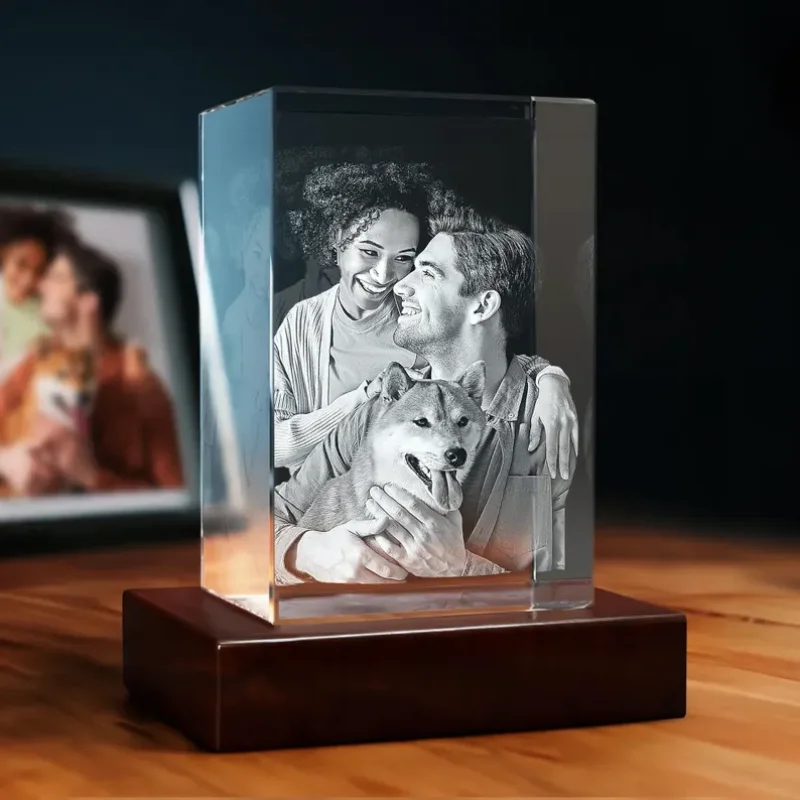
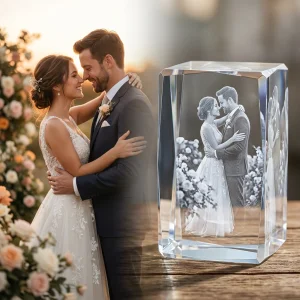
That search led Hugo to sub-surface laser engraving. Instead of pressing ink onto paper, laser technicians take a standard two-dimensional smartphone photo and map its depth. They convert the image into a volumetric 3D point cloud averaging 1.5 million spatial points. High-frequency green laser pulses then recreate the dog inside pure glass without scratching the exterior surface.
If you want to preserve your dog's wildest park sprints, agility runs, or water dock jumps, here is how custom pet crystal keepsakes turn action photography into permanent glass art.

How 2D Action Photos Turn into 3D Glass Art
A static portrait photo is simple to etch. Action shots present a structural challenge. When Buster leaps, his body contorts. Photogrammetry software and specialized optical designers process the image, building a three-dimensional mesh model. They map the depth of the snout, the flare of the ribcage, and the trailing angle of the back paws.
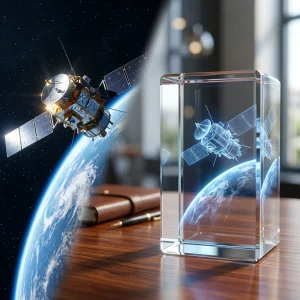
The conversion engine plots roughly 1.5 million micro-points. Each point represents a tiny coordinate inside the solid glass block. A 532nm green diode laser targets these coordinates. The laser passes straight through the outer polished surface of optical-grade K9 crystal without altering the exterior walls. When the light beam converges at a precise interior focal point, the thermal shock causes a minute micro-fracture. Thousands of these precise micro-fractures form a fully realized, three-dimensional floating image of your dog.
Optical-grade K9 crystal glass is selected for this exact process. K9 glass boasts exceptional clarity and a high refractive index of 1.517. It contains zero bubble inclusions or internal striations. Lower grade soda-lime glass cracks or clouds under laser pressure, while pure K9 holds crisp micro-fractures that bounce ambient room light back to your eyes.
5 Crystal Keepsake Designs Built for Active Dogs
Different playtime postures demand specific crystal geometries. Matching the glass shape to your dog's motion profile ensures the 3D laser engraved glass pet looks balanced and stable.
1. The Mid-Air Fetch Rectangular Block
Horizontal space is vital for sprinting dogs. A solid rectangular block measuring 3.1 x 4.7 x 2.3 inches provides wide horizontal depth. Hugo chose this format for Buster's disc catch. The extended width accommodates the dog's outstretched body, the floating frisbee, and the trailing grass line underneath. The sharp 90-degree outer corners act like a clean photo frame, giving you a clear view directly into the action from the front, top, and sides.
2. The Agility Weave Prism
Dogs navigating weave poles or A-frames move along dynamic diagonal angles. Bevel-edged prisms feature hand-polished 45-degree angled borders along the front faces. These chamfered edges catch surrounding ambient light, directing soft rainbow highlights across the interior laser nodes. When viewed from slight side angles, the bevels split the scene into mirrored reflections, echoing the fast, zigzag rhythm of agility trials.
3. The Dock-Diving Cube
Vertical leaps and steep water drops fit best inside a heavy square cube crystal. Measuring 3 x 3 x 3 inches, the cube format provides equal depth on all sides. This volumetric space works well for dock-diving dogs frozen at the peak of their upward arc. The deep interior allows the laser to etch water droplets suspended behind the dog's hind legs, adding real physical separation between pet and background splash.
4. The Dual-Dog Chase Arch
If you own two dogs that race side-by-side, an arched crystal block frames the interaction. The rounded top crest softens light passing down through the block. The wide base gives technical design teams space to set up a double point cloud. One dog can sit slightly forward in the foreground layer while the chasing dog sits two centimeters behind in the background depth field.
5. The High-Jump Portrait Tower
Vertical orientation suits dogs that catch balls mid-bounce or stand on rear legs during play. A portrait tower measuring 4.7 x 3.1 x 2.3 inches centers the dog's vertical spine. Setting the baseline low in the crystal creates dramatic height, making a medium-sized terrier look like it is leaping straight off your desk surface.

Choosing Between Solid Rectangular Blocks and Bevel-Edged Prisms
Selecting the right glass geometry alters how light hits the internal laser points. Here is how the two primary cuts compare under real room lighting:
- Solid Rectangular Blocks: They offer zero optic distortion. Flat, perpendicular faces let light enter at right angles. This keeps the interior point cloud crisp from straight-on viewing distances. Rectangles work best when placed on dark wooden shelves or inside enclosed display cases.
- Bevel-Edged Prisms: The angled corner cuts refract incoming light into rainbow spectra. This adds visual movement around the laser nodes. Prisms excel when displayed near natural window light or under direct overhead track lighting. However, extreme side angles can create slight visual doubling along the outer edges.
Photo Rules and Technical Limitations
Laser engraving relies entirely on the structural data inside your digital upload. Not every photo on your phone translates into a high-density point cloud. Knowing what causes low interior point density saves you from a faded or hollow result.
The primary issue with action shots is motion blur. If your camera shutter was too slow, dog fur bleeds into the background. Software cannot locate where the fur ends and the grass begins. This leads to missing patches in the 3D model.
Dark fur presents another obstacle. Black Labradors or Belgian Malinois photographed in heavy shade lack pixel contrast. The software requires clear highlight-to-shadow ratios to project depth. On low-contrast dark dogs, interior point density can drop below 500,000 nodes, leaving the finished crystal looking faint or ghost-like inside.
Frame coverage matters just as much. If your dog occupies less than 40% of the original photo frame, cropping tightly reduces the resolution. Always upload photos where your dog fills most of the frame under direct sunlight or high-speed outdoor lighting.

Follow these rules when picking your playtime image:
- Use high shutter speeds: Select images shot in full daylight where paws, teeth, and eyes remain sharp.
- Avoid distant shots: Ensure the dog takes up at least 50% of the overall image frame before cropping.
- Check fur contrast: Dark coats need bright direct light to reveal muscle lines and chest markings.
- Watch for hidden limbs: Photos where a dog's leg is hidden entirely behind its body leave blank zones in the 3D depth profile.
Pairing Your Crystal with the Right LED Light Base
A custom pet crystal keepsake requires external illumination to show its full detail. Without a direct light source below or behind the glass, the laser micro-fractures look invisible. Ambient room light simply passes straight through K9 crystal glass.
An LED light base shoots clean photons upward into the bottom face of the block. As light hits each internal laser micro-fracture, the tiny fractured nodes reflect the light beam, causing the 3D image to glow distinctly in mid-air.
Matte black wooden bases fitted with stationary white LEDs offer the best contrast. Pure white light (around 6000K color temperature) keeps the dog's coat representation neutral and accurate. RGB light bases that cycle through red, blue, and green hues can distract from fine details, though a solid warm-white light setting works well on dark oak desks.
Hugo chose a rectangular crystal block for Buster's high-flying disc catch, setting it on a black wooden base with static white LEDs. The 1.5 million points lit up instantly on his side table. Every tooth edge, flying drop of saliva, and tensed shoulder muscle stood out in solid spatial depth. The flat phone screen photo was transformed into a permanent, light-filled moment of play.
Frequently Asked Questions
Can you convert a normal 2D smartphone photo into a full 3D crystal engraving?
Yes. Specialized photogrammetry software builds a volumetric 3D model from a single flat photo. Graphic designers manually adjust facial contours, muscle structures, and fur lines to build a complete 180-to-360-degree point cloud before laser engraving begins.
What is the difference between surface laser printing and sub-surface crystal engraving?
Surface printing applies ink or shallow etchings directly onto the outside layer of glass, which can wear off or scratch over time. Sub-surface laser engraving uses a 532nm green diode laser to pass through the glass surface, micro-fracturing the interior while leaving the outer walls smooth and untouched.
What happens if my dog photo has a busy or messy background?
Designers automatically remove busy park backgrounds, leash lines, and unwanted objects during the 3D modeling phase. The final engraving isolates your dog in clear space, though custom options allow background elements like frisbees or agility hurdles to remain if desired.
Why is K9 crystal preferred over standard decorative glass for pet keepsakes?
K9 crystal is an optical-grade borosilicate glass valued for its high purity, low bubble count, and high refractive index. It resists heat damage from high-frequency laser pulses, ensuring clean laser micro-fractures without structural cracking.