The Physics of Sub-Surface Laser Engraving: How Light Scatters Inside Solid Crystal
Standard laser surface etching burns the exterior layer of a material through simple linear absorption. Sub-surface laser engraving (SSLE) operates on a completely different optical mechanic. High-purity optical glass, such as BK7 or K9 borosilicate crystal, features high transmittance for visible light wavelengths. A 532 nm green laser beam passes through the polished face of a crystal block without heating the exterior skin.
This transparency vanishes at the exact focal point inside the block. Engineers achieve this by running high-power pulsed Diode-Pumped Solid-State (DPSS) lasers paired with high numerical aperture optics. As the conical beam converges to a tight waist—often smaller than 30 micrometers—the concentrated photon flux reaches a critical threshold.

At this precise focal point, normal optical transparency collapses. The material experiences non-linear optical absorption, specifically multiphoton absorption, where bound electrons absorb multiple photons simultaneously. This rapid intake converts the focal coordinate into a localized micro-plasma. Once the energy pulse crosses the laser energy density threshold—typically between 10 and 100 GW/cm²—the plasma expands and cools instantly. It creates a controlled micro-fracture measuring roughly 20 to 80 micrometers across. The exterior surfaces stay completely unblemished because beam energy outside the focal zone remains far below the ionization limit.
Nanoseconds vs. Picoseconds: Laser Pulse Dynamics
Pulse duration dictates how clean and controlled the internal fracture becomes. Early SSLE machinery relied on nanosecond-pulsed Nd:YAG lasers operating with pulse widths between 1 and 10 nanoseconds. While effective, a nanosecond pulse transfers significant thermal energy into the surrounding material lattice. Thermal expansion creates larger, irregular micro-cracks that limit point-cloud resolution.
Modern precision internal glass laser etching utilizes sub-nanosecond and picosecond lasers. A pulse width of 10 to 50 picoseconds delivers energy so rapidly that heat cannot conduct into the surrounding glass before micro-fracturing finishes. Physicists call this process stress-dominated cold ablation.
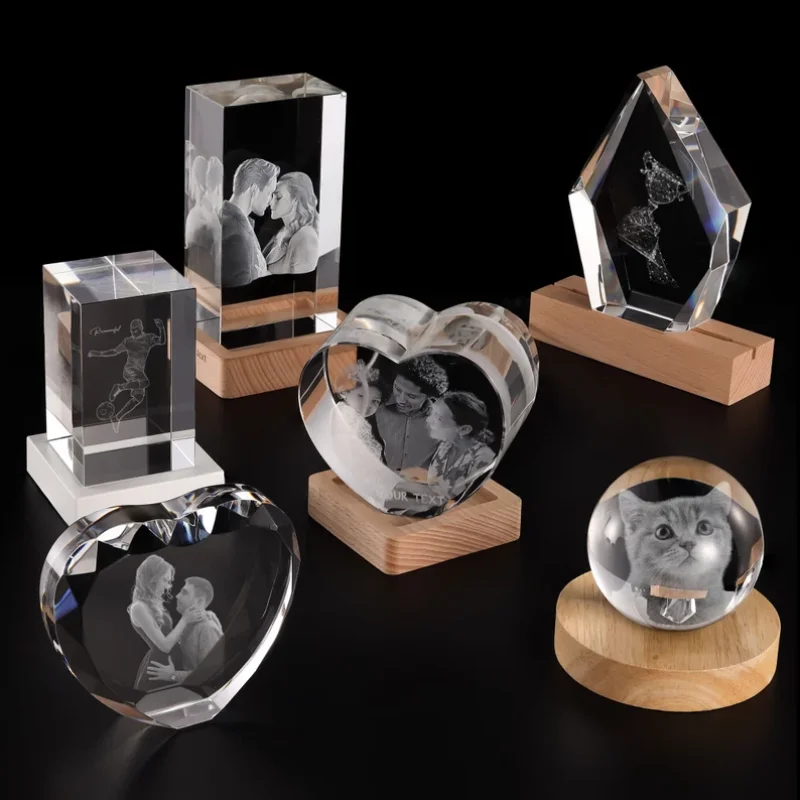
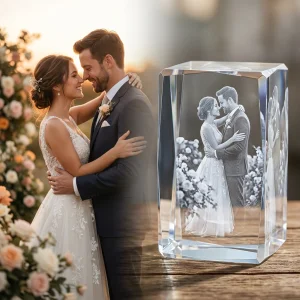
Short pulses yield tight, uniform fractures with predictable spherical geometries. High-end machines map points in 3D coordinate space (X, Y, Z) at rates exceeding 4,000 dots per second. A finished 3D portrait inside a glass block contains anywhere from 500,000 to over 3,000,000 individual micro-fractures.
Core Technical Parameters of SSLE Systems
Executing internal glass laser etching requires exact calibration across optical, thermal, and spatial variables. The table below outlines standard operational parameters used in professional crystal etching setups.
| Parameter | Standard Operating Range | Technical Effect on Crystal |
|---|---|---|
| Laser Wavelength | 532 nm (Frequency-doubled Nd:YAG / Nd:YVO4) | Matches the high transparency window of K9/BK7 glass to avoid surface absorption. |
| Pulse Duration | 10 picoseconds to 5 nanoseconds | Shorter pulses reduce thermal spread, yielding smaller, cleaner micro-fractures. |
| Laser Energy Density Threshold | 10 to 100 GW/cm² | Minimum energy required to trigger non-linear optical breakdown in optical glass. |
| Focal Spot Diameter (Beam Waist) | 15 to 40 micrometers | Determines the minimum physical dot size of the suspended image point cloud. |
| Spatial Resolution (X, Y, Z) | ±5 to ±10 micrometers | Precision of the galvo mirrors and motorized Z-stage positioning the focal point. |
| Substrate Material Grade | K9 Optical Crystal / BK7 Borosilicate | Requires bubble-free material with high homogeneity and zero internal tension. |
Material Limitations and Engineering Constraints
SSLE cannot work on every clear material. Standard soda-lime window glass contains internal mechanical stresses, microscopic air bubbles, and iron impurities. Focused laser energy hitting an iron impurity causes catastrophic thermal stress, shattering the block along hidden fault lines.
Only high-homogeneity materials work reliably. K9 optical crystal and BK7 borosilicate glass undergo strict annealing annealing cycles to eliminate internal stress tensor points. Synthetic fused silica works exceptionally well but increases raw material costs dramatically.
Point-cloud density has strict geometric limits. Placing micro-fractures too close together—closer than 30 micrometers—causes individual fracture zones to bridge. Inter-fracture propagation turns microscopic dots into visible internal crack planes, ruining optical clarity.
Image illumination relies entirely on light scattering. Micro-fractures appear bright white because they refract ambient light. Without direct overhead or base lighting, sparse point clouds look washed out. SSLE cannot produce native color variations; grayscale tones are achieved entirely by altering point spacing and dot density.
Can sub-surface laser engraving crack the glass over time?
No. The micro-fractures created during sub-surface laser engraving are stable stress-relieved voids. Because optical glass like K9 is fully annealed before etching, the thermal energy of the micro-explosion dissipates instantly. Unless the crystal block is dropped or subjected to thermal shock over 150°C, the internal point cloud remains stable indefinitely.
Why can't you engrave full-color images inside crystal blocks?
The process relies on physical micro-fractures inside the glass matrix. These micro-cracks refract and scatter ambient light, creating tiny opaque white dots. Because no pigments, inks, or chemical dyes are injected into the solid crystal, the physical image remains strictly monochromatic. Color effects only occur when external light-emitting diodes illuminate the base of the glass.
What is the difference between surface laser etching and internal glass laser etching?
Surface laser etching uses CO2 or UV lasers to heat and chip the outer boundary of a material, leaving a rough tactile texture on the exterior. Internal glass laser etching passes high-frequency green DPSS laser pulses through the smooth exterior, converging energy only at deep interior coordinates without burning or altering the outer surface.