The Physics of Sub-Surface Laser Engraving: How Light Creates 3D Structures Inside Solid Crystal
A light beam can pass clean through a block of clear glass without heating the outer surface, yet vaporize a sub-millimeter spot precisely at its center. Process mechanics rely on high-energy optics and non-linear light-matter interactions. Standard glass processing uses surface heat to etch or melt exterior walls. Sub-surface laser engraving operates entirely inside the material matrix through a phenomenon known as laser induced optical breakdown.
Glass is transparent to visible and near-infrared light because its bandgap energy exceeds the energy of individual photons passing through it. Photons pass between atoms without absorption under ordinary light levels. Everything changes when a laser focuses a beam down to a spot smaller than 30 micrometers. Energy density spikes dramatically at that pinpoint focal coordinate, exceeding $10^{10}$ Watts per square centimeter.
At this specific power density threshold, multiphoton ionization occurs. The intense localized electromagnetic field pulls electrons directly out of crystal lattice atoms. Free electrons accelerate rapidly, striking adjacent atoms to trigger an avalanche ionization process. Within nanoseconds, the glass matrix undergoes laser induced optical breakdown, converting a localized microscopic point into high-temperature plasma.
Nanosecond Pulses and Micro-Fracture Dynamics
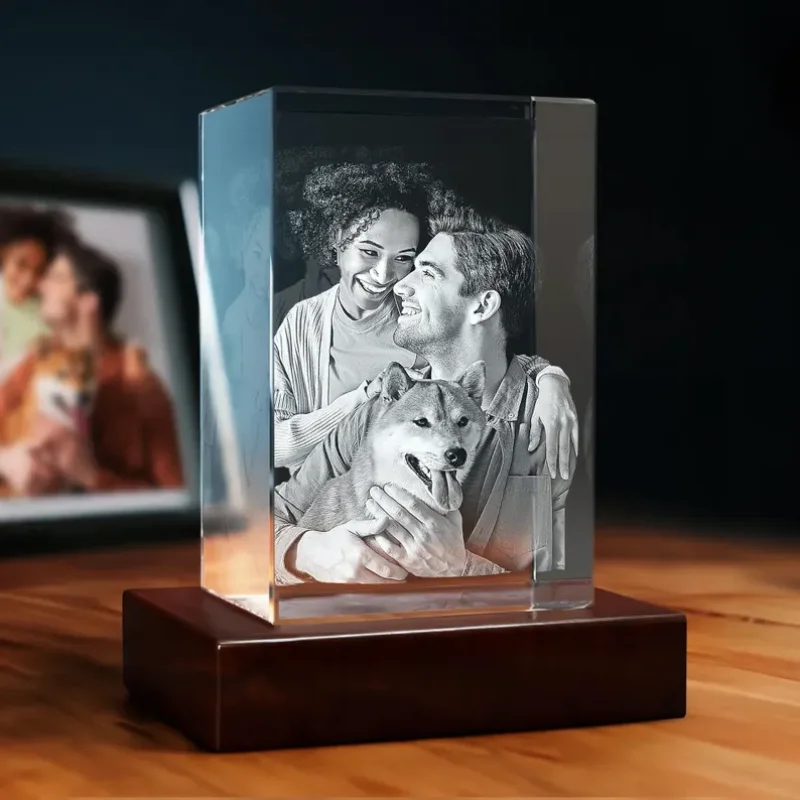
The plasma pocket expands in fractions of a microsecond. As the brief light pulse ends—typically lasting between 1 and 10 nanoseconds—the localized pocket cools violently. This localized thermal contraction creates a permanent micro-crack inside the matrix. Each micro-crack measures between 20 and 100 micrometers across. It acts as an uncolored physical fracture that scatters ambient light, appearing as a bright white dot. A single completed 3d laser crystal block contains between 300,000 and 2,500,000 of these individual points.
Timing determines structural integrity. If pulse energy leaks over microsecond durations, heat dissipates outward into surrounding glass. Surrounding glass expands, generating structural stress lines and visible cracks. High-frequency Q-switches restrict light emission to fast nanosecond bursts. Repetition rates run between 1,000 Hz and 10,000 Hz, placing thousands of precise micro-cracks per second without heating the outer block mass.
Comparing Laser Wavelengths and Interaction Optics
Laser selection dictates whether energy absorbs on the glass surface or focuses safely inside it. Surface etching uses far-infrared output at 10,600 nm from CO2 units. Silicate glass absorbs 10,600 nm light immediately at the outer boundary. Sub-surface processing requires light wavelengths where optical glass displays near-zero linear absorption, such as 1064 nm (Nd:YAG) or 532 nm (frequency-doubled green solid-state lasers).
| Laser Parameter | CO2 Laser | Nd:YAG Laser | Green DPSS Laser |
|---|---|---|---|
| Wavelength | 10,600 nm (Far-IR) | 1064 nm (Near-IR) | 532 nm (Visible Green) |
| Primary Mechanism | Surface Thermal Shock | Sub-Surface Multiphoton LIOB | Sub-Surface High-Precision LIOB |
| Pulse Duration | Continuous / Microsecond | 3 – 10 Nanoseconds | 1 – 5 Nanoseconds |
| Focal Spot Diameter | 100 – 300 µm | 40 – 80 µm | 10 – 30 µm |
| Internal Penetration Depth | 0 mm (Surface only) | 5 to 150 mm | 5 to 200+ mm |
| Material Focus Capability | Exterior marking only | Standard internal 3D clouds | High-density micro-point clouds |
Galvo Scanning and Focal Plane Control
Positioning millions of individual points inside a 3D volume requires extreme steering accuracy. Dual-axis galvo scanners move high-speed mirrors mounted on precision galvanometers. These mirrors direct the laser beam across an F-theta field lens. A dynamic optical Z-axis shifter adjusts focal depth on the fly, moving the focal plane up and down inside the block depth.
Galvanometric systems position the beam at speeds past 3,000 millimeters per second. Mechanical placement tolerances stay tighter than 10 micrometers across the scanning field. Point rendering routines start at the furthest depth inside the crystal block, working backward toward the front face. Ordering points from back to front prevents existing micro-fractures from blocking or refracting incoming laser light directed at deeper layers.
Material Purity and Micro-Shattering Failures
Sub-surface laser engraving leaves no room for raw material flaws. Common window glass and decorative soda-lime items carry microscopic air bubbles, iron inclusions, and uncontrolled internal stress. When focused pulses hit an internal bubble or iron trace, energy absorbs prematurely. That energy surge causes uncontrolled spiderweb cracking or shatters the entire crystal block.
High-grade 3d laser crystal production uses K9 or BK7 optical borosilicate glass. K9 glass undergoes fine thermal annealing across several days to lower internal strain birefringence under 10 nanometers per centimeter. Material parameters must meet strict standards:
- Inclusions and air bubbles: Zero allowed above 5 micrometers size.
- Refractive index homogeneity: Variations kept within ±0.0005 across the full block.
- Iron oxide concentration: Below 0.002% to maximize light transmission at 532 nm.
- Surface polish quality: Scratch-dig rating of 60/40 or better prevents beam distortion on entry.
Operational Limitations and Incompatible Materials
Sub-surface engraving operates within narrow physical parameters. Misapplying the technology to inappropriate materials leads to catastrophic failure or ruinous distortion.
Plastics and acrylics melt instead of micro-fracturing. Thermal energy from nanosecond pulses produces localized yellowing, material charring, and soft voids inside acrylic matrices. Tempered glass cannot accept internal engraving; internal tension triggers complete structural failure, destroying the item instantly.
Point spacing faces physical limits. If two dot centers sit closer than 80 micrometers, adjacent micro-cracks bridge together. Merging micro-cracks form visible internal stress planes, leading to glass flaking or structural failure inside the block. Color choices are impossible within the internal lattice. Every dot is a physical fracture, reflecting ambient room light as neutral white.
Can sub-surface laser engraving create colored designs inside crystal?
No. The laser produces physical micro-cracks through laser induced optical breakdown, leaving bright white fractures. Color can only be introduced externally using LED illuminated display bases that project colored light through the base of the crystal block.
Why doesn't the laser burn or mark the outer surface of the glass block?
The laser beam enters the glass unfocused over a large surface area. Wide surface distribution keeps energy density far below the optical breakdown threshold. Energy reaches the required threshold level only at the tightly focused internal spot coordinate inside the crystal matrix.
What is the difference between K9 optical glass and standard decorative glass for laser engraving?
K9 optical glass features superior optical clarity, consistent refractive indices, and minimal internal stress. Standard glass contains microscopic air inclusions, higher iron levels, and high internal mechanical strain. Pulsing high-energy laser light into standard glass causes uncontrolled web fracturing or block destruction.