5 Laser-Engraved Crystal Wedding Gifts That Last a Lifetime
Zoe stared at the wedding registry on her laptop. Sheet sets, stainless steel mixing bowls, and a red silicone spatula. Her sister, Maya, was marrying Sam in less than a month. Zoe refused to buy something destined to sit in a kitchen drawer for five years. She wanted high end personalized wedding gifts with weight, clarity, and permanence.
She turned to custom glasswork. Cheap etched glassware often looks frosted with sloppy, flaking edges. High-grade optical crystal combined with calibrated CO2 laser setups produces crisp, permanent markings. Here are five personalized crystal wedding gifts Zoe evaluated, alongside the technical details that separate heirloom pieces from disposable stemware.

1. 3D Sub-Surface Laser Engraved K9 Crystal Heart Block
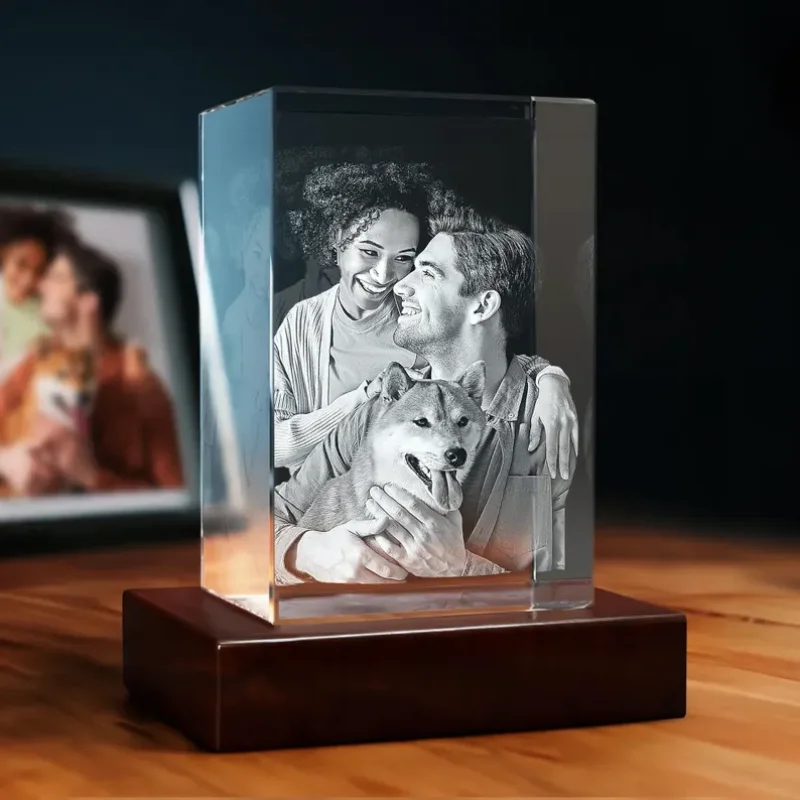
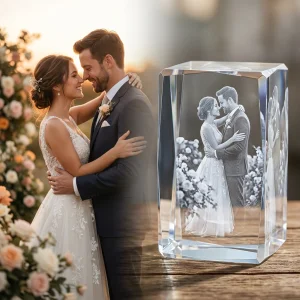
Zoe settled on a 120mm K9 crystal heart block as her primary display piece. Rather than etching the outer skin, the artisan focused a diode-pumped green laser inside the glass. The beam rendered a 3D volumetric point cloud of Maya and Sam's engagement photograph suspended inside the heart.
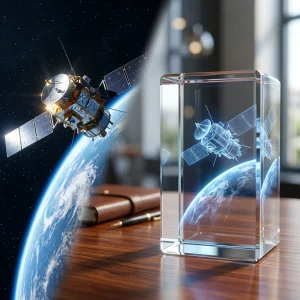
Sub-surface laser engraving (SSLE) passes clean light through the outer boundary without burning the surface. The laser stops at precise coordinates within the core, micro-fracturing the glass to reflect ambient light. K9 optical crystal is mandatory here. Standard soda-lime glass contains microscopic air pockets and high thermal expansion rates. Fire an SSLE laser into cheap glass, and internal pressure cracks the whole block. K9 glass contains zero lead, offers high density, and maintains the optical purity required to hold 800,000 internal points without fracturing.
2. Monogrammed Lead-Free Crystal Wine Decanter
Sam collects regional cabernets, so Zoe paired the heart block with an ergonomic 750ml lead-free crystal decanter. The surface features their shared initial inside a minimal geometric border.
Surface etching on curved glass requires strict heat control. Artisans run a 30W CO2 laser at roughly 300 DPI. Glass conducts heat poorly. Firing a direct laser beam across raw glass creates uneven micro-fractures that chip away when touched. Engravers prevent flaking by laying down a wet paper mask or brushing a light coat of liquid dish soap over the glass. The damp layer absorbs residual heat, focusing the laser beam to create a smooth, milk-white frost.
3. Custom Toasting Flutes with Rotary Laser Etching
For the reception toast, Zoe selected a pair of hand-blown crystal champagne flutes. She added the couple's names and wedding date in a 12pt serif font along the bowl curve.
Etching cylindrical stemware demands a motorized rotary attachment. The rotary unit turns the glass in sync with the laser head's X-axis motor, maintaining a constant focal distance. Without rotary tracking, the laser beam loses focus as the curved glass surface drops away. Defocused beams scorch the surface edges and blur fine details.
4. Heavyweight Square Crystal Whiskey Tumbler Set
Zoe considered a set of four 10-ounce square whiskey tumblers featuring 20mm solid crystal bases. The extra weight gives them a grounded, substantial hand feel.
Flat tumbler facets simplify the laser pass compared to tapered stemware. Engravers use a fast raster speed on a 40W CO2 laser—roughly 70% speed at 20% power. This setting etches clean, sharp lettering into the flat glass faces without weakening the structural integrity of the vessel walls.
5. Beveled Edge Crystal Keepsake Jewelry Box
The final option on Zoe’s list was a heavy crystal keepsake box framed with polished brass hardware. The flat glass lid provided the ideal surface for a custom vector line illustration of the wedding venue.
Vector line etching follows vector stroke paths rather than scanning back and forth like raster shading. Running low power along vector paths prevents deep stress lines from forming on the lid edges, ensuring the glass stays shatter-resistant through daily use.
Care Guidelines and Laser Constraints
Laser engraved wedding gifts require straightforward care to retain their clarity. K9 optical crystal is durable, but dishwasher heat cycles expand the surface micro-fractures created by laser etching. Detergent chemicals settle into these micro-grooves over time, clouding the crisp white etching. Hand washing with warm water, mild soap, and a microfiber cloth keeps crystal bright indefinitely.
Physical size limits apply to 3D sub-surface blocks. While surface etching scales easily onto large decanters, sub-surface point clouds face lens depth constraints. Crystal blocks larger than 150mm demand specialized multi-axis focal lenses. Packing point density too tightly inside large blocks builds up internal tension, causing structural cracks. Keeping point density below 500,000 points per 100mm volume prevents thermal stress failures.
Zoe ordered the K9 crystal heart block and the decanter set. When Maya unwrapped them at the rehearsal dinner, the weight and razor-sharp etching made an immediate impression against a sea of paper gift bags.
Can laser-engraved crystal glassware go in the dishwasher?
No. Hand washing is required for all surface-etched crystal gifts. Dishwasher heat cycles expand the microscopic fractures created by the laser beam. Over time, dishwasher detergent settles inside these tiny grooves, causing permanent cloudiness and rough edges.
What makes K9 optical crystal superior to soda-lime glass for laser etching?
K9 optical crystal features high density, exceptional light refraction, and zero internal air bubbles. Standard soda-lime glass has higher thermal expansion rates and inconsistent chemical mixing. When etched with a laser, soda-lime glass chips unevenly, while K9 crystal yields smooth surface frosts and crisp 3D sub-surface renderings.
How do engravers prevent glass from chipping during laser surface etching?
Engravers apply a thin layer of wet paper towel or liquid dish soap to the glass surface before firing the CO2 laser. This coating absorbs excess heat, distributing thermal energy evenly across the surface and preventing the glass from shivering or flaking along design edges.
What is the maximum size limit for 3D sub-surface laser engraving?
Most 3D sub-surface laser engraved blocks stay under 150mm in length or width. Larger crystal blocks require complex focal depth controls and build up internal stress. Exceeding 500,000 point fractures per 100mm block volume risks spontaneous internal cracking due to trapped thermal tension.