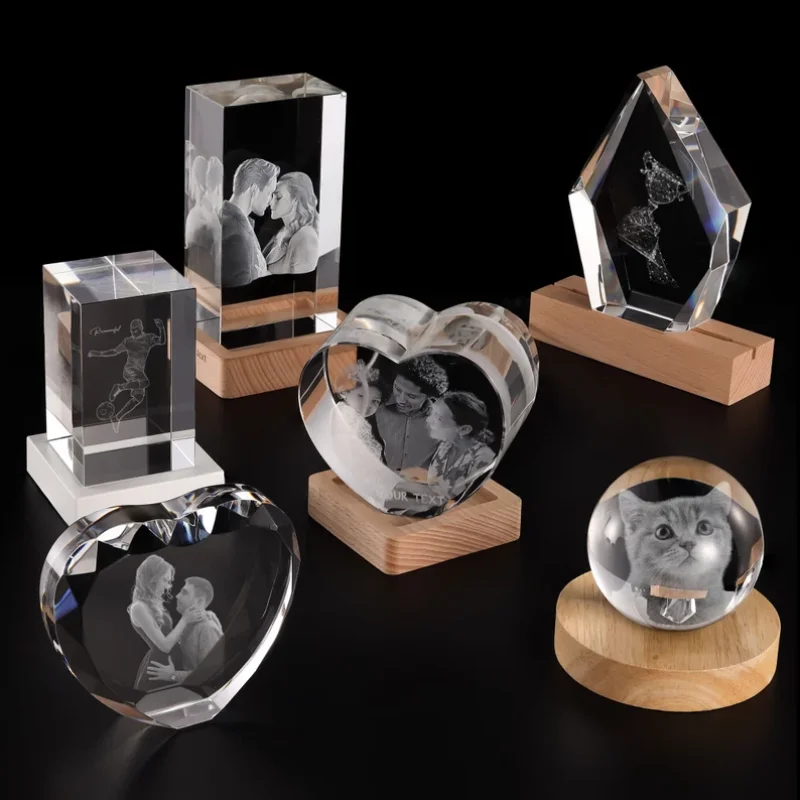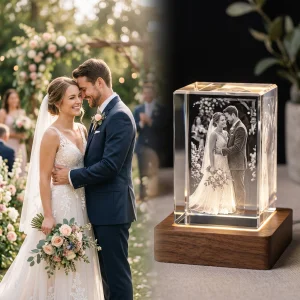
Manufacturing 3D Subsurface Engraved K9 Crystal Wedding Keepsakes
Standard window glass fails under interior laser stress. High-iron float glass shatters when targeted internally because microscopic impurities absorb light unevenly. Crafting durable 3D laser engraved wedding photos requires K9 optical crystal, a high-purity borosilicate crown glass known for high optical clarity and low inclusion counts.
1. Optical Crystal Selection and Grading
K9 crystal contains less than 0.015% iron oxide. Float glass contains far more, giving it a characteristic green hue. K9 offers a refractive index of 1.516, allowing light transmission above 99% across visible light wavelengths.
- Inclusion rating: Grade A K9 permits zero bubbles or inclusions larger than 0.005mm per cubic centimeter.
- Internal stress: Annealed below 10nm/cm birefringence to prevent spontaneous fracturing during laser processing.
- Surface flatness: Diamond-polished to within λ/4 flat to prevent laser beam refraction errors.
2. Photo Pre-Processing and Depth-Map Generation
Flat 2D wedding photos can't be burned directly into glass block interiors. Production teams convert 2D raster files into 3D point clouds using grayscale depth-mapping software.
First, a technician isolates bride and groom portraits from background clutter. Facial geometry gets mapped using a parametric 3D mesh. Depth layers assign Z-axis coordinates to every pixel. White represents proximity, black represents depth. The conversion software generates an array of discrete coordinate points across X, Y, and Z planes. Standard 50x50x80mm blocks require between 800,000 and 2,000,000 spatial coordinates. Source photos must hit a baseline resolution of 300 DPI at 1:1 print scale. Lower resolutions force software to extrapolate pixels, creating blurry micro-crack clusters.
3. Subsurface Laser Engraving (SSLE) Mechanics
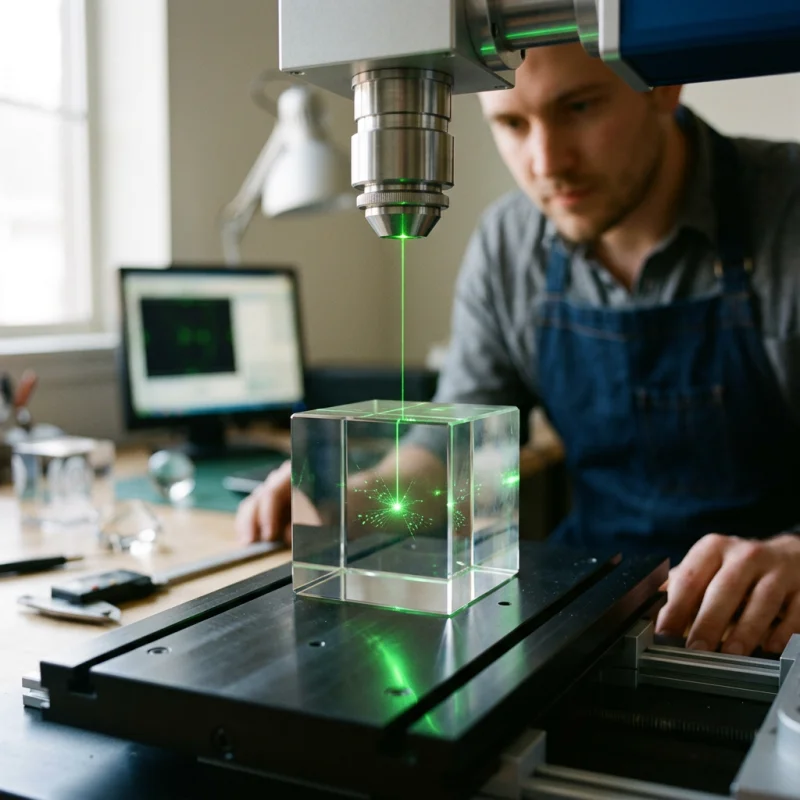
Interior carving relies on Subsurface Laser Engraving (SSLE) powered by a frequency-doubled Diode-Pumped Solid-State (DPSS) green laser operating at a 532nm wavelength.
Why 532nm? K9 crystal is completely transparent to green light at standard energy densities. The laser pulse passes straight through the outer surface without burning or heating the exterior glass shell. High numerical aperture optics converge the laser beam at a precise focal point inside the block volume.
At this focal plane, energy density spikes beyond the dielectric breakdown threshold of K9 crystal (roughly 10^10 W/cm²). Microscopic localized plasma forms. The localized expansion creates a micro-fracture between 10 and 30 micrometers wide. The laser pulses at rates up to 4,000 Hz, repositioning along galvo mirror axes to lay down thousands of dots per second. These tiny internal cracks catch and refract light, producing detailed white 3D point-cloud images suspended in clear glass. These pieces serve as everlasting wedding gifts that never fade, oxidize, or yellow over time.
4. Process Parameters and Machine Specifications
Precision calibration ensures clean facial details without over-exposing adjacent glass areas. The table below outlines standard operational settings for K9 crystal engraving.
| Parameter | Standard Float Glass | Optical K9 Crystal |
|---|---|---|
| Laser Wavelength | 1064nm (Infrared) / 10.6µm (CO2) | 532nm (DPSS Green) |
| Pulse Duration | Nanoseconds to Microseconds | 3 to 7 Nanoseconds |
| Point Cloud Density | Not Applicable (Surface Cracking) | 800,000 - 2,500,000 dots |
| Voxel (Micro-Crack) Size | >100 micrometers (Irregular) | 10 to 30 micrometers |
| Internal Refractive Index | 1.52 (High Dispersion) | 1.516 (Low Dispersion) |
| Iron Content (Fe2O3) | >0.08% | <0.015% |
5. Chamfering, Polishing, and LED Base Integration
Raw crystal blocks leave the laser chamber with sharp 90-degree edges. Computer-controlled diamond grinding wheels chamfer edges at 45 degrees, removing micro-burrs and preventing edge chipping. High-speed felt wheels loaded with cerium oxide slurry polish the chamfers back to optical transparency.
The finished piece needs direct illumination to highlight internal detail. Unlit crystals look faint because internal micro-cracks rely on scattered ambient light. Custom display bases use 3000K warm-white LEDs mounted directly beneath the glass footprint. Light enters through the bottom face, travels up the polished crystal body, and bounces off each internal micro-crack, making the 3D portrait glow brightly.
Thermal Stress Risks and Image Resolution Constraints
Subsurface crystal blocks resist external abrasion, but thermal environment impacts structural integrity. Direct sunlight causes uneven heating inside the crystal. If one face heats up while another remains cool, the micro-fracture network acts as a stress plane, causing cracks across internal shear lines. Place finished pieces away from south-facing windows or heat registers.
Source image quality sets the upper ceiling for detail. Low-resolution graphics or compressed web uploads lack pixel density. When converted into a spatial point cloud, poor photos yield pixelated, muddy structures inside the crystal.
Frequently Asked Questions
Why does subsurface laser engraving require K9 crystal instead of regular float glass?
Standard float glass contains high concentrations of iron oxide and internal micro-bubbles. When a high-frequency laser focuses inside float glass, these impurities absorb light prematurely, causing catastrophic thermal cracking rather than controlled micro-fractures. K9 crystal undergoes vacuum degassing and slow annealing, yielding ultra-high purity, 99% light transmission, and uniform density required for fine point-cloud control.
How are 2D wedding photographs converted into 3D crystal images?
Designers convert high-resolution 2D photographs (minimum 300 DPI) into 3D depth maps using parametric spatial modeling software. The software isolates subjects, builds a 3D head-and-shoulder wireframe, and assigns Z-axis depth values based on facial geometry and lighting gradients. This model converts into a point cloud containing up to 2,500,000 coordinate dots, which guide the 532nm laser focus points.
Can direct sunlight damage a 3D laser engraved crystal keepsake?
Yes. Prolonged direct sunlight causes thermal gradients across the solid block. Because subsurface laser engraving relies on micro-fracture points inside the crystal, severe thermal expansion forces these tiny micro-cracks to expand along internal stress planes, creating visible surface-to-core cracks. Keep crystal gifts indoors, away from direct solar radiation.