Crafting a Permanent Tribute: How Isla Found Comfort in Laser-Engraved Granite
Eight months after David died, his backyard hydrangeas bloomed in full indigo clusters. Isla stood by the soil bed with a rotted pine garden stake in her hand. Moisture had split the wood. The hand-painted lettering of his name was smeared beyond recognition. She had tried resin markers next, but winter frosts cracked the synthetic edges within weeks.
She needed something permanent for the garden David built. A simple nameplate wouldn't do. Isla held a digital photo on her phone, taken during their last trip to the Oregon coast. David was leaning against a drift-log, his eyes crinkled in a half-smile. When Isla brought the file to a local stone carver, the mason shook his head. Sandblasting required rubber stencils. The abrasive grit blasted deep grooves, but it couldn’t reproduce fine skin tones or thin strands of windblown hair. Sandblasting demands stencil walls at least 1/16th of an inch thick. Anything smaller crumbles under high-pressure aluminum oxide grit.
Disappointed, she researched specialized stone ateliers and discovered a custom laser engraved granite memorial marker. The mechanical precision changed her plans immediately.

Sandblasting Versus Laser Precision
Sandblasting chips stone away through brute physical force. High-pressure air drives abrasive particles into open stencil cuts, carving millimeter-deep pockets into rock. This process suits large monument lettering across cemetery headstones. It fails on intricate human portraits.
Laser engraving relies on thermal optics rather than kinetic impact. A focused beam—often from a 100-watt CO2 laser or a 1064nm MOPA fiber laser—strikes the polished granite surface for a fraction of a millisecond. The extreme, localized heat instantly vaporizes the polished black crystal face. This micro-fracturing process is called spalling. Instead of cutting deep trenches, the laser leaves behind a tiny, brilliant white dot roughly 0.004 inches in diameter.
Because the laser head glides on precision stepper motors, it lays down up to 500 dots per inch (DPI). Fine details survive intact. The slight crinkle at the corner of David's eyes, the weave of his wool sweater, and the delicate serifs of a small epitaph reproduce crisp and clear.
Why Stone Selection Dictates Portrait Contrast
Isla wanted her laser etched granite plaque to stay sharp against shifting garden light. The secret lies in the stone's geological composition. Light gray granites like Georgia Gray or Barre Gray contain dense scatterings of white quartz, clear feldspar, and dark mica flakes. When a laser vaporizes light granite, the resulting micro-fractures turn white, matching the surrounding stone. Contrast drops to near zero. A photo etched on gray granite looks ghostly unless filled with dark industrial paints.
For high-contrast portrait work, carvers select Shanxi or Absolute Black granite. These micro-grain stones contain virtually no quartz specks or color bands. The raw surface polishes to a mirror-like black shine. When the laser beam strikes this dark canvas, the shattered micro-cavities create bright, frosted white marks against pitch black. Light bounces off the microscopic fractures, giving the portrait instant depth.
Engraving Parameters: 500 DPI Photo Etching and Vector Lines
Etching a human face into stone requires distinct raster and vector programming. Isla uploaded David's photo to the studio. Technicians first stripped the color channels and adjusted the photo's dynamic range, boosting mid-tone sharpness to compensate for the stone's light-scattering properties.
Next, a dither algorithm like Stucki or Jarvis-Judice-Ninke converted gray gradients into variable dot densities. Deep black areas receive zero laser hits. Mid-tones get spaced dots. Bright highlights receive dense, overlapping micro-fractures. Running the laser at 500 DPI creates a continuous-tone optical illusion for the human eye.
Typography demands a different path. While the portrait uses raster dither patterns, David's memorial text uses line vector engraving. The laser head follows geometric paths along outer letter boundaries before hatching the interior. This keeps text edges razor-sharp down to millimeter-scale heights, preserving clean epitaphs on smaller markers or urn accent plaques.
Unpainted Frosting Versus White Paint Fills
Isla planned to leave her memorial outdoors year-round. Outside weather introduces an unexpected variable: liquid water.
Unpainted laser frosting relies on trapped light reflections inside micro-cracks to appear white. When rain falls on raw laser-etched black granite, water seeps into those micro-fractures. The liquid fills the tiny air gaps, altering the light refraction angle. Suddenly, the white photo darkens and vanishes until the stone dries out in the sun.
To prevent rain blackout, skilled engravers coat the etched design with an exterior-grade titanium white acrylic litho paint. The paint coats the microscopic pockets, locking out moisture while permanently enhancing low-light readability at dusk or under overcast skies. Isla opted for the acrylic sealed finish. Heavy summer downpours won't wash away David's image.
Placing the Memorial
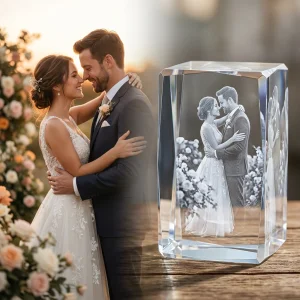
Two weeks later, a padded package arrived at Isla's doorstep. Inside rested a thick slab of Absolute Black granite, cool and heavy in her hands. David's face smiled back at her with clean clarity, framed by his favorite line of poetry written in vector-etched script.
She carried the stone into the garden, clearing a flat resting space amid the damp soil beneath the hydrangeas. The black stone stood out against soft blue petals and deep brown mulch. Winter frost would come again, but granite withstands freeze-thaw cycles without flaking. Isla sat on her bench, folded her hands, and watched the afternoon light catch the polished stone.
Why does an unpainted laser engraved granite memorial fade when it rains?
Unpainted laser engraving creates microscopic surface fractures that reflect light, making the etched areas look bright white. When rainwater lands on the stone, it penetrates these tiny crevices and replaces the trapped air. This eliminates the light reflection, temporarily turning the design dark until the moisture evaporates. Applying an exterior white litho paint fill prevents this issue entirely.
Can photo portraits be etched onto light grey granite stones?
Light grey granite offers low visual contrast because the frosted white laser marks match the light background color of the stone. Photographs etched onto grey granite appear faint and washed out. For clear photo portraits, Absolute Black granite is required. If grey stone must be used, dark paint fills are necessary to create readable contrast.
How long does a laser etched granite plaque last outdoors?
Granite is extremely durable, resisting rain, weathering, and severe freeze-thaw cycles. The physical micro-fractures etched into the stone last for generations without degrading. Exterior-grade acrylic paint fills applied to the etching typically last 10 to 15 years before requiring a minor touch-up, while the underlying laser-engraved stone design remains permanent.