Taming Entryway Clutter with Custom Wooden Pet Gear Racks
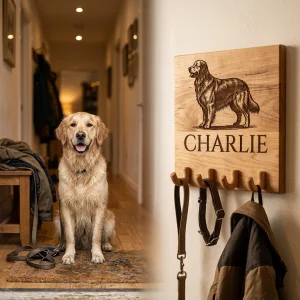
Freya stepped through her front door on a rainy Tuesday evening, holding a soaking wet Golden Retriever named Barney. Her boot caught on a tangled heap of nylon leads, waste bag rolls, and a drenched dog coat resting on an entry chair. Barney shook his fur, spraying muddy water across the drywall. The flimsy plastic hook strip she bought online months ago had ripped free from the wall last week, leaving behind two ugly holes. She needed a permanent wall storage system built to handle heavy daily wear.
Instead of buying another disposable plastic organizer, Freya built a custom setup. She chose solid wood storage units featuring laser engraved dog gifts that combine structural strength with clean visual design. Her new entryway wall now holds a multi-hook leash rack, dedicated coat pegs, and an integrated feeding schedule board that keeps her family organized.
Selecting Solid Hardwoods Over Thin Plywood
Material selection dictates how long a pet organizer lasts. Cheap online sellers often use 1/8-inch Baltic birch plywood. That thin material bends under tension, splits around screw holes, and delaminates when exposed to damp dog gear. Hanging a heavy wet harness on a thin plywood peg eventually snaps the wood fiber.
Freya picked 3/4-inch solid hard maple for the base rack and kiln-dried beechwood for the mounting pegs. These materials handle daily abuse without breaking down.
- Hard Maple: Dense grain structure resists splintering under direct pulling forces and holds deep laser engraving marks without crumbling.
- Beechwood: High shear strength allows a 2-inch peg to hold up to 15 pounds of wet winter dog jackets without sagging.
- Structural Durability: Solid lumber retains its mounting tension even if you move the rack to a new wall location later.
Laser Settings for Sharp Silhouettes and Text
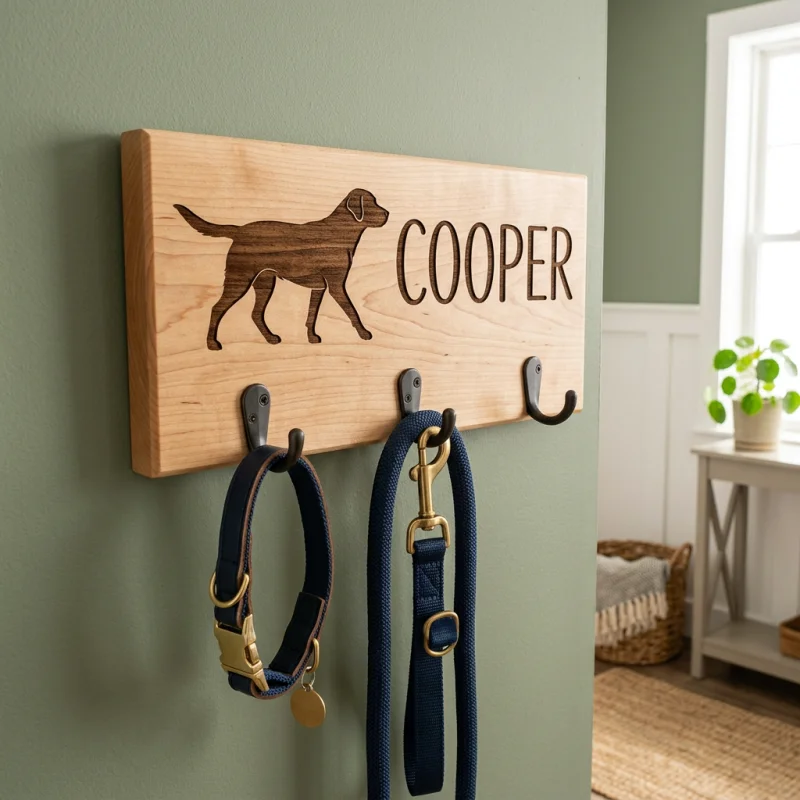
Achieving clean graphics on hardwood requires precise laser parameters. The engraver used a 50-watt CO2 laser with a raster setting of 400 DPI. Setting the raster resolution to 400 dots per inch creates fine micro-shading, capturing the subtle coat texture of Barney's breed silhouette without charring the surrounding maple substrate.
To outline the silhouette and burn Barney's name into the wood, the machine switched to vector marking mode at 18% power and a speed of 30 millimeters per second. This low-heat pass sharpens the edges of the lettering. Excessive power causes soot bleeding, which ruins small letter loops in dog names. The sharp contrast between the pale hard maple and the dark charred engraving makes the text readable from across the hallway.
Surface Preparation and Protective Coatings
Unfinished wood absorbs moisture from damp leashes, causing grain raising and dark mold spots within weeks. Pre-sanding is mandatory before burning the graphic. The maple board was sanded down to 220 grit. Smooth surface preparation stops carbon smoke stains from embedding into porous wood fibers during rastering.
After engraving, a quick swab with isopropyl alcohol cleans off loose carbon soot. Three coats of clear satin polyurethane protect the finished product. The clear finish coats the engraved recessed lines, allowing damp leads to hang against the board for hours without raising the wood grain.
Hardware Installation and Weight-Bearing Specs
A pet gear rack is only as reliable as its wall fasteners. Heavy leather leads, brass clasps, reflective harnesses, and winter coats add up quickly. A proper installation prevents the unit from tearing out of drywall.
Freya routed two deep keyhole slots into the back of the 3/4-inch maple board. Using keyhole slots allows the rack to flush-mount directly against the wall without visible screw heads. She secured the rack using two zinc drywall anchors rated for 50 pounds each.
- Lower cast metal hooks organize short training leads, flashlights, and poop bag dispensers.
- Upper 2-inch beechwood pegs hold heavy winter jackets and weighted safety vests.
- An acrylic feeding schedule board mounts alongside the rack, featuring a laser-etched dry-erase grid to track morning and evening meals for family members.
When shopping for personalized pet gifts, prioritizing thick hardwood construction, clean 400 DPI laser work, and protective sealers guarantees that your entryway stays organized for years.
What is the best wood thickness for a wall-mounted leash rack?
Use solid hardwood that is at least 3/4-inch thick. Avoid 1/8-inch or 1/4-inch plywood, as thin layers flex and split under the weight of heavy metal hardware and wet dog coats.
How do you prevent laser engraving from smudging on wooden pet boards?
Pre-sand the wood to 220 grit before engraving, clean the burnt lines with isopropyl alcohol to remove carbon soot, and coat the board with three layers of clear polyurethane sealer.
How much weight can custom beechwood coat pegs hold?
When anchored into a 3/4-inch hardwood backer board and mounted with 50-pound wall anchors, 2-inch beechwood pegs support up to 15 pounds per peg.