7 Annual Sales Milestone Trophy Designs for Executive Achievements
Grace sat at her desk at 7:15 PM, holding a scratched acrylic sample block. It felt lightweight and cheap. Marcus, her Vice President of Enterprise Sales, had just closed a $14.2 million recurring revenue contract. Giving him a flimsy piece of plastic or a surface-printed plaque felt like an insult. Last December, the company handed out budget soda-lime glass awards. Within three months, two broke from subtle thermal stress near south-facing conference room windows. The silkscreened graphics on another peeled away after routine dusting.
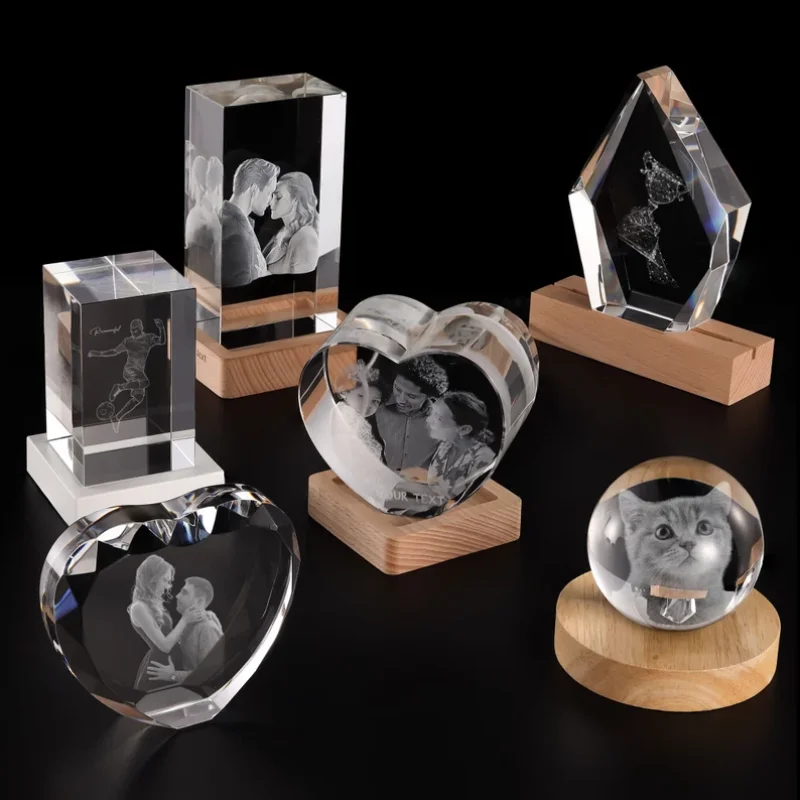
Marcus needed something permanent. Grace wanted weight, optical clarity, and precision engineering that matches an executive milestone. She abandoned basic surface-engraved plaques and began evaluating sub-surface 3D laser-engraved K9 optical crystal obelisks.
Material Integrity: K9 Optical Crystal vs. Cheap Glass
Most commercial awards use basic soda-lime glass. That material contains iron impurities, creating a muddy green tint across bevels. More critically, soda-lime glass develops microscopic air bubbles during mass casting. When hit with high-energy lasers, those internal inclusions explode, forming ugly spiderweb cracks.
Grace specified VHK/K9 optical grade crystal for the executive series. K9 crystal uses a lead-free potassium silicate formula that delivers an exceptional refractive index of 1.5168. It's completely colorless, perfectly dense, and inspected under polarized light for zero internal inclusions.
- Edge Beveling Tolerance: Machine-ground and hand-polished edges maintained to tight +/- 0.1mm tolerances.
- Thermal Stability: Free from internal stress lines, preventing spontaneous thermal fractures under direct sunlight.
- Optical Clarity: Over 99% light transmission ensures zero chromatic distortion across the crystal body.
The Physics of Subsurface Etching: 532nm DPSS Lasers
How do you engrave the center of a glass block without scratching its outer surface? Grace toured the production facility to verify the process. The answer lies in non-linear optical absorption.
Engineers use a 532nm green Diode-Pumped Solid-State (DPSS) laser. The focal lens directs the laser beam through the exterior glass surface without causing damage. At the exact focal point inside the K9 block, energy density spikes. This creates a localized micro-fracture measuring between 10 and 50 microns. By firing thousands of pulses per second, the laser builds a precise three-dimensional point cloud inside the crystal structure.
Raster images like JPEGs or low-res PNGs fall apart during this conversion. They lack spatial depth and result in sparse, cloudy micro-fractures. Grace supplied clean vector artwork (.EPS or .SVG format). This allowed software engineers to plot high-density point clouds containing up to 500,000 individual coordinate points per cubic inch. The result is a sharp, solid volumetric graphic suspended inside the solid crystal column.
7 Annual Sales Milestone Trophy Designs for Executive Tiers
Grace categorized her recognition program into seven distinct architectural forms, assigning each design to a specific revenue threshold.
1. The Monolithic Hex Obelisk
Designed for $10M+ enterprise legends. Standing 11 inches tall, this six-sided obelisk features sharp 45-degree hand-polished bevels. The internal 3D point cloud renders a volumetric company crest alongside floating revenue typography that appears to hover in mid-air.
2. The Tiered Pinnacle Tower
A stepped structural tower designed for cumulative multi-year achievements. Each tier represents a $2.5M growth step. The subsurface laser engraves milestone dates into distinct internal planes, creating a multi-dimensional timeline inside a single piece of crystal.
3. The Faceted Prism Column
This design uses a rhomboid top angle cut to act as an internal mirror. Light entering from office windows hits the top facet and refracts downward, illuminating the internal 3D laser-engraved details without external lighting arrays.
4. The Archival Block Obelisk
An ultra-heavy 80mm solid crystal block built for complex 3D product renders. Grace selected this form factor to etch a 1:1 scale micro-model of the medical device Marcus sold during his record deal, complete with internal mechanical detail.
5. The Helix Revenue Tower
A cylindrical K9 pillar housing an intricate double-helix data stream point cloud. It symbolizes compounded annual growth and fits well on modern minimalist executive desks.
6. The Beveled Horizon Pillar
A dual-material design featuring a dense black crystal pedestal fused seamlessly to a clear K9 obelisk body. The dark base absorbs excess light, giving internal point clouds crisp contrast under bright office lighting.
7. The Asymmetric Zenith Obelisk
Cut with a sharp, slanted roofline angled at 30 degrees. This geometry faces upward toward a seated executive, ensuring full visibility of internal etching when viewed from an office chair.
Light Refraction: 2D Surface Engraving vs. 3D Subsurface Etching
Surface-frosted 2D laser etching relies on shallow glass chipping. Against a bright glass wall or sunny window, surface engraving disappears because light passes straight through the shallow cuts. Dust and fingerprint oils also accumulate in surface grooves, dulling the text over time.
Subsurface 3D laser micro-fractures sit completely sealed inside the non-porous crystal. Fingerprints wipe off the exterior with a microfiber cloth without touching the graphic. Because the point cloud consists of thousands of microscopic interior facets, ambient light refracts from every angle. The design stays visible against dark walnut paneling, bright drywall, or floor-to-ceiling glass backdrops.
Procurement Checklist: Vector Prep and Lead Times
Ordering custom corporate recognition trophies requires clear technical milestones. Grace established a four-step procurement routine to guarantee delivery before the annual sales gala:
- Vector Art Conversion (Day 1-2): Convert flat logo graphics into 3D CAD coordinate files (.STEP or .IGES). Ensure point cloud density reaches at least 350,000 points per cubic inch for thick structural elements.
- 3D Digital Proofing (Day 3): Inspect rotational 360-degree digital proofs to check font legibility and point spacing.
- Laser Calibration & Production (Days 4-8): Run 532nm DPSS lasers at calibrated pulse speeds to prevent micro-fracture thermal bleed.
- Quality Inspection (Days 9-10): Examine each finished award under high-intensity optical lamps for edge bevel tolerance (+/- 0.1mm) and zero surface pitting.
When Marcus stepped onto the stage at the annual gala, Grace handed him the Monolithic Hex Obelisk. The 8-pound optical crystal caught the spotlight, casting a bright refraction pattern across the stage podium. The internal 3D enterprise model looked suspended in fluid glass. Marcus ran his thumb across the glass exterior—completely smooth, perfectly cold, and built to outlast his career.
How far in advance should I order custom 3D laser engraved crystal awards?
Allow 10 to 14 business days from final 3D vector proof approval. Custom volumetric point cloud conversion takes 48 hours, while laser etching and manual quality control require additional production buffers for bulk corporate orders.
What file formats are required for 3D subsurface crystal engraving?
Vector files such as .EPS, .AI, or .SVG are required for corporate logos and text. For custom 3D product models or architectural renders inside the glass, supply .OBJ, .STEP, or .STL CAD files to generate precise point cloud coordinates.
Will subsurface 3D crystal etchings fade or turn yellow over time?
No. Subsurface micro-fractures reside inside non-porous K9 optical crystal, completely protected from air, moisture, and cleaning chemicals. Unlike cheap acrylic or resin trophies, K9 glass contains zero synthetic polymers and will not yellow or degrade under UV exposure.