Sub-Surface 3D Crystal Engraving for Cosplay Championship Trophies: Technical Manufacturing Guide
Converting Stage Photography to 3D Point Cloud Density Maps
Capturing a winning cosplay performance in solid optical glass requires converting flat pixels into three-dimensional coordinates. High-resolution stage photography provides the source data. Software algorithms calculate depth vectors across costume geometry, turning specular highlights and fabric contours into spatial coordinates.
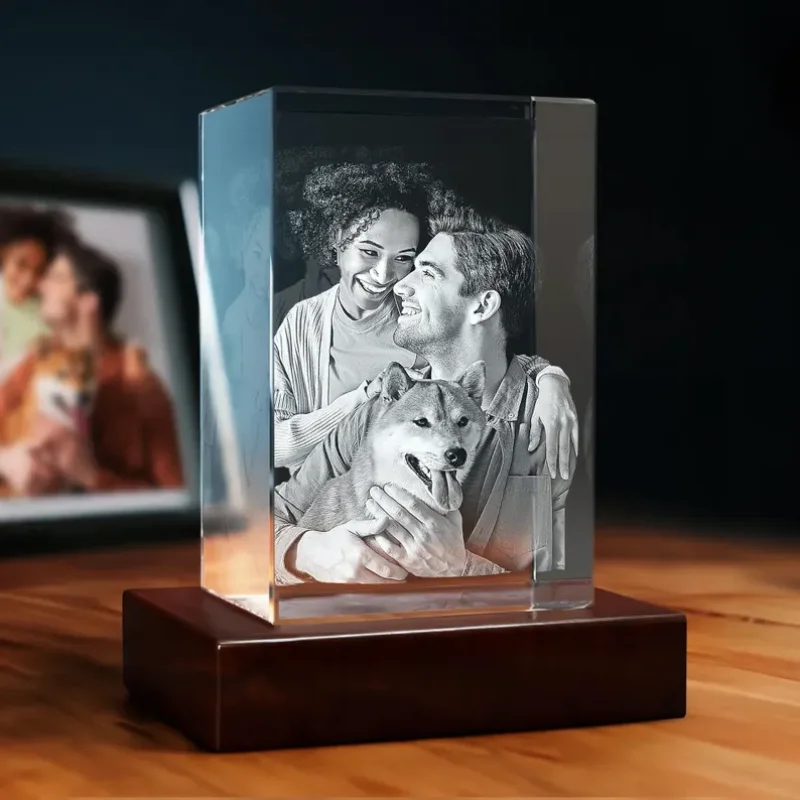
A custom 3D laser engraved photo crystal relies on point density rather than continuous lines. Conversion software generates an internal geometry model consisting of 1.5 million to 4 million precise points. Each coordinate represents an individual micro-fracture inside the glass block.
Shadows degrade coordinate accuracy. Deep shadows under wide armor pauldrons or inside heavy prop recesses lack color information. This forces software to estimate depth, which creates hollow patches in finished glass. High-contrast images taken with dedicated rim lighting yield clean depth maps with tight coordinate spacing down to 10 microns between points.
K9 Optical Crystal Selection and Surface Preparation
Sub-surface laser engraving demands pure optical substrate. Standard soda-lime window glass contains iron impurities that absorb laser energy unpredictably, causing structural cracks along internal thermal fault lines.
Production requires synthetic K9 crystal (borosilicate crown glass) with 99.9% optical purity. K9 glass maintains high transmission rates in the visible spectrum with a refractive index of 1.517. Block dimensions for a standard cosplay championship trophy measure 80x80x120 mm, weighing roughly 1.9 kilograms.
Before laser processing, blocks undergo a six-step mechanical polish using cerium oxide slurry to achieve optical flatness (surface quality 60/40 scratch-dig standard). Polished surfaces allow the laser beam to pass through without refraction distortion, focusing energy within the interior mass.
Sub-Surface Micro-Fracturing Mechanics (532nm DPSS Green Laser)
Surface lasers, like 10,600 nm CO2 systems, etch glass through thermal shock on the outer boundary layer. The CO2 beam heats surface silica until it fractures, leaving a rough exterior texture. This process cannot penetrate inside glass.
Sub-surface engraving uses a Diode-Pumped Solid-State (DPSS) green laser operating at a 532 nm wavelength. K9 crystal is transparent to 532 nm light at low energy densities. The system focuses the laser beam through a high-numerical-aperture galvo lens, concentrating peak power density exceeding 100 megawatts per square centimeter at an exact coordinate inside the crystal interior.
At this focal point, non-linear optical absorption occurs. The high electric field strips electrons from atoms, creating micro-plasma. Rapid thermal expansion forms a controlled micro-crack measuring 20 to 50 microns across. The outer surface of the glass block remains undamaged because energy density outside the focal point stays below the dielectric breakdown threshold of K9 glass.
5 Crystal Glass Laser Engraving Ideas for Champions
Translating stage victories into permanent glass displays works best with specific composition styles designed for 3D point cloud rendering.
- Full-Body Victory Pose: Isolate the winning stage pose from the background. Convert the entire outfit, weapon props, and footwear into a suspended 3D point cloud centered within an 80x80x120 mm block.
- Close-Up Armor Texture & Helmet Details: Focus on intricate craft details like filigree, foam textures, or LED-embedded helmets. High point-density processing captures minute surface details on 1:1 scale close-ups.
- Prop and Weapon Focus: Isolate large build props—such as 6-foot broadswords or mechanical wings—and render them diagonally across a rectangular K9 block for maximum scale.
- Duo or Group Performance Scene: Map multiple performers in their winning stage positions. Depth mapping preserves correct spatial distances between team members.
- Stage Moment with Trophy Base: Combine a 3D point cloud of the cosplayer with flat 2D vector text engraved near the bottom detailing the event name, placement, and year.
Laser Parameters and Glass Specifications
The table below compares technical parameters used in sub-surface K9 crystal engraving versus standard surface laser marking.
| Parameter | Sub-Surface 3D Engraving | Surface Engraving |
|---|---|---|
| Laser Source Type | 532 nm DPSS Green Laser | 10,600 nm CO2 Laser |
| Glass Substrate | Optical K9 Crystal (99.9% Pure) | Soda-Lime / Float Glass |
| Point Pitch Resolution | 10 to 15 microns | 100 to 250 microns |
| Internal Point Cloud Density | 1,500,000 – 4,000,000 points | N/A (2D Surface Etch) |
| Micro-Fracture Size | 20 – 50 microns | 150 – 300 microns |
| Standard Block Size | 80 x 80 x 120 mm | Variable sheet thickness |
Base Illumination and Optical Display Integration
Micro-fractures inside K9 crystal appear opaque white under ambient light because the cracked surfaces scatter light rays randomly. To maximize visible contrast, display the crystal on an illuminated base.
Dual RGB LED light bases project light upward through the bottom face at a 90-degree angle to the front viewing surface. As light hits each internal micro-crack, total internal reflection scatters light toward the viewer's eye. Warm white (3000K) highlights high-density armor detail, while cool blue (6500K) enhances edges on translucent weapon prop renderings.
Image Submission Guidelines and Technical Limitations
Submitting images for a cosplay championship trophy requires clean source files to avoid spatial rendering errors.
Optimal Source Photo Parameters:
- Resolution: 300 DPI or higher (minimum 3000x2000 pixels).
- Lighting: High contrast, key light set at 45 degrees, strong backlighting or rim lighting to delineate shoulder pauldrons, capes, and wig silhouettes from the background.
- Format: RAW or uncompressed PNG. JPEG compression creates blocky artifacts that translate into erroneous micro-fracture dots.
Technical Limitations:
- Translucent fabrics like organza or sheer lace don't generate clean depth maps and appear as sparse dot noise inside the glass.
- Low-polygon CAD models exported directly from game files without smooth shading result in blocky, faceted crystal models. Subdivide meshes before submitting.
- Deep pitch-black shadows lack depth data. Photographers must fill dark shadows with soft fill light during the stage shoot.
Can you engrave a 3D crystal directly from a standard 2D smartphone photo?
Yes. Spatial conversion software uses depth estimation and edge recognition to generate a 3D point cloud from a single 2D photo. While native 3D files or multi-angle photos provide higher depth precision, high-resolution 2D stage photographs with clear lighting yield sharp internal renderings.
Why doesn't the laser damage the outside surface of the crystal during internal engraving?
The 532 nm green laser beam passes through the outer glass surface without damaging it because energy is spread over a wide surface area. Internal optical lenses focus light energy into a tight point deep inside the glass block. Micro-fracturing only occurs at the exact spot where energy density exceeds the physical breakdown limit of the optical glass.
How do you clean and maintain a 3D laser engraved photo crystal trophy?
Because the laser engraving resides entirely inside the sealed interior of the K9 crystal block, the image never degrades, fades, or scratches. Clean outer glass surfaces with isopropyl alcohol or standard glass cleaner using a lint-free microfiber cloth. Avoid abrasive pads that can scratch polished external faces.