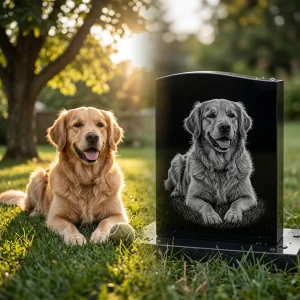
7 Laser-Engraved Stone Garden Markers to Honor Your Dog's Favorite Yard Spot
Caleb stood near the base of the white oak tree, looking down at a patch of dead clover. That exact spot was where Barnaby, his seven-year-old rescue mutt, tracked sunny spots from 10:00 AM to 3:00 PM every afternoon. Barnaby passed away in October. By November, Caleb tried marking the space with a painted wooden sign. Snow rotted the pine board before February. Next came a molded resin plaque from a big-box store. It cracked under the first zero-degree frost, turning yellow and brittle within weeks.
He needed something built to handle midwestern ice storms and summer humidity. He decided to craft a custom pet memorial stone using real rock and targeted laser etching.
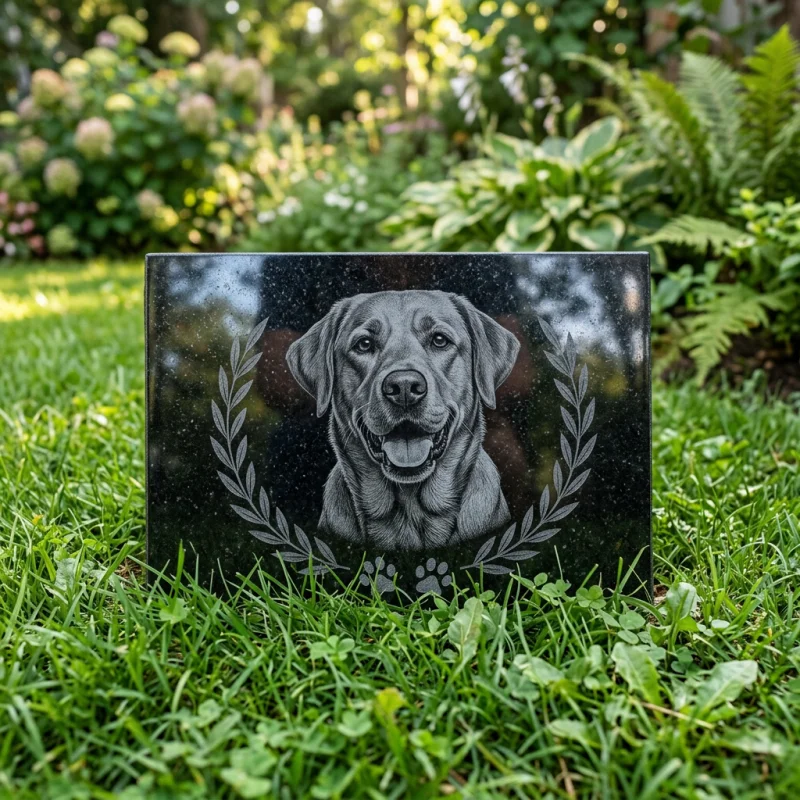
1. Absolute Black Granite Tile for Fetch Zones
Caleb started with a 12x12-inch slab of absolute black granite, polished on one face. Dark granite offers the highest contrast available for outdoor stone work. When hit by a focused laser beam, the dark polished surface chips away in micro-fractures. These reveal a bright gray tone against the dark stone background.
2. Smooth River Rocks for Yard Edging
Along the fence line where Barnaby used to slide to a halt after catching tennis balls, Caleb placed smooth basalt river stones. These naturally dark rocks range from 6 to 8 inches across. They don't offer the glass-like smoothness of granite tile, but their rounded shapes merge naturally into mulched flowerbeds and lawn borders.
3. Technical Setup: Power, Resolution, and Laser Types
Etching hard natural rock requires precise thermal output. In his workshop, Caleb set up an 80W CO2 glass-tube laser system. Stone does not burn or vaporize like hardwoods. Instead, silica and quartz crystals inside the stone micro-fracture under rapid thermal shock.
- Laser Power Source: A 50W to 100W CO2 laser tube operating at 10.6 microns wavelength provides the proper heat absorption on mineral surfaces.
- Engraving Modes: Use raster photo engraving for portrait work. Reserve vector line etching for typography outlines and line art.
- Resolution Settings: Keep raster files between 300 DPI and 600 DPI. Going higher than 600 DPI places heat pulses too close together, causing adjacent micro-fractures to overlap and flake away, leaving a blurry gray mess.
- Speed and Power Ratio: Run an 80W tube at roughly 300 mm/sec speed with 75% to 80% power output on dark river rocks.
4. Preparing Photos and Paw Prints into Vector Files
Raw smartphone photographs cannot go straight to laser engraved stones without prep work. Caleb took a high-resolution photo of Barnaby catching a flying disc and brought it into photo editing software.
He stripped the background trees out, isolated Barnaby's profile, and boosted the mid-tone contrast. He then ran a Jarvis dithering filter at 300 DPI to translate shade gradients into strict black-and-white pixel dots. For a second marker, Caleb used a 2D paw print stamped in non-toxic black ink from Barnaby's final vet visit. He scanned the ink print at 1200 DPI, converted the raster edges into a clean vector file format (.SVG), and scaled it up without losing edge crispness.
5. Paint Fill and Sealing for Outdoor Weatherproofing
Micro-fractures look bright gray in indoor light. Out in the yard, rain fills those microscopic cracks. Water neutralizes light refraction, making the engraved image vanish until the rock dries out completely. Caleb fixed this issue with a simple two-step finishing method.
First, he sprayed outdoor high-viscosity white acrylic paint directly across the raw engraving. While the paint was wet, he dragged a flat rubber squeegee across the polished granite face, scraping away surface excess while leaving paint trapped in the laser-etched lines. Once dry, he applied a coat of siloxane stone sealer. The siloxane prevents standing rainwater from penetrating the rock grain while remaining vapor-permeable.
6. Stones to Avoid: The Frost-Thaw Trap
Some rock types break down quickly when left exposed to weather outdoors. Caleb avoided these materials after testing sample scraps in his freezer:
- Porous Limestone: Limestone absorbs ground water like a sponge. When winter temperatures drop below 32°F, trapped water freezes, expands, and splits the laser-engraved details apart.
- Soft Sandstone: Individual sand grains flake away under low-power laser thermal shock. Heavy rainfall washes fine details away in less than a year.
- Layered Slate: Water creeps between slate layers, causing wide sheets of stone to spall and separate during spring thaw cycles.
7. Installing the Markers in the Yard
Caleb set the large granite marker right into the sod where Barnaby slept. He dug down four inches, dumped a two-inch base of crushed paver gravel for drainage, and seated the granite slab flush with the top of the turf. Lawn mower wheels pass right over it without scraping the polished face.
Smaller laser engraved stones now sit scattered along the edge of the mulch bed nearby, holding up through heavy rain, midsummer sun, and deep winter freezes.
What is the best type of stone for laser engraving outdoor pet memorials?
Absolute black granite and dense dark basalt river stones are the best options. Absolute black granite provides maximum visual contrast when laser-microfractured, while dark basalt river rocks offer high durability without flaking during winter freezing cycles.
Can you laser engrave a real photo onto a natural river stone?
Yes, but the photo must be processed specifically for stone etching. High-resolution photos should be converted to 1-bit dithered images (such as Jarvis or Stucki dithering) at 300 to 450 DPI. Natural river rocks require smooth, flat surface areas to avoid distortion across uneven ridges.
How do laser engraved custom pet memorial stones hold up against winter freeze cycles?
Dense, non-porous stones like granite and basalt resist water absorption and withstand freeze-thaw cycles easily. Applying an outdoor white acrylic paint fill inside the etched lines and sealing the stone surface with a siloxane sealer prevents water build-up inside the laser micro-fractures, stopping ice expansion from cracking the detail.