7 Engraved Crystal Glass Keepsakes to Honor Late Loved Ones at Your Wedding Memorial Table
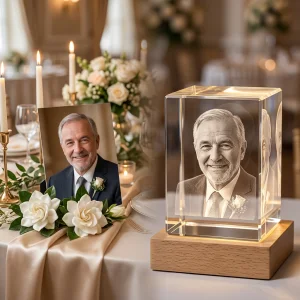
Aurora sat at her kitchen table six weeks before her October wedding, surrounded by fabric swatches, floral drafts, and three silver photo frames. Inside the frames were paper prints of her late father, Arthur, and her grandmother, Rose. Every time she arranged the frames on her mock memorial display, something felt off. Outdoor breezes at her barn venue would knock light frames flat. Paper prints looked temporary. She wanted a permanent, quiet way to keep her missing family members close during the ceremony without making the table look like a roadside shrine.
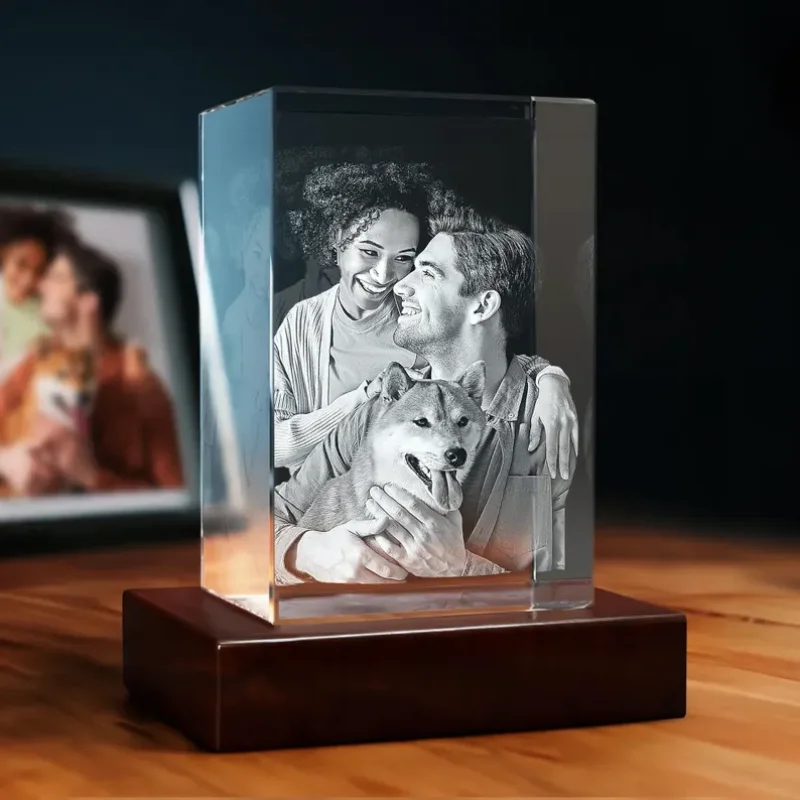
Her search led her to subsurface 3D laser-engraved K9 optical crystal blocks. Rather than sitting on top of paper or ceramic, these floating portraits remain suspended inside clear optical glass.
Subsurface laser engraving never breaks the exterior surface of the block. A computer-guided green laser operating at a precise 532-nanometer wavelength passes straight through the polished exterior of high-density K9 optical crystal. By focusing energy on specific coordinates deep inside the glass, the laser creates controlled micro-bursts. These tiny physical fractures form a dense point-cloud. Each individual micro-burst catches surrounding light, compiling hundreds of thousands of dots into a fully three-dimensional image suspended inside solid glass.
When Aurora uploaded her favorite photograph of her father from 1994, the system flagged it. The scan was only 72 DPI with low contrast around his dark suit jacket. Laser technicians convert 2D flat photographs into 3D CAD point-cloud files using manual depth-mapping software. To render spatial layers clear—such as the distance between a lapel, a nose, and background shadows—the source photo needs a minimum resolution of 300 DPI.
Low-contrast vintage photos demand digital restoration first. Technicians boost line definition, balance grayscale histograms, and isolate subjects from dark backgrounds before running the point-cloud conversion algorithm. Aurora had her father's vintage photo restored, sharpening the focal planes and re-scanning it at high resolution.
1. The Classic Beveled Rectangle Block
Aurora chose a 3x2x2-inch K9 optical rectangle for her father's portrait. Straight vertical edges and hand-polished bevels refract ambient room light into subtle prism bursts along the borders. This geometric block gives the point-cloud software room to build deep facial contours from ear to ear without distorting the outer edges.
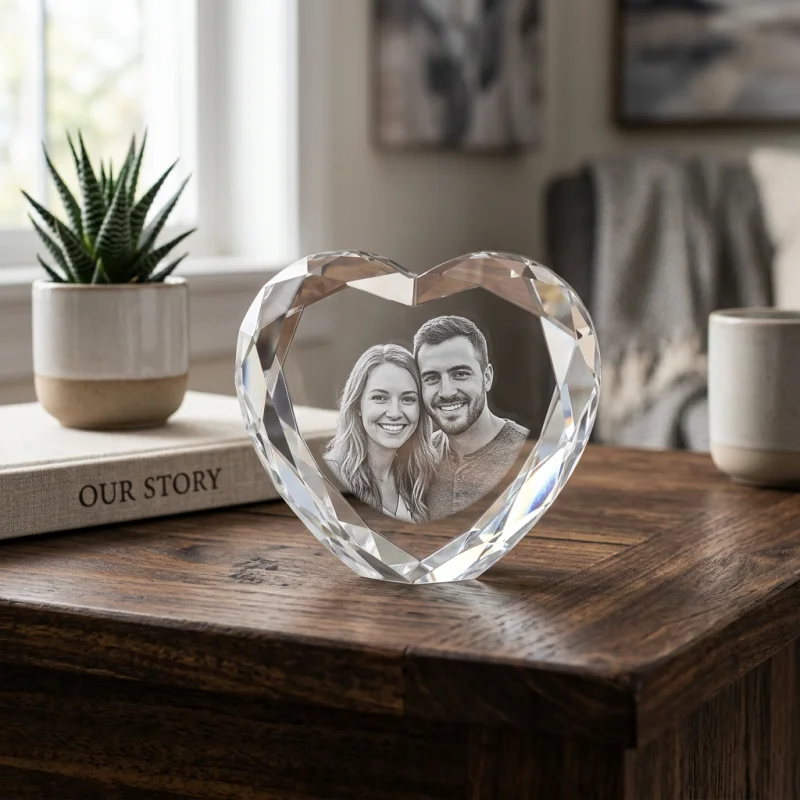
2. The Faceted Heart Crystal
For couples honoring grandparents who shared decades of marriage, heart-shaped optical glass creates an intentional center for the table. Multi-faceted cut edges catch nearby candlelight. The wide horizontal center fits two-person portraits comfortably across a single plane.
3. The Vertical Tower Block
Taller blocks measuring 4x3x2 inches suit full-length or half-body photographs. Aurora selected this shape for her groom's late mother, capturing her standing in her 1980s lace wedding gown. The added height gives the 532nm laser vertical room to project her dress layers without squishing the facial proportions.
4. The Arch-Top Optical Crystal
Arch-top blocks feature a rounded upper curve reminiscent of stained-glass windows or garden gates. The curved top softens the sharp corners typical of formal reception tables. They look balanced when placed directly in front of taller floral arrangements or lit pillar candles.
5. The Floating Cube
Cubes offer equal optical depth from every side. When set on an illuminated base, a cube allows guests to view the suspended point-cloud from multiple angles as they walk past. Depth mapping creates natural profile contours inside the glass block that shift visually depending on your perspective.
6. The Slim Ice-Block Plate
If your memorial display shares a small table with a guest book or card box, thin glass plates save precious surface space. These self-standing blocks hold sharp frontal detail while maintaining a slim footprint under one inch deep.
7. The Hexagonal Pillar
Six polished vertical faces bounce surrounding light directly through the internal engraving. Geometric pillars suit multi-person group portraits, giving laser depth software spatial room to stagger multiple faces across different background and foreground layers.
Setting Up the Display: Lighting, Placement, and Safety
Clear glass alone can look dim under flat overhead lighting. Aurora placed each crystal piece on a warm light base.
Color temperature alters the final look. Cold blue LEDs (5000K-6000K) look clinical and bleach out small micro-burst details inside the glass. Warm LED bases set at 3000 Kelvin penetrate the point-cloud evenly, filling every micro-fracture with a soft flame-colored glow that enhances internal spatial depth.
Simple layout guidelines for your memorial space:
- Cover the table with dark matte linen or velvet to maximize contrast behind clear glass blocks.
- Place warm 3000K LED light bases beneath each block to illuminate the inner point-cloud without shining bright light into guests' eyes.
- Use low-heat LED tea lights near glass keepsakes rather than wax candles to prevent black soot from settling on polished surfaces.
- Position taller vertical blocks behind smaller flat pieces so every portrait remains visible.
Sunlight Warning and Optical Safety
High-purity K9 optical glass acts like a powerful magnifying lens. Never place solid crystal keepsakes in direct sunlight—a real risk during outdoor summer ceremonies or next to south-facing venue windows. Focused sunlight streaming through thick glass can act as an ignition focal point, scorching table runners, dry florals, or wooden furniture within minutes. Keep all crystal displays under shaded covers, indoor spaces, or covered tents.
What image file format works best for 3D laser engraving?
High-resolution JPEG, PNG, or TIFF files with a minimum resolution of 300 DPI yield the cleanest results. Strong lighting and distinct contrast between the subject and the background allow technicians to map 3D point-cloud depth accurately.
Can old black-and-white photos be converted into 3D crystal engravings?
Yes. Vintage black-and-white prints convert cleanly into 3D files. Faded or low-contrast prints need digital restoration first to sharpen facial features before running the depth-mapping software.
Why is K9 optical crystal used instead of standard glass?
K9 optical crystal offers exceptional clarity, high density, and zero internal air bubbles or lead impurities. This structure lets the green 532nm laser pass cleanly through the outer surface to create clean internal micro-bursts without fracturing the outer block.
How do you clean fingerprint smudges off crystal keepsakes on the wedding day?
Wipe the block using a lint-free microfiber cloth lightened with a spray of alcohol-based glass cleaner. Avoid paper towels or rough fabrics that leave lint behind or scratch polished outer bevels.