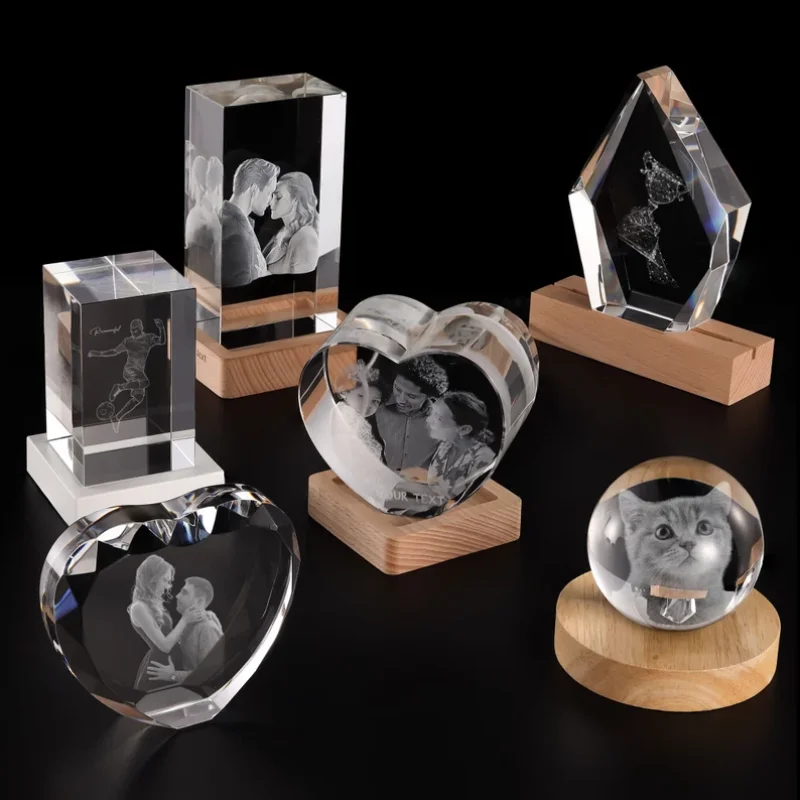
Subsurface Crystal Glass Laser Engraved Keepsakes for Top Sales Performer Trophies
Hannah sat at her desk staring at last year's award photos. The Q4 sales banquet was 22 days away. 14 sales representatives had smashed their annual targets, generating $18.4 million in net new revenue. Yet, the acrylic awards sitting on her desk told a miserable story. Shipping boxes had scuffed their edges. Room lights turned the surface a cloudy, pale yellow tint. The engraved letters looked like cheap stamped plastic.
Hannah refused to hand out disposable plastic for an $18 million milestone. She called her corporate awards vendor to switch to lead-free K9 optical crystal and subsurface laser engraving. Custom 3D laser engraved glass awards would give her team heavy, permanent pieces that stay clear for decades.

Subsurface Micro-Burst Physics vs. Cast Acrylic
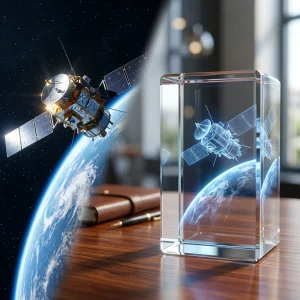
Subsurface engraving never touches the outer face of the glass. A focused green laser beam at a 532-nanometer wavelength passes straight through the polished exterior of lead-free optical crystal. At the exact focal coordinate inside the glass, energy density spikes. This causes a microscopic thermal explosion called a micro-burst. The localized heat vaporizes a tiny point inside the crystal volume, leaving a micro-fracture that reflects light.
By firing thousands of pulses per minute, the laser builds a precise point cloud inside the solid block. The surface remains completely smooth to the touch.
Cast acrylic awards degrade quickly. UV light breaks down polymer chains, yellowing acrylic awards within 18 months. Acrylic ranks at a 2 to 3 on the Mohs hardness scale, meaning basic microfiber cleaning cloths scratch it over time. Optical K9 crystal ranks at a 6 on the Mohs scale. It resists surface scratches and maintains optical transparency indefinitely.
5 High-Impact Crystal Keepsake Formats
Hannah selected five distinct glass shapes tailored to specific sales achievements for her upcoming gala.
- The Monolith Column: Standing 10 inches tall and 3 inches thick, this heavy rectangular pillar houses a detailed 3D bar chart detailing monthly revenue growth. It's built for the annual Top Earner award.
- The Beveled Octagon Block: A 7-inch wide square with deeply angled corners. The facets capture interior light rays and multiply the suspended 3D corporate logo across eight internal viewing angles. Hannah assigned this design to President's Club qualifiers.
- The Flame Prism: Features a sharp 45-degree top bevel cutting across a 9-inch vertical body. The angled bevel acts like a magnifying lens over the interior point cloud. This format highlights the Dealmaker of the Year.
- The Faceted Mountain Peak: Cut with sharp geometric slopes that mimic alpine ridges. Internal layers show floating quota markers scaled along the vertical axis. It targets the top outbound business development rep.
- The Floating Sphere Block: A solid 6-inch optical block containing a suspended 3D globe showing international office nodes. It recognizes the Regional Sales Director of the Year.
Vector Conversion and Text Legibility Rules
Creating crisp internal graphics requires converting standard flat production assets into spatial data files. Hannah uploaded vector SVG files of the company logo and Q4 earnings performance charts. Software converts flat vector lines into 3D point cloud maps formatted as DXF or OBJ files.
Text size dictates internal legibility. Micro-text smaller than 6pt font becomes illegible inside thick glass. When laser focal points sit closer than 0.05 millimeters, micro-bursts merge together into cloudy, blurred blobs. Corporate taglines should remain at 7pt or higher. Clean sans-serif typefaces like Inter, Helvetica, or DIN retain sharp edge definition inside dense point clouds.
Laser Focal Control and Parameter Tuning
Engraving thick optical blocks without image distortion requires strict laser parameter management. Laser pulse rates must stay between 2000 Hz and 4000 Hz. Misaligned focal depth settings distort the laser beam as it penetrates deeper into thick crystal blocks. This elongation turns round micro-points into stretched oval streaks, warping internal figures.
Preventing spherical aberration across a 4-inch deep block requires adjusting the laser lens position dynamically relative to glass thickness. Subsurface energy density must remain within 1.5 to 2.5 Joules per square centimeter. Lower energy yields faint, invisible points. Higher energy causes interior thermal cracks that ruin optical clarity.
Maximizing Visual Impact with LED Lighting
Subsurface micro-fractures don't generate light; they catch and scatter ambient light rays. Dark banquet rooms obscure unlit glass awards. Hannah paired each award with a black brushed aluminum base containing 6000K cool white LEDs.
Directing light upward through the bottom face scatters light evenly across the internal point cloud, causing top sales performer trophies to glow against dark backgrounds. Warm 3000K lights give crystal a yellowish tint. RGB light strands degrade contrast across fine vector lines. Pure 6000K cool white diodes powered by internal lithium-ion batteries produce clean contrast for evening presentations.
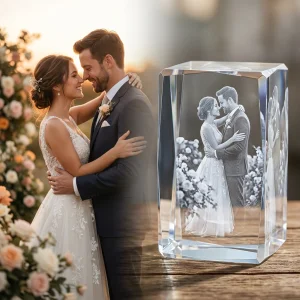
At the gala, Hannah placed 14 illuminated crystal monoliths along the head table. The cool LED light illuminated the suspended 3D performance charts inside each lead-free block. As winners raised their awards under the spotlights, the sharp glass cut through the room without a single scratch or yellow haze.
What is the minimum font size for readable text inside subsurface engraved crystal?
Keep internal text at 6pt or larger. Anything under 6pt causes adjacent micro-burst points to overlap, creating blurry text. Sans-serif fonts render clearer than serif fonts at small scales.
Why does subsurface laser crystal perform better than cast acrylic for long-term recognition awards?
Optical K9 crystal has a Mohs hardness rating of 6, preventing surface scratches during cleaning. Unlike cast acrylic, optical crystal contains zero polymer resins, so it will not turn yellow when exposed to room lighting over time.
How do you convert a 2D vector logo into a 3D subsurface crystal design?
Designers convert 2D SVG or EPS vector lines into 3D CAD mesh files (DXF or OBJ). Specialty software assigns depth layers and calculates point-cloud coordinates. The laser software then maps exact spatial coordinates for interior micro-burst points.
What LED color temperature works best for illuminating crystal trophies?
Use 6000K cool white LEDs. Cool white light scatters cleanly off internal micro-burst fractures without adding color distortion. Warm white LEDs introduce yellow tones, while RGB lighting reduces contrast inside dense point clouds.