The Photonic Science of Nacre: How Lasers Vaporize Shell Without Destroying Iridescence
Nacre, commonly known as mother-of-pearl, consists of 95% aragonite (crystalline calcium carbonate) and 5% organic biopolymers, primarily conchiolin proteins and chitin. Under an electron microscope, nacre resembles a brick wall. Microscopic aragonite tablets—300 to 900 nanometers thick and 5 to 20 micrometers wide—stack in orderly hexagonal arrays. Between these hard mineral bricks sits a thin 20 to 30 nanometer mortar layer of elastic conchiolin.
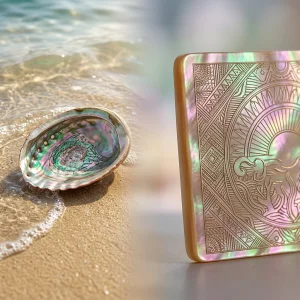
This bio-composite architecture causes iridescence. Light hits the transparent aragonite micro-sheets. Part of the light wave reflects off the top surface of a sheet. Another part penetrates through and reflects off the sheet underneath. Because individual aragonite layers match the wavelengths of visible light (400 to 700 nm), the delayed reflections interfere with each other. Constructive optical interference magnifies specific wavelengths, generating shifting pink, green, blue, and gold tones. Preserving this optical effect during laser processing requires precise photonic control. Standard engravers burn the surface. Controlled photothermal light removes material without burning the surrounding matrix.
Absorption Dynamics and Localized Micro-Ablation
Laser processing relies on converting photon energy into work. When laser light hits mother-of-pearl, three physical behaviors occur: reflection, transmission, or absorption. Structural preservation depends entirely on absorption.
Infrared photons from standard 10,600 nm CO2 lasers react heavily with water and organic molecules, but they deposit energy through gross thermal heating. The energy transfer excites lattice vibrations across the material, raising the bulk temperature above 500°C within milliseconds. Crystalline aragonite fractures under this heat. Conchiolin burns off completely.
Effective nacre laser engraving requires photochemical or cold micro-ablation. When using a UV cold laser 355nm wavelength, photon energy reaches 3.49 electron-volts (eV). This photon energy matches or exceeds the atomic bond energies of the conchiolin protein matrix. Instead of heating the shell, the ultraviolet photons break C-C and C-N molecular bonds directly. The material converts instantly from a solid phase into a localized plasma gas plume, expanding away at thousands of meters per second. The process skips the liquid phase entirely. Energy dissipates in the ejected material before heat diffuses into adjacent aragonite layers.
Comparing Laser Wavelengths for Nacre Processing
Different laser sources produce wildly different structural results on mother-of-pearl. Wavelength, pulse duration, and peak power determine whether the shell retains its luster or degrades into fragile powder.
| Laser Parameter | 10.6 µm CO2 Laser | 1064 nm Fiber Laser | 355 nm UV Cold Laser |
|---|---|---|---|
| Primary Laser Mechanism | Photothermal (Thermal Melting) | Photothermal / Near-IR Absorption | Photochemical (Direct Bond Breaking) |
| Pulse Duration | Continuous Wave or Microsecond | 1 to 200 Nanoseconds | 10 to 15 Picoseconds / Nanoseconds |
| Heat Affected Zone (HAZ) | >150 Micrometers | 40 to 80 Micrometers | <5 Micrometers |
| Ablation Threshold Energy | High (~12 J/cm²) | Moderate (~6 J/cm²) | Low (~0.8 J/cm²) |
| Surface Finish Quality | Chalky white, rough, micro-cracked | Darkened, scorch-tinted edges | Crisp, iridescent, sub-micron edge precision |
| Aragonite Crystal Integrity | Transforms to Calcite Phase | Partial Thermal Shock Cracking | Unaltered Phase Structure |
Thermal Accumulation, Heat Bleaching, and Delamination
High-power continuous lasers ruin delicate shell work through two catastrophic failures: thermal bleaching and structural delamination.
Thermal bleaching happens when heat exceeds 250°C. Conchiolin, the protein binder, pyrolyzes into volatile organic compounds. Without this dark protein mortar, light scatters randomly inside the calcium carbonate structure instead of reflecting in parallel paths. The shell loses its iridescence, turning opaque and chalky white. At 400°C, a secondary phase transition occurs: aragonite transforms into calcite, a softer crystal form with lower optical density.
Structural delamination stems from mismatched thermal expansion coefficients. Aragonite expands along its c-axis at 22 × 10⁻⁶ / K, while conchiolin expands at a vastly different rate. Thermal spikes generate shear stress between the nano-tablets. The mortar snaps. Whole layers lift off like wet plywood left in the sun. Using ultra-short pulse frequencies (between 30 kHz and 80 kHz) on a UV cold laser 355nm allows the sub-surface matrix to cool below the 60°C thermal threshold between light pulses.
Material Limitations and Processing Hazards
Precision light control expands options, but mother-of-pearl imposes hard mechanical limits. Knowing when to avoid laser marking saves valuable shell blanks.
Veneers under 0.2 millimeters thick present major risks. Warping occurs if pulse energy exceeds 15 microjoules, as residual stress inside the organic matrix releases rapidly. Shell sourced from freshwater mussels exhibits denser conchiolin layers than marine Pinctada maxima (white mother-of-pearl). Freshwater shells absorb UV light faster, requiring a 15% reduction in average power to prevent edge yellowing.
Health safety demands strict engineering controls. Laser ablation of nacre generates airborne dust particles under 2.5 micrometers in diameter. Inhaling pulverized calcium carbonate and burnt protein fragments causes severe respiratory irritation and long-term lung scarring. Laser workstations require dedicated Class M HEPA filtration systems with active carbon stages to capture fine dust and organic fumes.
Frequently Asked Questions
Can standard desktop CO2 lasers achieve detailed engravings on mother-of-pearl jewelry?
No. Standard CO2 lasers deliver heavy thermal energy that burns the conchiolin binder and turns aragonite into chalky white calcite powder. The resulting mark lacks detail, loses all iridescence, and crumbles over time.
Why is a UV cold laser 355nm preferred for nacre laser engraving over a fiber laser?
A 355nm UV laser uses short-wavelength ultraviolet photons that break chemical bonds directly through photochemical photoablation. This cold process removes ultra-thin material layers with a heat-affected zone under 5 micrometers, leaving the underlying iridescence completely intact.
What power settings work best for high-precision nacre laser engraving on watch dials and fine jewelry inserts?
Optimal results occur using a 355nm UV cold laser operating between 1.5 and 3.0 watts of average power, a pulse frequency of 40 kHz to 60 kHz, and a hatch speed between 500 mm/s and 800 mm/s. These settings keep thermal buildup far below the 250°C destruction threshold of conchiolin protein.