The Physics of Sub-Surface Laser Engraving: How Focused Light Writes Inside Solid Crystal
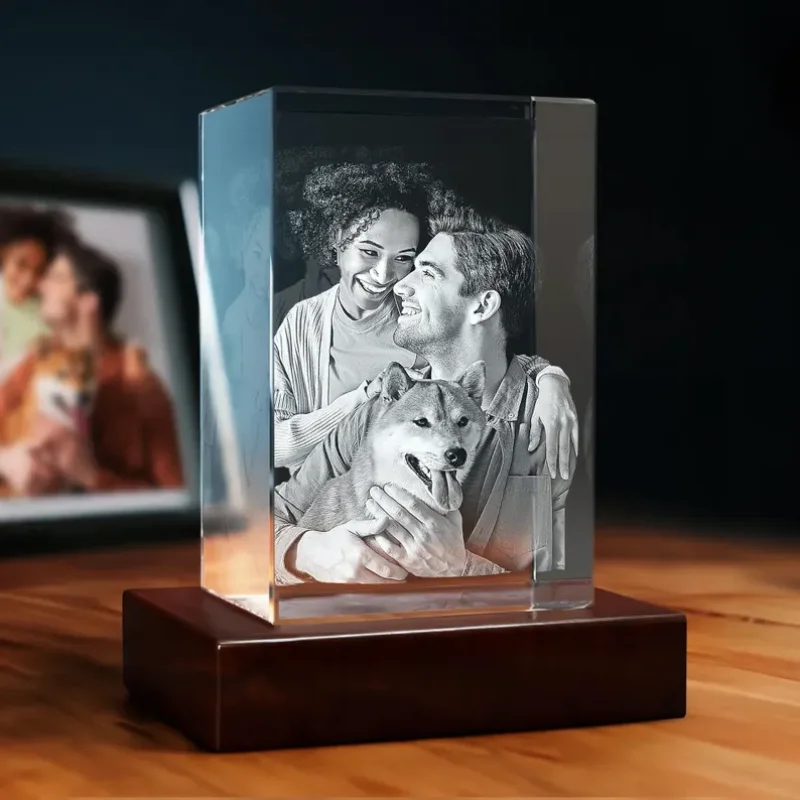
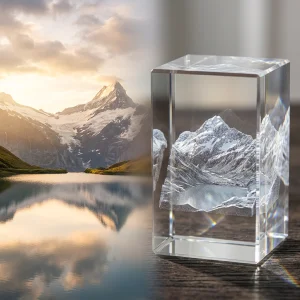
Run your fingers across a 3D laser crystal block. The exterior feels completely smooth. No grooves. Smooth everywhere. Yet inside that solid optical glass sits a sharp, high-definition three-dimensional image suspended in mid-air. This looks like magic. It isn't. Science makes it happen through optical physics executed at nanosecond speeds.
Standard surface etching burns or gouges the outside of a material. Internal glass engraving works differently. The laser beam travels straight through the surface without marking it, depositing concentrated energy at a precise focal coordinate inside the glass block. Here is how green light converts into millions of microscopic internal fractures without shattering the surrounding crystal frame.
Non-Linear Absorption: Why the Exterior Remains Undamaged
Glass is transparent because light photons pass through its atomic lattice without being absorbed. Under normal illumination, optical crystal absorbs almost zero light energy. A low-power laser beam entering a K9 glass cube passes out the opposite face intact.
Sub-surface laser engraving breaks this rule by altering energy density. The laser machine doesn't focus light on the crystal surface. Instead, a high-precision lens converges thousands of light rays onto a microscopic point buried millimeters or centimeters deep within the block.
At that exact focal coordinate, light intensity hits a critical threshold. Power density reaches gigawatt levels per square centimeter. The glass can no longer transmit the light passively. Multiphoton ionization takes over. Glass atoms absorb multiple photons simultaneously, breaking molecular bonds instantly.
This rapid energy transfer creates a micro-explosion contained inside the rigid crystal matrix. Temperatures at the focal point spike briefly above 2000°C, causing localized micro-fracturing. The resulting crack measures between 30 and 100 micrometers wide. Because light scatter bounces off this tiny internal fracture, the spot appears as a bright white dot. Multiply that single point by three million coordinates, and a detailed 3D structure emerges inside the glass.
Technical Parameters of Sub-Surface Systems
Achieving clean internal points requires tight operational tolerances. Industrial sub-surface engravers rely on frequency-doubled Nd:YAG or green diode lasers operating at a 532 nm wavelength. Green light provides a tight focal spot while penetrating high-purity optical glass with minimal premature scattering.
| Parameter | Typical Specification | Function in Engraving Process |
|---|---|---|
| Laser Wavelength | 532 nm (Green Light) | Ensures deep optical penetration through glass before focal convergence. |
| Pulse Duration | 1 to 5 Nanoseconds | Delivers extreme peak power quickly to prevent heat spreading into surrounding glass. |
| Pulse Frequency | 3,000 to 5,000 Hz | Determines the speed at which dots are written (up to 300,000 points per minute). |
| Focal Point Size | 20 to 50 Microns | Defines the single-dot resolution (voxel) inside the crystal matrix. |
| Substrate Material | K9 Optical Crystal (BK7) | Provides high purity, uniform refractive index (1.5168), and low bubble inclusions. |
| Dot Pitch (Spacing) | 0.08 mm to 0.15 mm | Maintains safe distance between fractures to prevent structural cracking. |
Pulse timing is everything. If the laser fires for too long, heat transfers into the surrounding glass, creating tension cracks instead of clean micro-points. By keeping pulse durations in the nanosecond range, thermal damage stays localized to the focal volume.
Sub-Surface Engraving vs. Exterior Etching
Traditional glass customization relies on sandblasting, chemical etching, or surface laser ablation. These methods physically disrupt the outer glass boundary. Sandblasting uses high-pressure abrasive grit to pit the surface. CO2 lasers crack the top layer by heating moisture trapped in the glass matrix.
Surface etching leaves a texture you can feel. It collects dust, oils, and fingerprints over time. Clean it aggressively, and you risk eroding fine text lines.
Sub-surface laser engraving keeps the structural shell pristine. Moisture, dirt, and mechanical abrasion cannot touch the internal image. Light enters the clear exterior faces, hits the internal micro-fractures, and reflects back to your eye. The artwork remains permanently locked inside, immune to environmental wear.
Limitations, Material Rules, and Use Cases to Avoid
Sub-surface laser technology is powerful, but it comes with strict physical boundaries. You cannot engrave every clear object on your desk.
First, material selection matters. Ordinary window glass, soda-lime drinking glasses, and tempered glass contain internal stresses, air bubbles, and iron oxides. Put a 532 nm pulse into standard glass, and existing internal stresses will shatter the entire piece along invisible fault lines. Only high-purity optical grade glass like K9 or synthetic quartz works safely.
Second, point density has strict ceiling limits. It's tempting to think more dots equal higher quality. That's false. If point spacing drops below 0.05 mm, adjacent micro-fractures merge. The localized stresses join forces, creating a runaway macro-crack. Over-dense designs end up looking like a milky, cloudy blur rather than a crisp model, frequently cracking during shipping due to internal structural weakness.
Third, refraction limits complex geometry. Sub-surface lasers require flat, polished entry faces. If you try to fire a focal beam through a spherical crystal ball or a faceted gemstone face, light bends unpredictably at the outer surface. The focal point distorts, rendering the internal dots blurry or misshapen. Curved glass items require specialized liquid immersion tanks to balance refraction indexes during the burning pass.
Finally, non-transparent materials are impossible to engrave internally. Stained glass, frosted crystal, and opaque acrylic absorb or scatter the laser beam at the outer surface, preventing the light from converging at an internal depth.
Does sub-surface laser engraving weaken the crystal block?
Minimal structural integrity is lost during normal engraving because micro-fractures remain isolated. As long as the design respects proper dot-pitch spacing (typically 0.1 mm or greater), the surrounding solid glass matrix absorbs mechanical shock without failing.
Can you produce colored 3D designs inside glass?
No. Sub-surface laser micro-fractures only produce physical micro-cracks that scatter ambient light, making them appear bright white or silver. Any color seen in 3D crystal keepsakes comes from external LED lighting bases positioned underneath the glass block.
What is the difference between 2D and 3D internal glass engraving?
Both processes use the exact same laser technology. A 2D render lays points across a single flat plane inside the block, similar to a photograph floating in glass. A 3D render plots points across X, Y, and Z axes, generating depth so you can view the object from different angles.