Sub-Surface Laser Engraving in K9 Crystal: A Technical Selection Guide for Corporate Leadership Awards
Freya sat at her desk on a rainy Tuesday morning, holding a tarnished brass plaque. Twelve months ago, her company spent thousands on executive gifts that were now peeling at the corners. As Director of Corporate Operations at a Boston technology firm, she had three weeks to source corporate leadership recognition awards for six retiring board members and the incoming chief executive. She needed something that would not yellow, scratch, or degrade over the next fifty years.
Optical Clarity: K9 Crystal vs. Leaded Glass
Freya's first lesson in trophy sourcing came down to material chemistry. Traditional decorative crystal often contains lead oxide. Lead adds weight, but it creates a soft glass that scratches during shipping. Over time, leaded crystal develops a faint greenish-yellow tint under standard gallery spotlighting.
K9 optical crystal is a high-grade borosilicate crown glass. It replaces lead oxide with potassium silicate. Its refractive index sits at 1.516, providing the same optical clarity found in high-precision camera lenses and astronomical telescope mirrors. For executive awards, K9 crystal offers distinct structural characteristics:
- K9 Optical Crystal: Zero visible inclusions, bubble-free internal structure, surface hardness resistant to micro-abrasions, high thermal stability.
- Leaded Glass: Soft composition, prone to fine surface scratches, faint green-yellow chromatic dispersion, risks surface oxidation.
Freya examined a sample K9 block under her office lights. Viewed from the front, the edges disappeared. Light passed straight through the glass without scattering.
The Physics of Sub-Surface Laser Engraving
Traditional surface laser engraving uses infrared wavelengths to burn or melt the outer skin of glass. To place an image inside solid glass without breaking the outer walls, manufacturers use green diode lasers operating at a 532 nm wavelength. Green light passes cleanly through the polished exterior of K9 crystal without altering the surface.
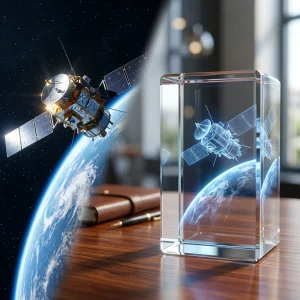
Subsurface focal depth tuning allows the technician to adjust the laser's focal point precisely inside the crystal block. At the exact spot where the green laser beam converges, intense energy creates a targeted thermal shock. This creates a microscopic fracture—a tiny, controlled white dot inside the glass.
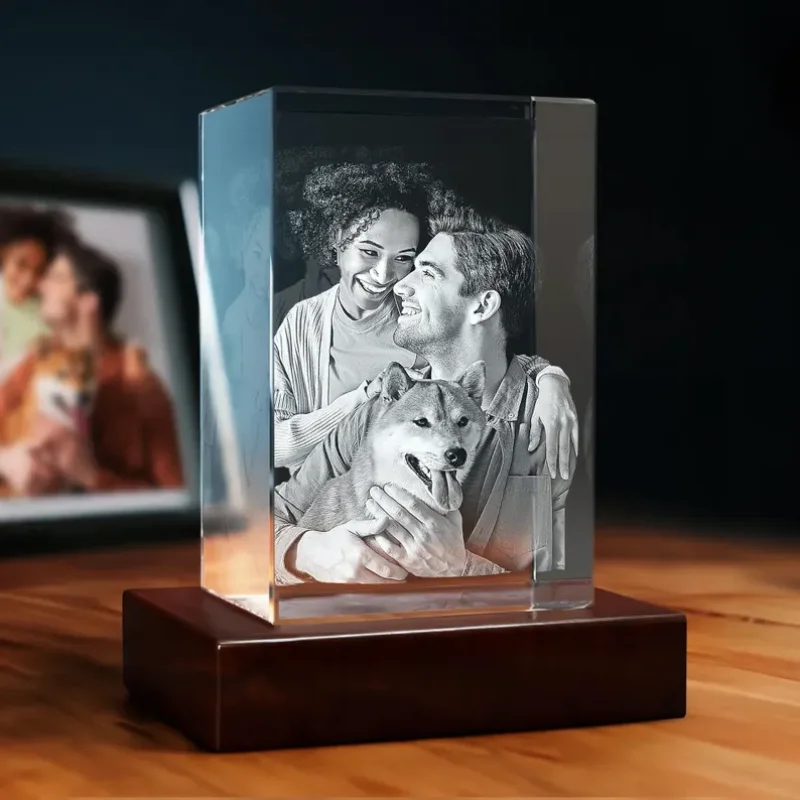
Micro-fracture point density dictates the visual sharpness of the final piece. Cheaper promotional trophies use low point density, roughly 100 to 200 dots per cubic millimeter. The resulting image looks faint and ghostly. High-grade 3d crystal glass trophies use point densities ranging from 800 to 1,500 dots per cubic millimeter. This dense point cloud catches ambient room light and produces a solid, brilliant white three-dimensional structure suspended in mid-air.

2D Surface Etching vs. 3D Volumetric Rendering
Freya evaluated two engraving methods for the company logo and the CEO's portrait: surface sandblasting and 3D volumetric laser rendering.
Sandblasting cuts flat grooves into the outer glass surface. Dust collects in those cuts. Fingerprint oils soak into the frosted areas and darken them over time. Surface etching also limits the design to a single flat plane.
Subsurface 3D volumetric rendering builds the design inside the core. Designers take standard vector files or CAD models and convert them into three-dimensional point cloud coordinate maps (X, Y, and Z axes).
- 2D Surface Etching: Single-plane depth, exterior texture prone to dust accumulation, vulnerable to physical wear.
- 3D Subsurface Volumetric Rendering: 360-degree spatial depth, internal permanent seal, completely impervious to handling and ambient air.
When Freya rotated the sample render of an executive portrait, the face retained its depth and facial contours from every angle instead of flattening out like a printed photograph.
Structural Requirements and File Formatting
Volumetric 3D laser rendering requires physical depth. You cannot etch a 3D point cloud into a thin glass pane without shattering the material structure.
To withstand internal micro-fracturing across multiple Z-axis planes, the crystal block must measure at least 30mm thick. Monoliths and obelisks measuring 50mm to 80mm in depth give the 532 nm laser beam enough interior volume to layer points safely without creating thermal stress fractures.
Preparing the artwork requires specific file formats depending on the complexity of the design:
- .OBJ or .STL Files: Required for physical product replicas, corporate mascots, or complex geometric trophies.
- High-Resolution CAD / STEP Files: Best suited for architectural blueprints, headquarters buildings, and structural designs.
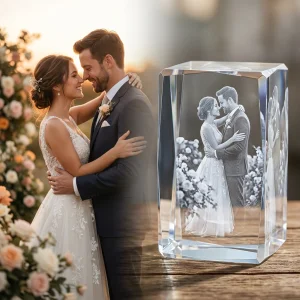
- 180-Degree Multi-Angle Photos: Necessary for executive portraits. Dedicated mapping software builds a 3D facial mesh from multiple photographic angles.
Commissioning Monoliths and Obelisks
Freya ordered six rectangular K9 crystal monoliths measuring 220mm tall, 80mm wide, and 50mm deep. The substantial 50mm depth allowed the production team to layer a detailed 3D render of the firm's historic headquarters at the base, with the executive's portrait floating above it.
At the December gala, the awards took center stage under the ballroom lights. The 532 nm micro-fractures caught the overhead spots, lighting up the floating renders from within. No surface scratches ruined the faces. No brass oxidized. The optical clarity of the K9 crystal preserved the corporate legacy inside a glass structure built to last generations.
Why is K9 optical crystal preferred over leaded glass for corporate trophies?
K9 optical crystal offers superior clarity with a high refractive index of 1.516, zero internal bubbles, and no lead content. Leaded glass is softer, scratches easily during transport, and develops a yellowish tint over time under indoor lighting.
What minimum crystal thickness is needed for a true 3D laser engraving?
A minimum depth of 30mm is required for 3D volumetric rendering. Thicker profiles between 50mm and 80mm allow the laser to build dense point clouds across multiple Z-axis depth planes without compromising the structural integrity of the glass.
What file formats are required for 3D sub-surface laser engraving?
True 3D subsurface laser engraving requires 3D mesh or vector CAD formats such as .OBJ, .STL, or STEP files. For 3D executive portraits, specialized software converts high-resolution photos taken from multiple angles into a 3D volumetric point cloud.
Will sub-surface laser engravings fade or discolor over time?
No. Sub-surface micro-fractures sit entirely inside the sealed core of the K9 crystal block. Because the outer surface remains untouched and non-porous, dust, humidity, skin oils, and UV light cannot reach or alter the internal image.