Production Guide: Transforming Handwritten Vows Into Sub-Surface Laser Engraved K9 Crystal
Converting handwritten wedding vows into permanent display art requires precise optical physics, exact image vectorization, and clean glass selection. Paper fades, ink oxidizes, and framing leaves documents exposed to atmospheric humidity. Engraving handwriting directly into or onto glass locks the exact weight, flourish, and speed of a partner's penmanship into solid crystal.
Achieving crisp legibility requires a deep understanding of optical materials, laser wavelengths, and mechanical minimums. Here is how the manufacturing workflow operates from initial document capture to final illumination.

Step 1: Digitization and Vector Line Preparation
The manufacturing process begins with high-resolution digital scanning. Cell phone photographs introduce focal distortion, chromatic aberration, and perspective skew. Production teams scan original vow documents on flatbed scanners at a minimum of 1200 DPI in 24-bit grayscale.
Scanning at high resolutions isolates real ink density from paper grain. Ballpoint pens leave faint central gaps in fast downstrokes. Fountain pens create feathery ink bleeds along fibrous paper edges. Gel pens produce heavy, solid fills. Software thresholding converts these raw bitmap scans into clean mathematical vector paths.
Line width minimums govern laser success. Hand-drawn ink strokes must maintain a minimum vector width of 0.2mm (200 microns). If a handwritten line thins out below 0.2mm, the laser cannot reliably focus enough energy density to form a continuous mark. Thin script flourishes must be manually thickened in vector software through selective path offsetting, preserving the handwriting's character while preventing broken vector commands.
Step 2: Material Selection — K9 Optical Crystal vs. Float Glass
Standard architectural float glass contains iron impurities. These impurities create a distinct green edge tint, scatter internal light, and hide microscopic air bubbles. Float glass also suffers from internal structural strain from rapid cooling cycles during manufacturing. Laser energy directed into lower-tier glass causes unpredictable thermal fracturing.
High-end laser engraved wedding vows require K9 optical crystal blanks. K9 is a high-purity borosilicate crown glass praised for low optical dispersion and superior clarity. Its refractive index sits at 1.5168, with a light transmission rate reaching 92%.
Visual inspection under 10x magnification ensures the crystal blank contains zero inclusions, seed bubbles, or internal striations larger than 0.01mm. The outer surfaces must be optically polished to a surface flatness of lambda/4 or better to prevent beam refraction at the entry interface.
Edge finishing choice affects light delivery across the final product:
- Flat Polish: Clean, 90-degree square edges that maximize full-face viewing clarity.
- 45-Degree Chamfered Bevel: Hand-polished angled edges that catch ambient room light and refract it back into the internal engraving, framing the vows in a bright border.
- Pencil Edge: Rounded profile used almost exclusively for thin, flat glass plaques rather than thick crystal blocks.
Step 3: Laser Physics — Surface Frosting vs. Sub-Surface Etching
Two distinct laser techniques turn vector paths into visible text within glass substrates: CO2 surface rastering and green diode sub-surface etching. Each utilizes different light wavelengths and material interactions.
CO2 lasers operate at a long wavelength of 10.6 micrometers. Glass acts as an opaque barrier to this far-infrared light. The glass surface absorbs 10.6 µm energy instantly at the outer skin, causing localized photothermal heating. This thermal shock causes tiny surface fragments to micro-pop off the face—a process called spalling. The result is a tactile, frosted surface texture. It works well for flat glass plaques but remains vulnerable to dust, finger oils, and surface scratches.
Sub-surface crystal laser etching uses a short green wavelength operating at 532 nanometers. Pure K9 optical crystal is almost entirely transparent to 532nm light. The laser head passes over the outer face without scorching, burning, or heating the exterior glass skin.
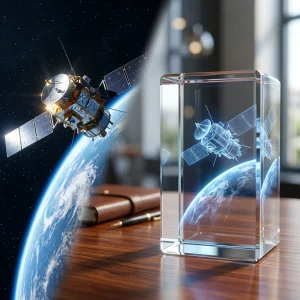
A high-numerical-aperture lens system focuses the green laser beam deep inside the crystal block. At the precise focal point inside the glass volume, power density spikes to gigawatts per square centimeter. This triggers non-linear optical absorption, leading to localized dielectric breakdown. A microscopic, controlled thermal fracture forms within microseconds, measuring roughly 20 to 50 microns in diameter.
The system fires up to 4,000 pulses per second, plotting individual points in three-dimensional space. Millions of these micro-fractures combine to build floating, dimensional handwritten vows sealed inside the block forever.
Technical Parameter Comparison
Controlling process variables dictates whether handwritten script remains sharp or turns into a blurry cloud of fractured glass. The table below outlines standard operational values for both laser methods.
| Process Parameter | CO2 Surface Frosting | Green Diode Sub-Surface Etching |
|---|---|---|
| Wavelength | 10.6 µm (Far-Infrared) | 532 nm (Green Visible) |
| Laser Reaction Type | Photothermal Surface Spalling | Photomechanical Sub-Surface Breakdown |
| Target Location | Exterior Surface (0.0mm depth) | Internal Volume (5mm to 50mm depth) |
| Dot Pitch / Resolution | 300 – 600 DPI | 800 – 1200 DPI (Dot Spacing ~0.05mm) |
| Pulse Duration | Continuous / Long Pulse (ms) | Q-Switched Short Pulse (ns or ps) |
| Minimum Vector Line Width | 0.3 mm | 0.2 mm |
| Surface Feel | Rough, Tactile Frosting | Optically Smooth, Untouched Glass |
Managing Heat Stress and Preventing Micro-Fractures
Glass is a poor thermal conductor. When a laser deposits energy too quickly into localized regions, thermal expansion creates internal tension. If laser pulses are placed too close together, individual micro-fractures merge into uncontrolled run-away cracks, ruined structural integrity, and cloudy, illegible text.
Preventing internal stress failures requires strict software dot-pitch rules. Technicians program software to enforce a minimum dot spacing of 0.05mm to 0.08mm between individual laser pulse sites. Spacing points prevents thermal stress fields from overlapping.
Pulse timing controls heat dissipation. Short nanosecond or picosecond pulse bursts prevent thermal energy from leaking into surrounding glass molecules. The energy breaks chemical bonds at the focal point before heat transfer occurs. This leaves the glass surrounding each etched dot crystal-clear and structurally sound.
Display Formats: Flat Glass Plaques vs. 3D Crystal Blocks
Choosing the right crystal format changes how the engraved vows fit into a room's decor.
Flat glass plaques typically measure between 5mm and 10mm thick. They rely on CO2 surface frosting or shallow sub-surface etching. They take up minimal depth on a shelf, but offer limited angle visibility under overhead lighting.
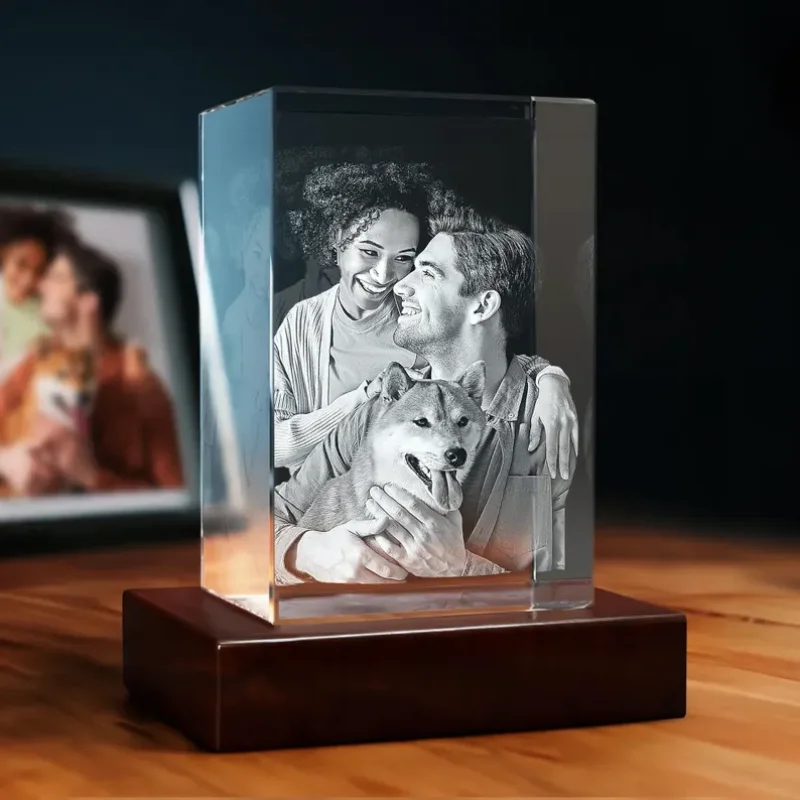
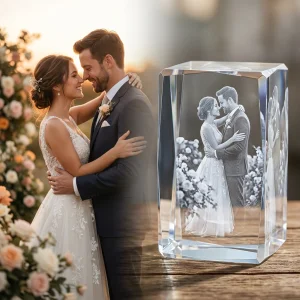
Solid K9 optical crystal blocks usually range from 30mm to 80mm in thickness. These thick formats allow technicians to engrave handwriting on multiple internal depth planes. The vows can float in front of a sub-surface background design, such as a wedding date, map coordinates, or floral vectors. The heavy glass block doubles as an optical prism, catching light across its polished surfaces.
Illumination and Display Contrast
Sub-surface micro-fractures are tiny physical breaks inside clear glass. They do not contain white ink or pigment. Their visible white appearance comes entirely from Mie scattering, where light hits the microscopic crack faces and bounces back toward the viewer's eye.
Without targeted lighting, an internal engraving can look faint against pale backgrounds. Custom LED bases fix this issue by shooting controlled light up through the bottom edge of the crystal.
Color temperature alters final presentation:
- 3000K (Warm White): Softens strong contrast. Matches warm wood bases, antique furniture, and ambient residential lighting.
- 6000K (Cool White): Delivers maximum optical contrast. Makes white micro-fractures pop against dark backgrounds with surgical clarity.
Positioning the light base directly beneath a beveled K9 crystal block directs light waves straight up through the core. As the light hits the floating micro-fractures, it scatters outward, making the original handwritten vows glow cleanly in mid-air.
What image resolution is required when uploading handwritten wedding vows?
Original vow documents should be scanned on a flatbed scanner at 1200 DPI saved in PNG or TIFF format. High resolutions ensure delicate pen lines, varying ink pressure, and tiny flourishes translate cleanly into laser paths without pixelation. Avoid standard smartphone photos, as ambient room lighting and lens curvature skew straight line vectors.
Can thin cursive or light pencil strokes be sub-surface laser etched into K9 crystal?
Vector line paths require a minimum thickness of 0.2mm to process reliable laser micro-fractures. Faint pencil marks or thin cursive lines must be digitally widened and adjusted during vector pre-production. Lines thinner than 0.2mm risk dropout, resulting in broken, illegible letters inside the crystal block.
Is sub-surface crystal laser etching permanent, or will it fade over time?
Sub-surface crystal laser etching is completely permanent and will never fade, yellow, or degrade. Because the handwritten image consists of microscopic physical fractures created inside solid K9 optical crystal, it remains protected from ambient air, moisture, cleaning chemicals, and ultraviolet light. The engraving stays intact as long as the crystal block itself remains unbroken.