The Photothermal Physics of Stone Laser Engraving
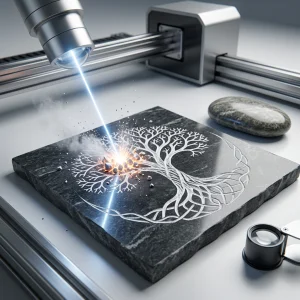
CO2 laser beams operating at a 10.6-micrometer wavelength don't burn stone. They crack it on a microscopic scale. When focused light hits granite, slate, or basalt, the rock absorbs energy instantaneously, driving localized surface temperatures past 1,000°C in microseconds.
Understanding how stone laser engraving works requires looking past traditional thermal melting or organic combustion mechanisms. Organic materials like wood char. Thermoplastics melt and re-solidify. Rock does neither efficiently due to high melting points and poor thermal conductivity. Focused laser photons generate extreme, localized thermal stress that triggers controlled laser micro fracturing.
The Mechanism of Laser Micro Fracturing
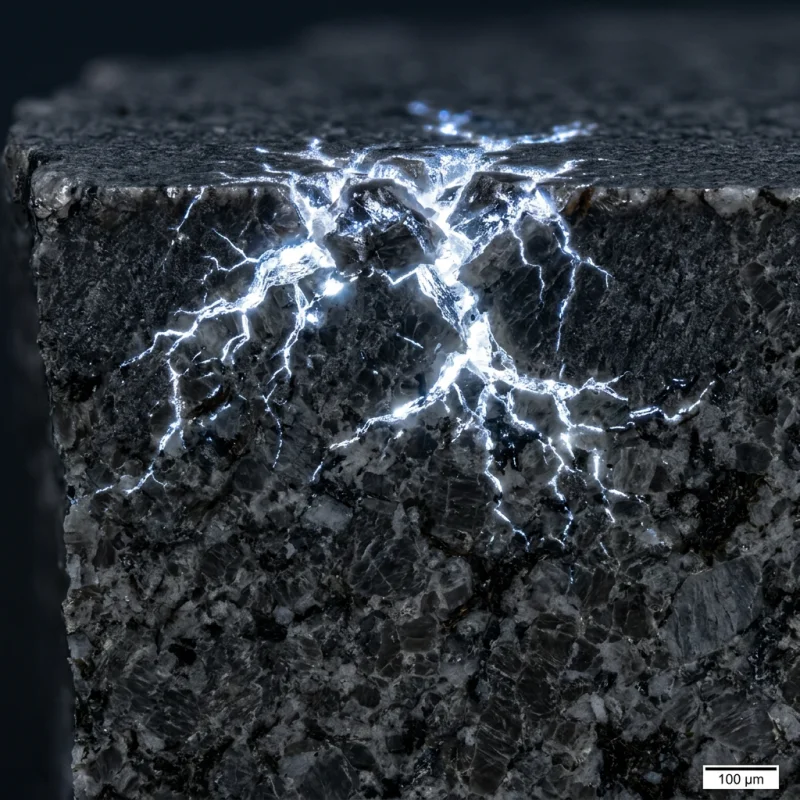
Stone contains trace amounts of trapped moisture alongside crystalline mineral lattices. As the laser spot strikes the surface, trapped liquid water expands violently into vapor. Quartz and silicate particles undergo rapid thermal expansion. The cool, unheated stone surrounding the target spot resists this sudden dimensional change.
Stress builds rapidly until the tensile strength of the mineral gives way. Microscopic flakes pop off the surface. What human eyes perceive as a crisp, bright, frosted mark is actually millions of tiny, light-scattering micro-fractures. No chemical reagents, dyes, or physical chisels touch the substrate.
Technical Specifications and Processing Parameters
Achieving clean results on rock requires balancing power density, pulse frequency, and motion speed. A standard 60-watt CO2 glass tube laser delivers sufficient photon flux when focused through a 2.0-inch focal length lens.
| Parameter | Optimal Value Range | Technical Impact |
|---|---|---|
| Laser Wavelength | 10.6 µm (CO2) | High absorption rate by silicates and minerals. |
| Laser Power | 40W – 100W | Higher power allows faster speeds without missing fracture thresholds. |
| Spot Size | 0.10 mm – 0.20 mm | Controls detail resolution and localized energy density. |
| Focal Length | 1.5" – 2.5" | 2.0" provides ideal depth of field for uneven rock surfaces. |
| Raster Speed | 200 mm/s – 500 mm/s | Prevents heat accumulation that causes deep cracking. |
| Resolution Settings | 254 DPI – 350 DPI | Prevents overlapping pulses from pulverizing adjacent fractures into dust. |
Mineralogy and Contrast Dynamics
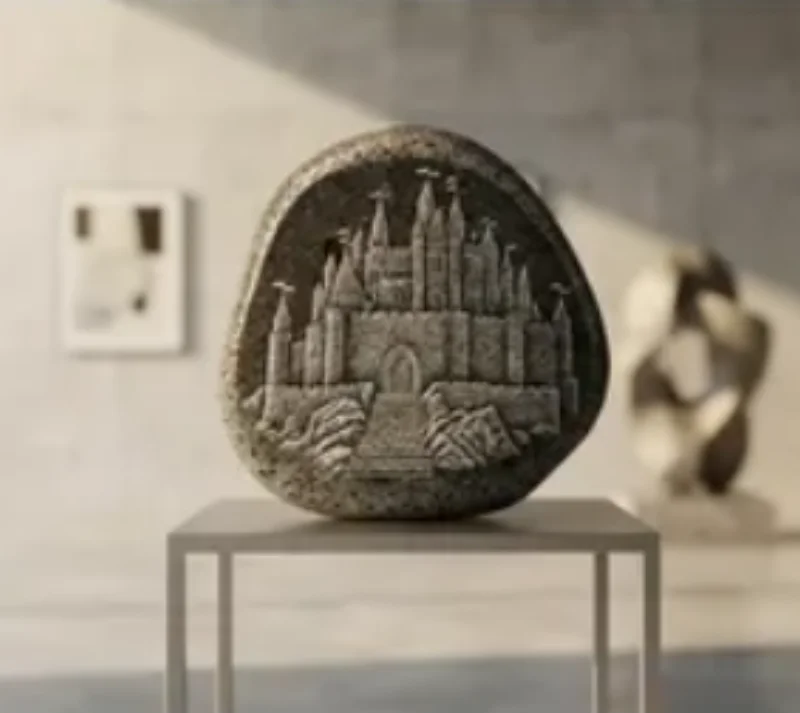
Granite ranks among the best substrates for stone laser engraving. Dark polished granite consists of quartz, feldspar, and amphibole. The polished surface reflects ambient light away from the viewer, appearing dark gray or black. When laser light induces micro-fractures, shattered quartz crystals scatter light in every direction, creating a bright white contrast without post-engraving acrylic infills.
Marble behaves differently. Composed primarily of calcite (calcium carbonate), marble absorbs 10.6 µm energy quickly and decomposes thermally around 800°C into calcium oxide and carbon dioxide gas. This produces a smooth, chalky mark rather than a jagged fracture grid. Light-colored marbles offer poor visual contrast unless treated with dark color fills after laser processing.
- Granite: High silica content. Excellent contrast on dark, polished surfaces. Requires medium-high energy density.
- Slate: Layered metamorphic rock. Engraves with light gray tones. Low power prevents splitting along foliation planes.
- Basalt: Fine-grained igneous rock. Yields sharp off-white marks with minimal edge chipping.
- River Pebbles: High variability. Porous rocks with absorbed ground moisture can explode or spall erratically under high wattage.
Thermal Shock and Material Limitations
Not all stones withstand intense laser radiation. Excessive power density causes severe structural failure, ragged edge blowouts, or full cracks across the workpiece.
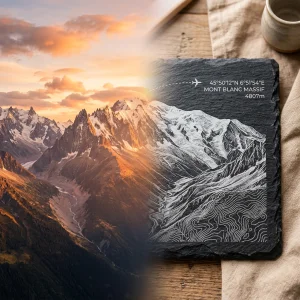
Thin slate coasters measuring under 3 mm shatter easily when hit with high wattage at low speeds. Thermal energy propagates horizontally along internal cleavage planes, separating the natural layers. Keeping power below 35W and motion speeds above 300 mm/s mitigates sheet separation on delicate slate.
Gemstones like opals, emeralds, and turquoise contain high water content or internal fracture networks. Direct photon exposure shatters these precious minerals or leaves dull, discolored scars. Precision laser marking should never be attempted on soft, hydrous, or highly fractured gem materials.
Outdoor environmental conditions demand special post-processing steps. Unsealed micro-fractured slate traps ambient dirt and rain. Water settling inside micro-fracture zones expands during freeze-thaw cycles, eroding fine details over time—applying a thin coat of penetrating silicone-based sealer preserves exterior slate gifts without dulling the light-scattering visual output.
Why does stone laser engraving appear bright white on dark rock?
Diffuse optical scattering causes the bright white mark. Polished dark stone reflects light smoothly away from your line of sight. When laser energy shatters the top mineral layer into microscopic, irregular fragments, those tiny rough surfaces bounce ambient light back toward the observer from all angles.
Can diode lasers engrave natural stone substrates?
Diode lasers operating at 450nm visible blue wavelengths struggle on unpainted, light-colored stones because the material reflects blue light instead of absorbing it. High-power diode modules (20W+ optical output) can mark dark slate by relying on surface pigment absorption, but 10.6 µm CO2 lasers remain far more efficient across all rock types.
How deep does a laser beam cut into stone during engraving?
Depth typically ranges between 0.05 mm and 0.3 mm. Laser processing relies on light micro-fracturing rather than deep material displacement. Deep relief cutting on stone requires mechanical CNC milling or high-pressure abrasive sandblasting.
Do laser-engraved stone items require special maintenance?
Clean stone keepsakes with warm water and mild liquid soap. Avoid applying heavy oils, waxes, or thick solvents to engraved areas. Liquids penetrating the microscopic fractures cancel the light-scattering effect, making white engravings look dark until the material dries completely.