Custom Wooden Leash Holders: Engraving Memorials for Your Dog's Favorite Trails
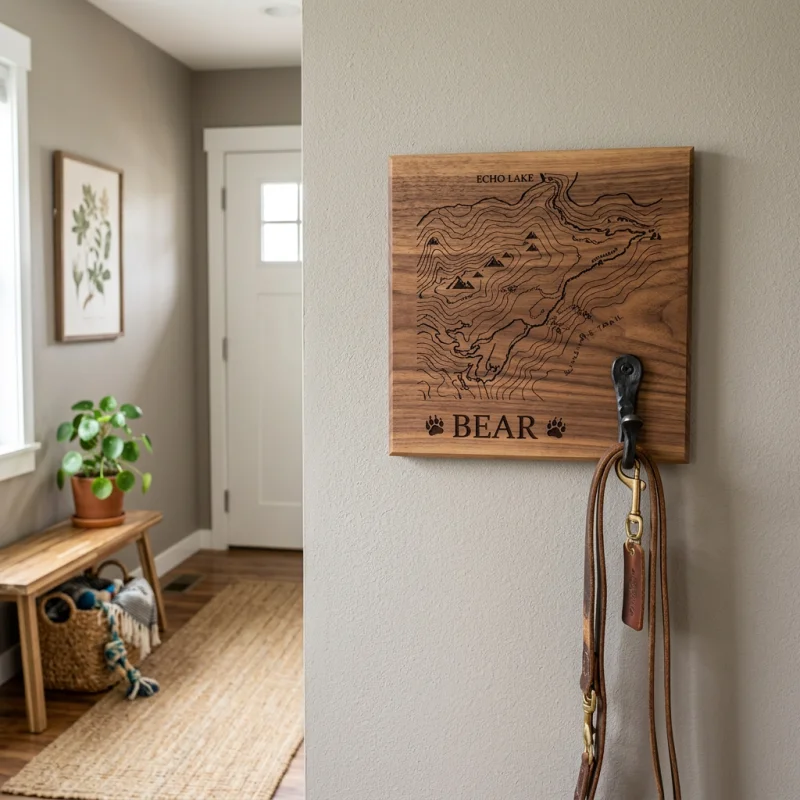
The hallway entryway felt too quiet. For ten years, James reached for the worn blue leash hanging off a bent nail near the front door at 6:00 AM sharp. Max, his rescue lab mix, knew that sound instantly. He would hit the hardwood floors running, tail slapping against the drywall. Now, three weeks after saying goodbye to Max, that blue leash sat flat on the hallway console table. James couldn't bring himself to tuck it away in a drawer. Stacking it in a dark closet felt wrong, but leaving it on a bent nail felt incomplete. He wanted something permanent for the entryway wall: a solid timber hanger laser-etched with the topography of the Pine Ridge loop where Max ran every autumn morning.
Memory objects carry weight. A generic store-bought hook doesn't tell the story of mud-soaked paws, 5:00 PM trail sprints, or cold winter walks along the creek. Building or customizing dedicated wooden memorial boards allows you to anchor those daily rituals into solid hardwood. Using precise CO2 laser burning, you can turn real trail maps, direct paw inkings, and action silhouettes into lasting physical art pieces.
Vectorizing Memories: Converting Paw Prints, Maps, and Photos
James started by collecting three items: a folded paper trail map of Pine Ridge, an ink press of Max's left front paw from the vet, and a backlit photo taken at sunset along the ridge. Raw photos and paper documents cannot go straight to a laser cutter. They must first become clean vector files or high-contrast raster images that a 40W to 80W CO2 laser can read.
To convert an ink paw print into line art, scan the physical print at 600 DPI. Open the image in vector software like Inkscape or Illustrator. Adjust the image contrast threshold until grey smudges vanish, leaving only solid black pad impressions against pure white background space. Run a trace bitmap filter to generate paths. Clean up stray node points so the laser cutter doesn't freeze or stutter over tiny paper splatters.
For custom trail maps, export GPX data from a GPS tracking app used during your walks. Import the line file into CAD or vector design tools. Set the line stroke width to 0.001 inches (or hair-line) for vector scoring, or widen the path stroke to 1 pt for vector engraving. Thin lines let the laser head score crisp elevation contour paths into the wood without charring the surrounding timber.
Action silhouettes demand simple backgrounds. Crop your dog's image, remove background trees or grass using a magnetic lasso tool, and fill the silhouette shape with pure black (HEX #000000). Keep edges crisp. Detailed dog fur burns cleanly when vectors use smooth curve nodes rather than jagged raster edges.
Wood Selection: Hardwood Density vs. Softwood Bleed
James initially grabbed a leftover piece of construction pine from his workbench. He ran a quick raster test cut on his 50-watt laser tube. The result was disappointing. Pine contains heavy resins and uneven growth rings. Under high laser heat, pine resin melts and bleeds across the grain, turning fine lettering into smudged, yellowed halos.
Switching to a block of kiln-dried American Black Walnut changed the result completely. Hardwoods feature tight, uniform cellular structures. When hit by a high-power laser beam, hardwoods produce clean, dark carbonization without melting surrounding fibers. Select your wood species based on density, contrast, and grain structure:
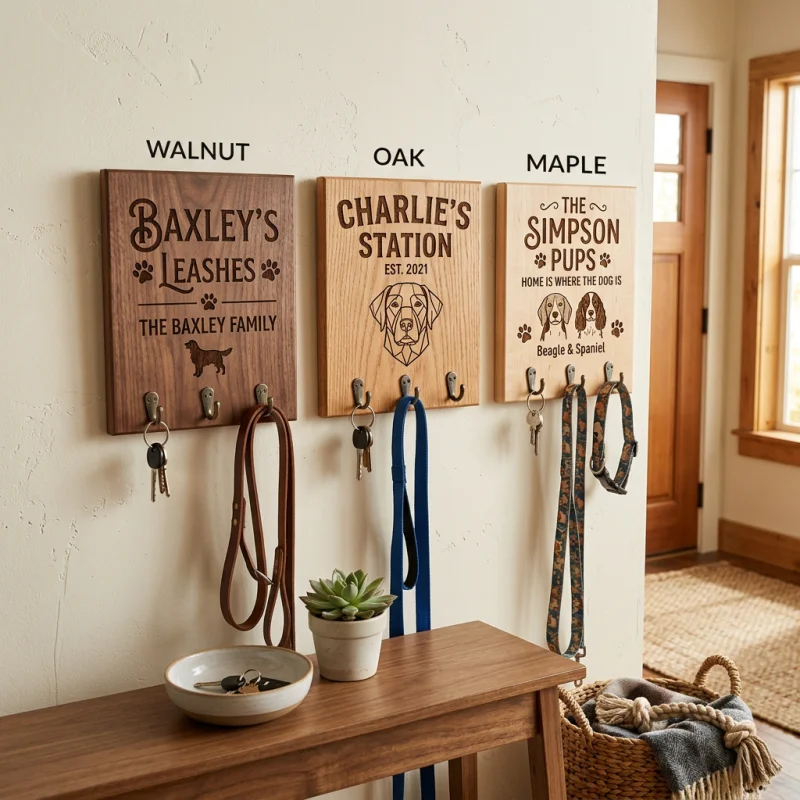
- Black Walnut: Deep chocolate tones with dark charcoal burning. Produces rich contrast without requiring paint fills inside the vector cuts.
- White Oak: Heavy, prominent grain lines and incredible structural strength. Holds heavy iron wall hardware without stripping screw threads. Engraves with a medium-dark caramel burn.
- Hard Maple: Pale cream color that provides maximum visual contrast for fine line maps and high-resolution 400 DPI typography.
- Cherry: Smooth, tight grain that engraves with clean precision. Darkens naturally over time when exposed to indoor ambient light.
Avoid soft pine, fir, or cedar for intricate laser engraving wood projects. Their soft earlywood rings burn away much faster than dense latewood rings, leaving uneven depth ridges across detailed silhouettes.
Laser Settings and Technical Parameters
Getting clean lines requires balancing laser wattage, focal distance, speed, and resolution. James mounted his prepared 3/4-inch walnut board onto the honeycomb bed of his 60W CO2 laser. He set his focal lens distance precisely at 2.0 inches using a step-gauge block.
For text and trail line scoring, set resolution between 300 DPI and 400 DPI. Setting resolution above 500 DPI deposits excess heat into small areas, causing edge burning along wood grain lines. Run vector scoring at faster speeds (around 150 to 200 mm/s) at 15% to 20% power to create thin, dark trail lines. Use raster engraving at 250 mm/s at 30% power to sink dark silhouette fills 0.5 mm deep into walnut or oak.
Always turn on active air assist. Pumping 20 PSI of compressed air through the laser nozzle blows away vaporized wood resin before it can settle around the burn edges, eliminating yellow sap smoke stains on raw hardwood surfaces.
7 Laser-Engraved Wooden Leash Holder Designs
Every walk has its own character. Here are seven distinct design concepts for building a personalized leash rack, matching different aesthetic styles and memorial memories.
1. The Topographic Elevation Map Board
This design isolates the exact geographic boundaries of your favorite park or hiking trail. Contour lines are vector-scored directly onto a 12x6 inch piece of hard maple. A small etched star marks your dog's favorite spot, such as a creek crossing or scenic lookout. Single or double cast-iron hooks mount directly below the map frame.
2. The True Paw Print Plaque
Featuring an exact 1:1 scale vector trace of your pet's physical paw print. Etched 1mm deep into a dark walnut slab, this layout places the paw print on the left, paired with your dog's name and dates etched on the right in a classic serif font. Two bronze key hooks sit beneath the wood block.
3. The Action Silhouette Profile
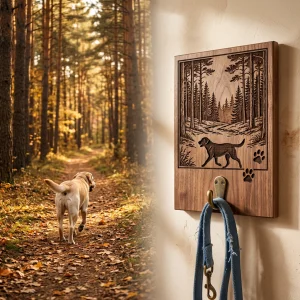
Designed around a dynamic side-profile vector of your dog mid-stride, leaping, or fetching a stick. The dark burnt silhouette creates a striking shadow-box effect on light cherry or oak wood. Below the silhouette, a single heavy brass cleat holds thicker leather leashes and harnesses.
4. The Coordinates & Waypoint Block
Minimalist and typography-focused. This design features large, crisp latitude and longitude coordinates pointing to the exact bench, dog park entrance, or trail trailhead where you spent your mornings. The clean text line burns best at 400 DPI into flat-sawn white oak.
5. The Dual-Species Inlay Board
This style uses a 40W laser to cut an outer frame from light maple and an inset memorial panel from dark walnut. The laser engraves the dog's name deeply into the walnut center, while the outer maple border provides high structural rigidity for mounting multiple iron hooks.
6. The Multi-Pet Staggered Wall Rack
Built for homes honoring multiple pets over time. A long 24-inch board features separate engraved sections for each dog, complete with individual paw prints and custom walk quotes. Hooks are staggered vertically to keep long leashes, short leads, and collars from tangling.
7. The Live-Edge Slab Hanger
Uses a thick slice of kiln-dried, live-edge timber retaining its natural outer bark. The laser engraves deep vector details into the smooth center face while preserving the organic, rugged edges of the wood slab. Pairs exceptionally well with rustic black forged-iron hardware.
Hardware Selection and Heavy Duty Mounting
A memorial leash rack must be functional. Leashes, heavy harnesses, and metal collar tags exert constant downward force. Using weak drywall anchors or small adhesive strips will cause the board to drop over time, damaging the wood.
Select heavy cast-iron, solid brass, or forged steel hooks. Pre-drill all screw pilot holes into the hardwood face using a drill press. Hardwoods like oak and walnut will snap head screws if you try driving hardware directly without pilot holes. Use threaded brass inserts on the back side of the board for ultra-secure hook attachment.
For mounting the board onto your hallway wall, flush-mount keyhole slots cut into the back of the wood block work best. Route two keyhole slots spaced exactly 16 inches apart from center to center. This allows you to drive 2.5-inch cabinet screws directly into two vertical wall studs inside your home's drywall frame. A stud-mounted 3/4-inch walnut board easily holds over 30 pounds without sagging.
Sealing and Maintenance Considerations
How you finish the wood determines how long the crisp laser burn lines stay vibrant. Unsealed hardwood absorbs moisture from damp leather leashes and humid indoor air, swelling the fibers and blurring fine vector cuts.
If the holder hangs inside an entryway, coat the finished wood with two coats of hand-rubbed hard-wax oil or satin spray lacquer. Hard-wax oil brings out the deep chocolate tones of walnut without filling in the laser depth cut with clear plastic build-up.
For leash hangers placed in covered outdoor porches, mudrooms, or breezeways exposed to damp air, use three coats of exterior-grade, UV-resistant polyurethane. Ensure the liquid finish flows fully into every engraved laser groove to block water penetration inside the raw charred wood fibers.
James completed his walnut board on a Saturday afternoon. He mounted the board 5 feet up on the entryway wall, right where the sun hit through the front door glass. He picked up Max's blue leash, clicked the brass clasp into place on the iron hook, and stepped back. The engraved topography lines of Pine Ridge caught the light, holding the memory of ten years of morning walks securely in place.
What vector file formats work best for laser wood engraving?
SVG, DXF, and AI files work best for vector line scoring because they store path coordinates as mathematical lines rather than pixels. For raster engraving like dense silhouettes or photos, high-resolution 300 to 600 DPI PNG or TIFF files offer clean black-and-white pixel contrast.
Can soft pine wood be used for custom leash holders?
Soft pine can be used for simple block lettering, but it performs poorly for intricate laser detail. Pine contains soft earlywood rings and heavy sap resin that melts under laser heat, causing yellow smudging and shallow uneven burns around fine lines. Hardwoods like walnut, oak, and maple produce far cleaner results.
How do I prevent smoke stains around laser-etched text on raw wood?
Apply low-tack painter's masking tape flat across the bare wood surface before running your laser cut. The laser burns through the tape into the wood, while the surrounding tape catches all sap smoke residue. Peel the tape off after burning to reveal clean wood surfaces with zero smoke halos.
What is the best way to mount a heavy wooden leash rack to drywall?
Route keyhole slots into the rear face of the wood board spaced 16 inches apart, matching standard wall stud spacing. Drive 2.5-inch wood screws directly into your wall studs for maximum strength. If studs are unavailable, use heavy-duty toggle bolts rated for at least 50 pounds rather than plastic drywall anchors.