From Mid-Air Catch to 3D Optical Glass: How Chloe Preserved Her Dog's Peak Agility
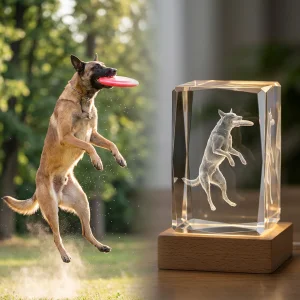
Chloe stared at three 8x10 glossy prints laid across her oak kitchen table. In every photo, her Belgian Malinois, Rex, leapt four feet off the grass, his jaw snapped shut around a red rubber disc. The camera shutter had caught him at 1/2000th of a second. You could see water droplets spinning off his coat and dirt clods flying beneath his back paws.
Yet on paper, the scene felt dead. Flat paper flattened his muscle structure. The background of green park trees bled straight into his dark brindle coat, turning his hind legs into a shadowy blur. Chloe had tried acrylic blocks before, but the printed backings scratched easily, fading after two summers on her south-facing office desk. She needed something solid. She wanted to see the depth of his chest expansion and the curve of his tail in actual space.
The Science of 532nm Sub-Surface Laser Engraving
Chloe turned to optical K9 crystal blocks built with sub-surface laser technology. K9 optical glass contains zero lead, offering high light transmission and a refractive index of 1.517. This structural purity allows high-frequency light to pass through the exterior surface without scorching or cracking the glass exterior.
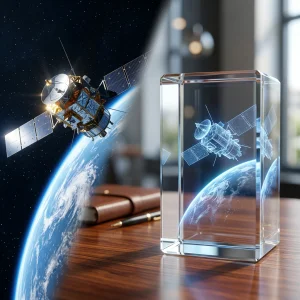
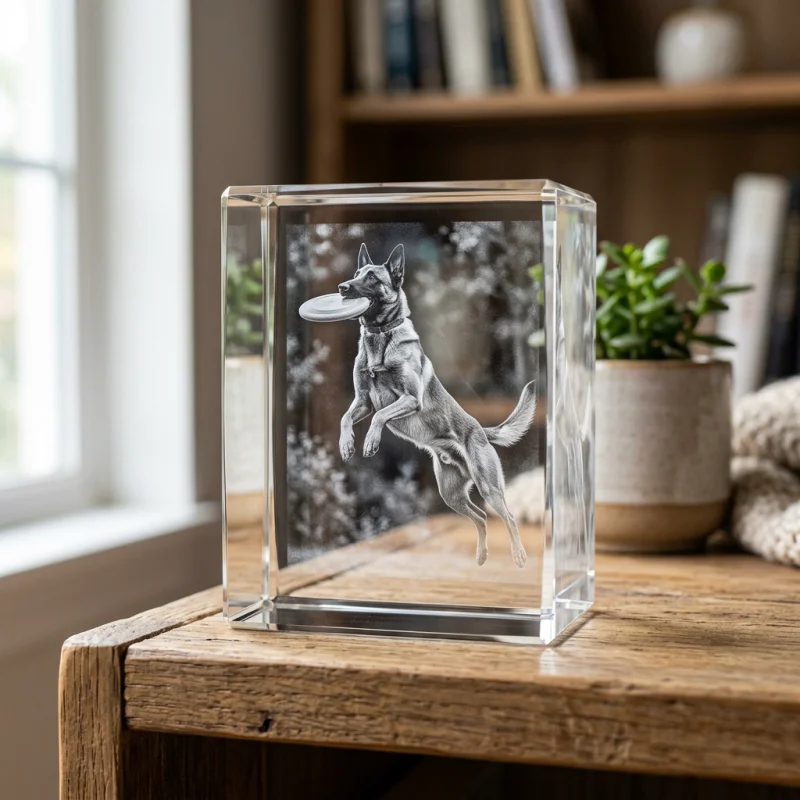
The manufacturing process uses a 532nm green laser. Computer systems guide the laser beam deep inside the solid glass block. At the precise focal point, thermal energy creates a microscopic fracture inside the crystal structure without leaving a mark on the outer surface. The laser pulse fires over and over, building a spatial map point by point.
A high-quality 3d laser engraved crystal block requires at least 1,000,000 points of density for a single animal profile. Complex movement—like Rex mid-jump with open jaws—demands nearly 1,800,000 coordinate points. These tiny internal fractures reflect ambient room light. When you walk past the glass block, the scattered light dots trick your eyes into seeing a fully realized three-dimensional body floating inside the solid optical mass.
Selecting Action Photos Free of Motion Artifacts
Chloe searched through 3,000 burst-mode photos on her hard drive to find the right shot. Transforming a 2D photograph into a 3D point cloud file requires clean visual data. Designers use specialized conversion software to extrude depth maps from original pixels, making image clarity mandatory.
Her first choice showed Rex catching a ball at dusk. The camera sensor had bumped the ISO to 6400, introducing digital noise. In a laser engraving, digital noise translates into random floating micro-dots that obscure the subject's face. Chloe discarded that file instantly.
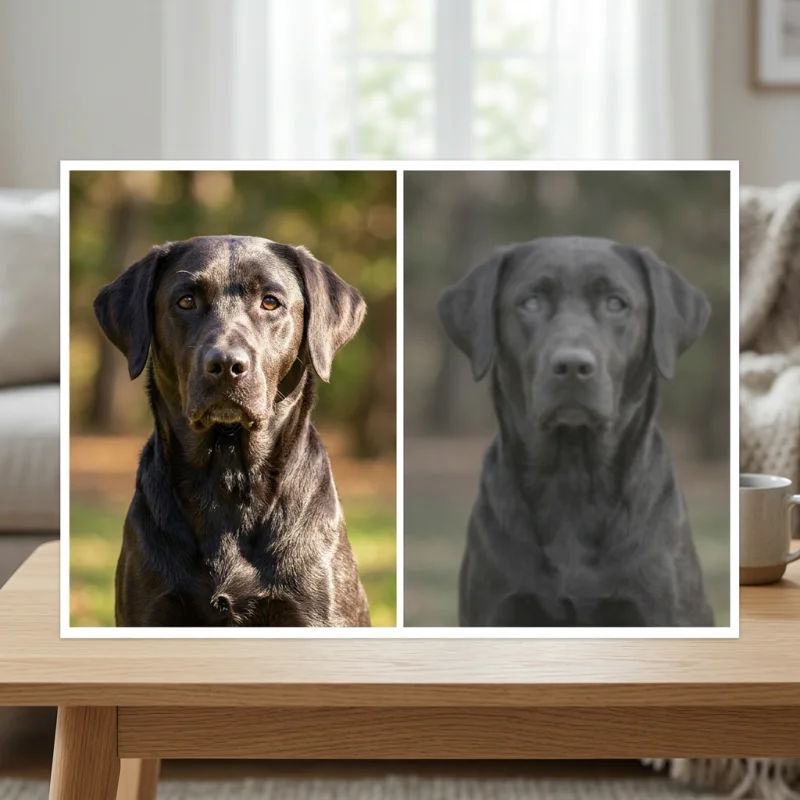
She picked a photo shot in direct morning sunlight at ISO 200, exported at 300 DPI. The subject contrast was crisp. Rex’s fawn and black fur stood out against a pale blue sky. Clear subject separation lets 3D modelers extract sharp outer boundaries, preventing his muzzle from merging into the background landscape.
Dark fur creates unique hurdles. If a dark dog sits against a dark couch or shadowed lawn, the depth-mapping software loses track of where the fur ends and the shadow begins. Chloe made sure her chosen photo had hard rim lighting along Rex’s back, giving the technician clear edge markers for the 3D conversion process.
Beveled Edges Versus Flat Rectangular Blocks
Choosing the glass shape changes how light hits the internal point cloud. Chloe evaluated two distinct cuts for her display: flat rectangular blocks and bevel-edged crystal blocks.
Flat rectangular glass blocks feature straight 90-degree edges. They offer an undistorted view from the front center. However, from acute side angles, straight edges reflect light like internal mirrors, blocking side views of the dog's rear legs.
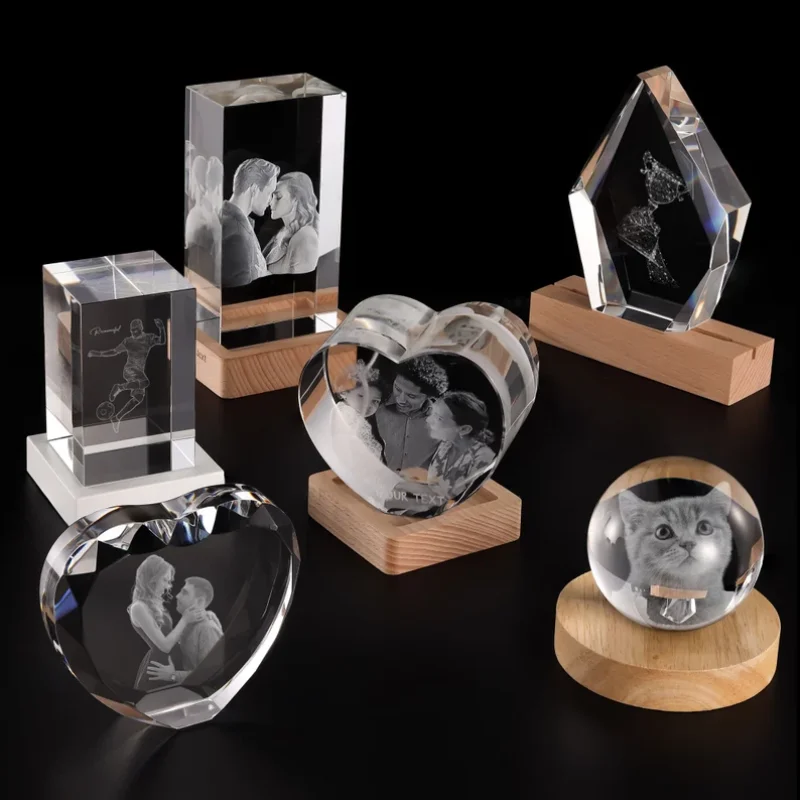
Beveled edges feature angled chamfers along all eight outer borders. These polished slopes act as light prisms. Ambient room light enters through the facets and bends inward, illuminating the dense dot cloud from multiple directions. When Chloe picked up a bevel-edged sample, the 45-degree angled cuts multiplied the light bouncing off the internal laser dots. The internal volume of the jumping dog appeared deeper, extending back toward the rear face of the glass block.
Illuminating Internal Micro-Fractures with LED Bases
Without proper lighting, sub-surface etchings lose impact. Dark wood desks absorb incoming room light, leaving the internal micro-dots looking gray or ghost-like.
Chloe added an LED light base to her order. The base uses surface-mounted diodes recessed inside an anodized aluminum track. The direction of light matters: light must enter from the bottom face of the glass block to hit the flat planes of the internal micro-fractures.
Color temperature changes the coat presentation:
- 6000K Cool White LEDs: Best for silver, black, brindle, or white coats. The blue-white light crisping accentuates sharp muscle lines, whiskers, and tooth definition.
- 3000K Warm White LEDs: Best for golden retrievers, Irish setters, or tan coats. The warm light brings out yellow undertones without blinding the viewer.
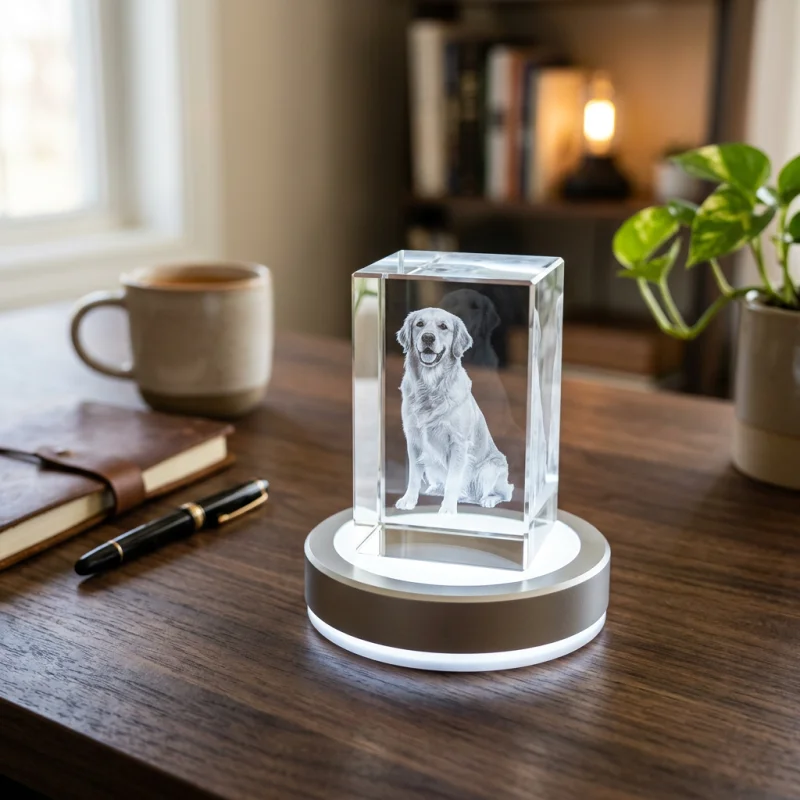
Chloe selected a matte black aluminum base with 6000K cool white diodes. The high-color-rendering light shot up through the bottom of the K9 block, lighting up every micro-dot in Rex's chest and paws against a pitch-black background.
Receiving the Finished 3D Keepsake
Two weeks after uploading her high-resolution RAW file, the shipping package arrived. Chloe opened the cushioned gift box and pulled out the heavy optical glass block. The solid K9 crystal felt cool, weighing just over three pounds.
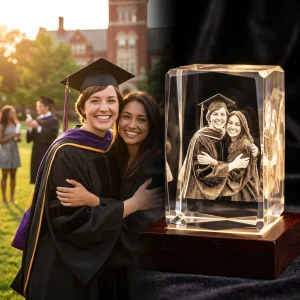
She placed the block onto the LED base, plugged in the power cord, and hit the switch. Rex floated inside the glass block—his ears pinned back, muscles taut, eyes locked on the disc caught between his teeth. By rotating the block on her desk, she could see the width of his shoulder blades and the angle of his hind legs suspended in mid-air. The 3d crystal dog keepsake held the raw energy of that morning at the park, permanently locked inside clear, heavy optical crystal.
Frequently Asked Questions
Can you convert a blurry phone photo into a 3D crystal engraving?
No. Motion blur and low-resolution images do not convert well into 3D point clouds. The laser conversion software requires sharp edges to distinguish the dog's body from the background. Photos should be at least 300 DPI, shot in good lighting, and free of motion blur around critical features like eyes, ears, and paws.
Will the laser etching fade or turn yellow over time?
No. The engraving exists as physical micro-fractures inside lead-free K9 optical glass. Because the outer surface remains sealed, moisture, UV rays, and air cannot reach the internal details. Unlike printed acrylic or photographic paper, K9 crystal does not yellow, fade, or degrade under sun exposure.
What is the difference between 2D and 3D crystal engraving?
A 2D crystal engraving etches a flat image inside the glass, maintaining a single flat focal plane like a standard photo. A 3D laser engraved crystal uses proprietary modeling software to extrapolate depth, creating a 180-degree or 360-degree point cloud model. This allows you to view the front, sides, and contours of your dog as you view the block from different angles.