Preserving Bucket-List Trips: How Sub-Surface Engraved Crystal Cubes Turn Photography Into 3D Heirloom Displays
Adam sat at his mahogany office desk, staring at a stack of printed 8x10 photos from his two-week safari in the Masai Mara. He spent nine months planning that trip with his wife, Sarah. Over rough dirt tracks, he carried a heavy DSLR camera body with a 200-600mm telephoto lens. The raw photo files were pin-sharp. Yet printed on paper, the sunrise shot of the two of them standing beside their Land Cruiser felt flat. Direct sunlight through his office window had already faded a canvas print he bought three years ago. Acrylic blocks scratched whenever he wiped away dust with a microfiber cloth. He wanted solid, permanent vacation photo souvenirs that would hold up under direct light without losing optical fidelity.
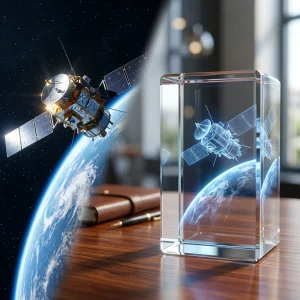
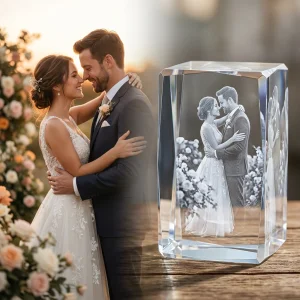
His search ended when he discovered sub-surface laser engraved crystal gifts made from K9 optical glass. The technology allowed him to suspend his two-dimensional camera shots inside a crystal block as a volumetric 3D image.
The Physics of Sub-Surface Laser Engraving
Standard glass etching damages the surface. Sub-surface laser engraving (SSLE) operates entirely inside the crystal block without breaking the polished outer faces. The manufacturing system uses a 532-nanometer green pulsed laser. This specific wavelength passes straight through clear optical materials until the optical assembly focuses the beam down to an exact internal point.
At that exact focal coordinate, the laser delivers rapid pulses of energy lasting mere nanoseconds. The localized heat causes a micro-fracture inside the glass structure. Each micro-fracture forms a micro-dot measuring between 20 and 50 micrometers across. Because the pulse duration is brief, thermal energy cannot spread to the surrounding glass, keeping the exterior surfaces glass-smooth.
Before laser cutting begins, CAD software processes the source photo. The software isolates the subjects, calculates depth maps, and converts pixel data into a point-cloud matrix. High-density crystal cubes use between 800,000 and 4,000,000 individual micro-fractures to construct the physical object layer by layer.
Material quality dictates the final output. Manufacturers use optical K9 crystal, a high-purity borosilicate crown glass. K9 crystal features a high refractive index of 1.517 and low dispersion rates. It contains zero bubble inclusions, clouding, or greenish iron tints common in standard window glass. High optical purity lets ambient light bounce off each micro-fracture cleanly.
Surface Etching Compared to Internal Micro-Fracturing
Traditional laser marking machines blast away material from the top layer of wood, stone, or glass. That leaves exposed edges, rough surface grit, and weak spots prone to chipping. Dirt, oil, and dust collect inside those outer grooves over time, darkening the image.
Internal 3D micro-fracturing flips this dynamic entirely. The image rests protected inside a sealed glass shell. Dust cannot touch the micro-dots. Water, cleaning fluids, and fingerprint grease stay on the smooth glass faces, easily wiped clean with a soft cloth. Ultraviolet light cannot degrade the internal micro-fractures because there are no inks, pigments, or organic resins inside the crystal structure to break down under sunlight.
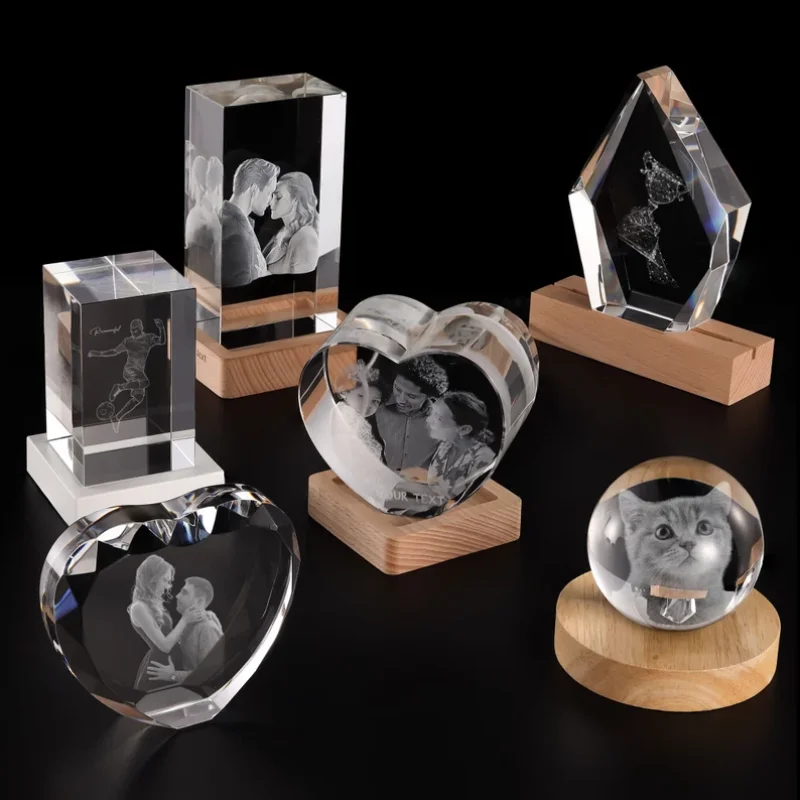
5 Crystal Cube Formats for Specific Travel Photography
Matching the crystal block format to photo framing determines how well the depth effect translates into three dimensions.
- 50mm Small Cube (0.3 kg): Best for single close-up subjects. Works well for tight wildlife face shots, single floral portraits, or macro architectural details.
- 80mm Medium Cube (1.3 kg): Ideal for couple portraits with environmental context. Adam chose this size to highlight himself and Sarah positioned next to their safari vehicle, leaving ample room for depth separation.
- 100mm Large Cube (2.5 kg): Fits detailed historical architecture, such as ancient temples, European cathedrals, or ruin sites. The higher volumetric mass supports dense point clouds exceeding two million laser dots.
- 60x60x100mm Vertical Tower Block: Tailored for tall structural landmarks. Perfect for redwoods, waterfalls, skyscrapers, or vertical cliff faces.
- 150mm XL Heavyweight Cube (8.4 kg): A substantial display piece designed for wide group photos or complex wide-angle action shots.
Image Requirements and Unsuitable Photo Scenarios
Not every digital photo converts cleanly into an internal crystal engraving. Adam tested a wide panoramic photo of the Great Rift Valley, but the results were poor.
Panoramic 16:9 shots squeezed into a square cube compress the point-cloud density down to tiny proportions. The micro-fractures blur together, creating a muddy grey silhouette without clear internal separation. Ultra-wide horizon photos require substantial horizontal cropping before laser processing.
Low-resolution camera files introduce similar issues. Smartphone photos taken in dark conditions or scaled below two megapixels lack the edge clarity needed by CAD depth algorithms. Without distinct edges, the conversion program cannot determine where foreground elements end and background elements begin.
Photo backgrounds affect final clarity too. High-contrast scenes perform best. A brightly lit subject positioned against a dark or blurry background lets the white laser points pop. A subject standing against a busy white background makes it difficult for the eye to isolate the suspended 3D point cloud.
Physical weight is another factor travelers must keep in mind. Optical K9 glass is heavy. A 100mm cube weighs 2.5 kilograms. These products serve as solid, permanent home or office desk displays, not light souvenir trinkets to cram into a backpacking haul bag during travel.
Enhance Depth with Lighted LED Display Bases
Sub-surface laser micro-fractures do not produce light on their own. They reflect and refract ambient light entering the crystal block. In dim room light, an unlit crystal can lose its dramatic 3D pop.
Adding a dedicated LED display base fixes this issue entirely. Light directed upward through the polished bottom face hits the internal micro-fractures at a perpendicular angle. The light scatters, illuminating every coordinate in the point cloud while the transparent, non-engraved areas remain dark.
Base selection changes the aesthetic:
- 6000K Cool White LED Bases: Produce a clean, crisp daylight appearance. Excellent for snowscapes, white architecture, and high-contrast wildlife shots.
- 3000K Warm White LED Bases: Project a soft golden glow. Best suited for sunset photos, beach scenes, and warm skin tones.
- Matte Black Solid Wood Bases: Hide the light source, directing full attention to the glowing crystal object.
Preserving the Moment
Adam placed the finished 80mm crystal cube on his office desk, seated on a black wooden base with 6000K white LEDs. When he turned the switch on, the Kenyan sunrise scene lit up in precise detail. Sarah's silhouette, the jeep's tire treads, and the acacia tree in the background floated suspended in clear glass, glowing under the light. Direct afternoon sunlight washed across his desk, but the crystal image remained unaffected—permanent, sharp, and sealed for life.
What image resolution gives the best sub-surface engraving results?
Photos should have a minimum resolution of 300 DPI at full frame size, or at least 2000x2000 pixels. High-contrast images with sharp subject separation produce the most distinct 3D point clouds inside K9 optical glass.
Can direct sunlight fade or damage a laser-engraved crystal cube?
No. Sub-surface laser engraving creates microscopic physical fractures inside the glass without inks, chemical dyes, or organic resins. UV light does not cause fading, yellowing, or degradation over time.
How heavy are K9 optical crystal cubes?
K9 crystal is high-density optical glass. An 80mm cube weighs roughly 1.3 kg (2.9 lbs), while a 100mm cube weighs approximately 2.5 kg (5.5 lbs). They are heavy, solid objects designed for desk or shelf displays.