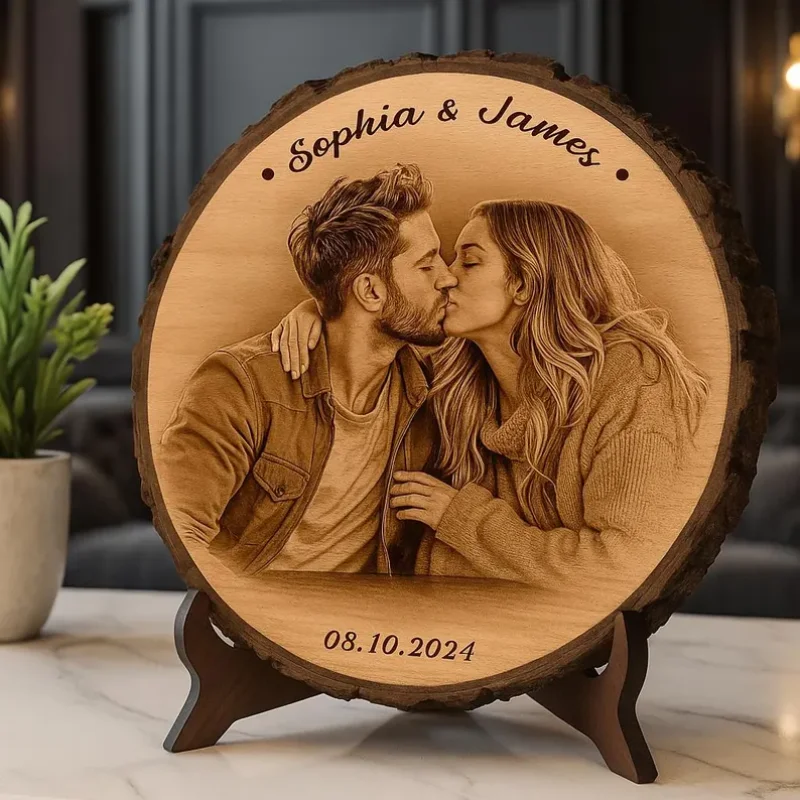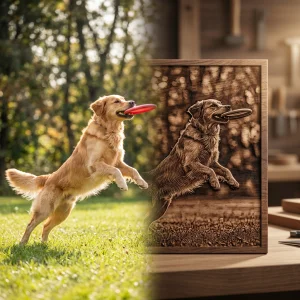
7 Laser Engraved Wooden Keepsakes to Honor Your Pet's Favorite Playing Moments
Action photos captured on a smartphone often languish in digital storage. A golden retriever leaping mid-air for a frisbee or a terrier straining against a tug rope carries energy that deserves physical form. Etching these moments into natural timber turns high-speed motion into tangible decor.
Converting Motion Photos into Engravable Files
A standard photo camera captures play moments at shutter speeds of 1/1000s or faster. Translating those crisp pixels into burn marks on wood requires high contrast. CO2 lasers operating between 50W and 80W interpret image files through rasterization. The laser head sweeps left to right, pulsing thousands of times per second to vaporize micro-layers of wood fiber.
Raw photos need prep work before hitting the laser software. Isolate your pet from busy backgrounds like tall grass or crowds. Crop tightly around the action. Convert the file to 8-bit grayscale and adjust contrast curves until highlights are clean white and shadow details under the belly stay distinct.
Apply a dithering algorithm such as Jarvis or Stucki in your control software. Dithering converts continuous grayscale tones into dot patterns. For laser engraving pet photos, set spatial resolution between 300 DPI and 600 DPI. Don't go above 600 DPI. High dot density creates heat buildup on most hardwoods, melting small detail lines together into dark blobs.
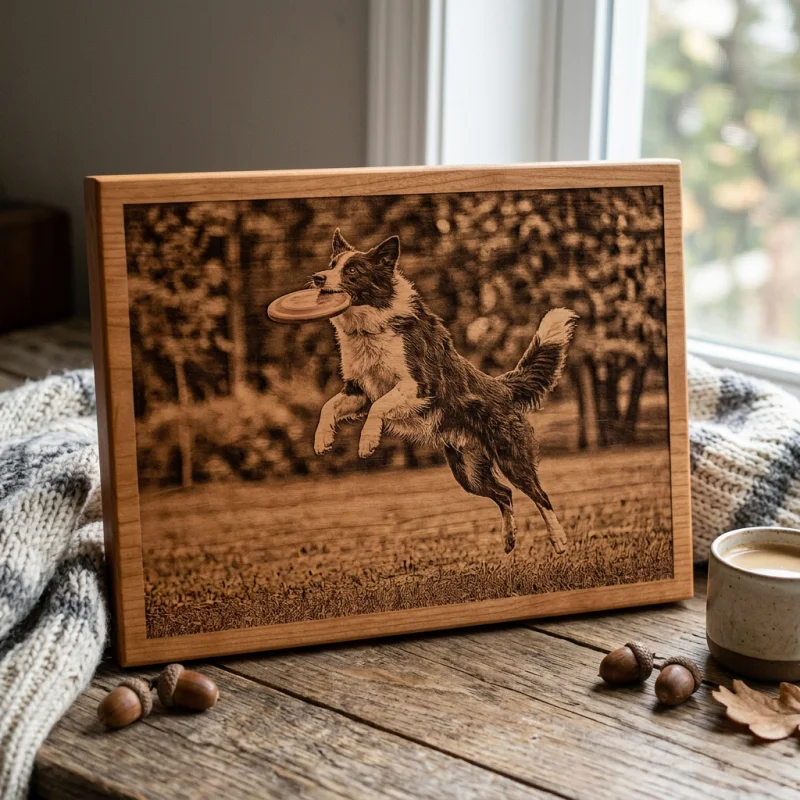
Wood Species Selection and Laser Response
Wood species behave differently under a laser beam. Softwoods like pine contain thick bands of earlywood and latewood. These bands vary in density, causing the laser beam to engrave unevenly. Dense hardwoods yield precise depth and consistent tone.
Solid walnut offers high contrast due to its deep brown heartwood. When burned, it creates rich dark tones with minimal char flare. Black cherry produces a warm, reddish contrast that darkens naturally over time as it oxidizes in room light. Basswood plywood provides a smooth, uniform surface with low wood grain interference. You'll get high detail on small facial features during fast play scenes.
| Wood Species | Density (g/cm³) | Grain Texture | Tone Contrast | 600 DPI Burn Depth at 300 mm/s (60W) |
|---|---|---|---|---|
| American Walnut | 0.61 | Medium / Open | High (Dark Brown to Charcoal) | 0.3 mm |
| Black Cherry | 0.56 | Fine / Closed | Very High (Warm Amber to Espresso) | 0.4 mm |
| Hard Maple | 0.70 | Fine / Closed | Moderate (Tan to Medium Brown) | 0.2 mm |
| Basswood Plywood | 0.42 | Ultra-Fine / Uniform | Medium-High (Cream to Soft Brown) | 0.6 mm |
7 Keepsake Designs for Playful Pets
Different play styles call for distinct wooden formats. Here are seven specific ideas for turning dynamic play sessions into durable laser engraved pet keepsakes.
1. The Mid-Air Fetch Block: Cut a 2-inch thick solid walnut slab measuring 8x10 inches. Raster an action photo of your dog catching a ball at peak elevation. Chamfer the edges at 45 degrees. The thick wood stands upright on a mantle without extra hardware.
2. Agility Weave Pole Plaque: Use a long, narrow strip of cherry wood measuring 4x18 inches. Engrave a sequence of three photos showing your dog navigating weave poles. Add time split numbers below each frame for competitive agility dogs.
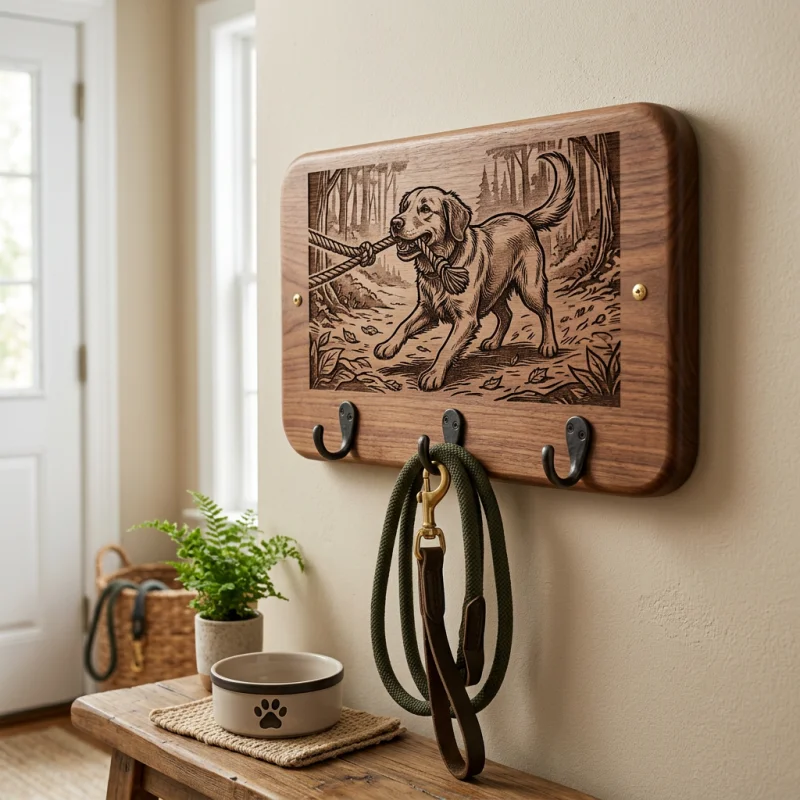
3. Tug-of-War Leash Rack: Take a 3/4-inch maple board. Laser-engrave your dog pulling on a rope across the top section. Install three brass hooks along the bottom edge to hang actual leashes and play ropes.
4. Dock Diving Splash Coasters: Cut 4-inch square basswood or cherry tiles. Engrave water-splashing leap photos onto each coaster. Treat them with waterproof varnish to handle liquid runoff from cold glasses.
5. Frisbee Catch Wall Clock: Cut a 12-inch circular cherry panel. Position the laser photo of your pet catching a disc in the center. Engrave numbers 1 through 12 around the perimeter. Install a silent quartz clock movement through a center-drilled 5/16-inch hole.
6. Flyball Sprint Keepsake Box: Construct a 6x6x4-inch box using finger joints on maple sides and a walnut lid. Etch the high-speed sprint photo across the entire lid surface. Store extra collar tags, ribbons, and microchip documents inside.
7. Snow Dash Table Display: Select a piece of live-edge slab wood with bark intact along the edges. High-contrast photos of dark dogs running through white snow translate cleanly onto light-colored wood species like birch or maple.
Laser Settings and Calibration Specs
Getting clean raster results requires matching your machine's wattage with travel speed and power percentage. Too much power turns fine whiskers into soot. Too little power results in low-contrast gray images that fade into the wood grain.
For a 60W CO2 laser tube, set raster speed to 350 mm/s. Adjust power to 18% for cherry and 22% for walnut. Run air assist at a low pressure around 5 to 10 PSI. High air pressure blows wood smoke back down into open wood pores, staining unengraved areas around your dog's silhouette.
Enable interval settings matching your DPI. For 300 DPI, set line spacing to 0.085 mm. For 600 DPI, drop line spacing to 0.042 mm. Use a 1.5-inch focal length lens when engraving tiny details like eye reflections. Switch to a standard 2.0-inch lens for larger plaques where smooth shading gradients matter more than micro-fine edges.
Finishing and Protection
Freshly engraved wood surfaces retain fine carbon dust. Wiping the piece with water causes ash to spread into the wood grain, muddying light areas. Apply denatured alcohol to a microfiber cloth and wipe lightly across the grain. The alcohol dissolves smoke residue without raising the grain or spreading carbon darks into light spots.
Lightly sand unengraved borders using 320-grit sandpaper wrapped around a flat block. Keep away from the burned lines so you don't sand away thin details. Seal the wood using two thin coats of spray-applied satin polyurethane or wipe-on Danish oil. Polyurethane protects against oxidation and locks in contrast without changing the natural warmth of the wood.
Technical Limitations and When Laser Engraving Fails
Not every photo translates well to wood rastering. Photos with heavy motion blur, harsh shadows cutting across the face, or blown-out white fur offer insufficient pixel data. When software ditherers try to process a blurry ear or paws lost in dark grass, the laser creates an unreadable black patch.
For low-quality or blurry source photos, skip raster photo engraving entirely. Use vector graphic software to manually trace the pet's silhouette and key action lines. Vector line art cut at low power (15 mm/s speed, 10% power) produces sharp outline art on wood without relying on pixel density.
Avoid using pressure-treated wood, exterior plywood with high formaldehydes, or heavily knotted pine. Resinous knots reject laser heat unevenly, causing sap to bubble up through the burned image. Keep finished keepsakes indoors. Direct sunlight degrades photo contrast on cherry and walnut within 12 to 18 months if left untreated with UV-inhibiting clears.
Can low-resolution phone pictures be used for laser engraving pet photos?
Low-resolution photos work best when converted to clean vector outlines. Direct photo rastering requires crisp focus, high contrast, and a resolution of at least 300 DPI at final output size. If the source image is blurry, vector tracing yields much cleaner results on wood.
Why does cherry wood darken over time after being laser engraved?
Cherry contains natural tannins that react to light exposure and oxygen. Over several months, the raw reddish-tan wood shifts into a deeper amber shade. This natural patina increases background richness while keeping the dark carbonized photo burns fully visible.
How do you clean soot off laser engraved pet keepsakes without ruining detail?
Dampen a lint-free microfiber cloth with 91% isopropyl alcohol or denatured alcohol. Gently wipe parallel to the wood grain. Avoid water, which soaks carbon dust down into raw wood pores and permanently discolors light regions.
What laser wattage works best for etching solid hardwood keepsakes?
A CO2 laser between 50W and 80W provides control over speed and power for hardwood photo rastering. Diode lasers under 20W can engrave hardwoods, but they require slow speeds that increase heat bleed and scorch nearby fibers.