5 Glass Laser Engraved Keepsakes for Science and STEM Graduates
Aurora held three store-bought graduation cards in her hand and tossed them into the bin. Her younger brother, Leo, wasn't the type to care about gold-foil lettering or generic motivational quotes. He was finishing a degree in Chemical Engineering with a minor in Computer Science. He spent his weekends adjusting his motorized telescope, tracking variable stars, and writing Python scripts to render 3D crystal lattices. Giving him a plain pen set felt lazy.
She wanted a gift that mirrored his exact passions. Something precise.
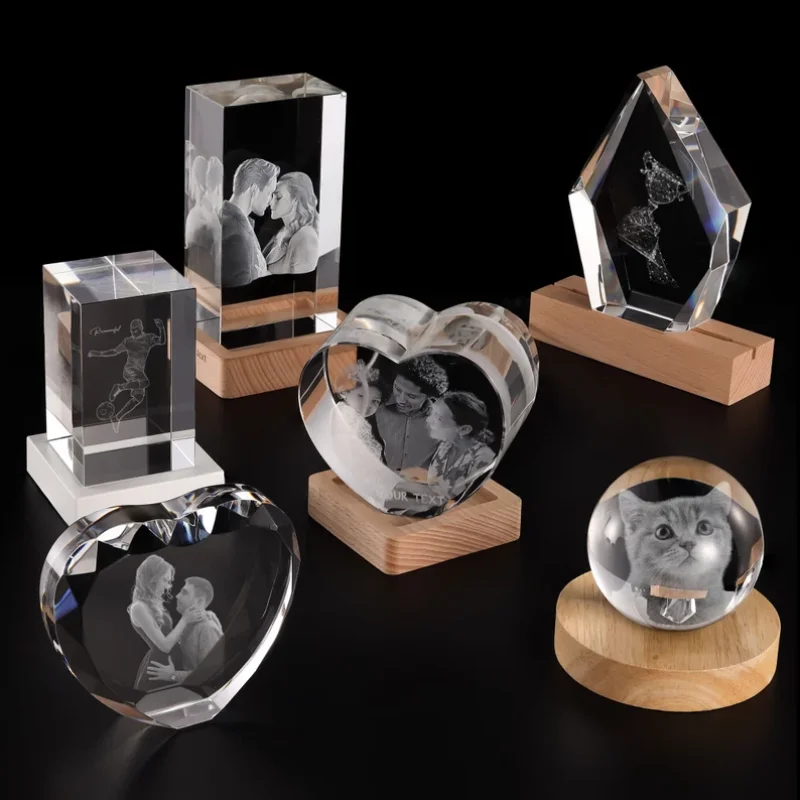
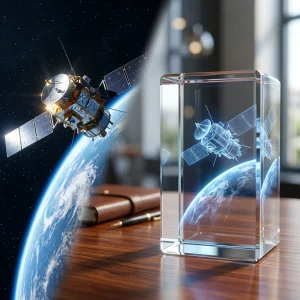
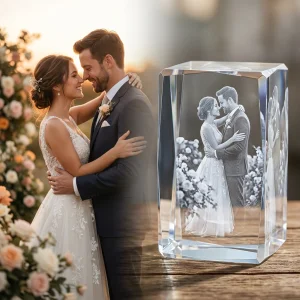
Her search led her to sub-surface laser engraved crystal gifts. These are not surface-etched glass products that feel rough under your thumb. Instead, high-frequency lasers focus light energy deep inside optical-grade K9 crystal. The process forms thousands of micro-cracks that suspend three-dimensional models inside solid glass. Aurora realized she could take Leo's actual code schematics, star charts, and molecular renderings and preserve them forever.

Inside the Glass: Green Laser Technology
Standard surface lasers heat glass from the outside. They leave jagged edges and shallow white lines. Sub-surface laser engraving relies on a high-precision 532-nanometer green diode laser. The laser light passes straight through the polished exterior of K9 optical crystal without marking the surface.
When the beam reaches its focal point inside the glass block, localized heat creates a microscopic pulse fracture. Each micro-crack acts as a tiny dot that reflects light. By firing tens of thousands of light pulses per minute, the machinery builds a floating point cloud.
K9 crystal is chosen over standard soda-lime window glass because of its high refractive index of 1.516 and exceptional optical purity. It contains zero inclusions or air bubbles that could deflect the laser beam and ruin the internal model.
1. The 3D Molecular Structure Cube
For chemistry, biochemistry, and material science graduates, flat 2D drawings fail to convey spatial geometry. Aurora compiled the structural file of caffeine, Leo's constant companion during late-night finals, into a 3D coordinate map.
These science graduation keepsakes convert PDB (Protein Data Bank) or MOL files into targeted point clouds. The laser etches bond angles, electron clouds, and atomic spheres into a solid 80mm K9 crystal cube. You can view complex proteins or simple organic compounds from every angle.
2. The Constellation and Deep-Sky Monolith
Stargazers and astrophysics majors appreciate real observational data. You can capture the night sky map corresponding to the exact date, time, and coordinates of their graduation ceremony.
The laser renders star brightness through dot density. Bright stars like Sirius receive denser point clusters. Fainter nebulae use sparse micro-cracks to simulate faint light. Mounted inside a tall vertical glass monolith, the stars appear suspended in dark space.
3. The Layered Circuit Diagram Block
Flat circuit board prints look flat on paper. Aurora considered rendering Leo's first custom microcontroller schematic inside glass.
Engineers can stack multi-layer PCB layouts along the Z-axis inside the block. Electrical traces, resistors, and logic gates float above one another. The result is a physical 3D schematic you can examine from top, side, and bottom.
4. The Topological Elevation Model
Geology, environmental science, and civil engineering grads work with physical terrain data. Digital Elevation Models convert topographical maps into 3D glass structures.
The laser etches mountain ranges, river valleys, and fault lines inside a thick glass slab. Sunlight catches the sharp crests of ridges. It highlights subtle terrain contours that paper maps cannot display.
5. Vector Wavefunction and Math Equation Prism
Theoretical physicists and math majors work with abstract systems. Fourier transforms, Maxwell’s equations, or custom Lorenz attractors turn into striking glass art.
Converting raw parametric equations into 3D coordinates allows vector lines to twist through a triangular K9 glass prism. As you rotate the prism, the mathematical curves bend and distort through internal refraction.
File Specifications and Laser Resolution
Creating clean laser engraved crystal gifts requires strict file preparation. Aurora learned this when her first test rendering produced an over-exposed blur inside the software preview tool.
- File Formats: Convert 3D models into .STEP, .STL, or OBJ files. For 2D vector overlays, use SVG or high-resolution PDF files with black lines on white backgrounds.
- Resolution and DPI: Set rendering engines to 1000–1200 DPI. This setting keeps micro-crack point spacing between 20 and 30 microns. Finer resolution prevents visible stair-stepping along curved surfaces.
- Density Limits: Avoid dense point clusters. Firing too many points in a tight area creates internal thermal stress. In crystal blocks under 50mm thick, over-etching causes stress fractures that cloud the glass or crack the block days after production.
- Tolerance Rules: Maintain a minimum 5mm margin between the laser point cloud and the outer glass edges. Edge interference throws off beam focus and causes uneven micro-cracks.
Pairing Keepsakes with Light Bases
Without proper lighting, internal micro-cracks look dim. Light must enter the crystal from the bottom edge to bounce off the internal fractures.
Aurora selected an anodized aluminum base with a 6000K cool white LED array for Leo's desk. The cool white light hits the microscopic fractures, causing the molecular bonds to glow against dark room backgrounds.
For star charts, a 3000K warm white base or a deep blue accent LED creates contrast. Place the light source directly beneath the bottom face so light travels vertically through the glass block.
What line thickness works best for circuit diagrams engraved in glass?
Vector lines should have a minimum thickness of 0.1mm in your design file. Thinner lines drop points during point-cloud conversion, which leads to broken circuit traces inside the glass block.
Can standard window glass or acrylic be sub-surface laser engraved?
No. Standard window glass contains iron impurities and internal tension that cause unpredictable cracking under green lasers. Acrylic melts and turns yellow. Optical-grade K9 crystal or synthetic quartz crystal is necessary for clean micro-fractures.
How do you clean sub-surface laser engraved crystal keepsakes?
Because the etching is fully contained inside the K9 crystal block, outer maintenance is simple. Wipe the polished glass surface with an alcohol-based glass cleaner and a lint-free microfiber cloth to remove fingerprints and dust.