Transforming Graduation Photos into 3D Laser-Engraved Crystal Keepsakes
Violet stared at the graduation photo on her phone screen. Marcus stood under the campus arches, velvet hood resting over his shoulders, diploma scroll in hand. The photo was sharp, taken in bright morning light. Standard photo paper didn't feel right. Framed prints sit behind glass until daylight bleaches the dye, turning black robes into washed-out gray within a decade. She wanted something substantial, permanent, heavy in the hands.
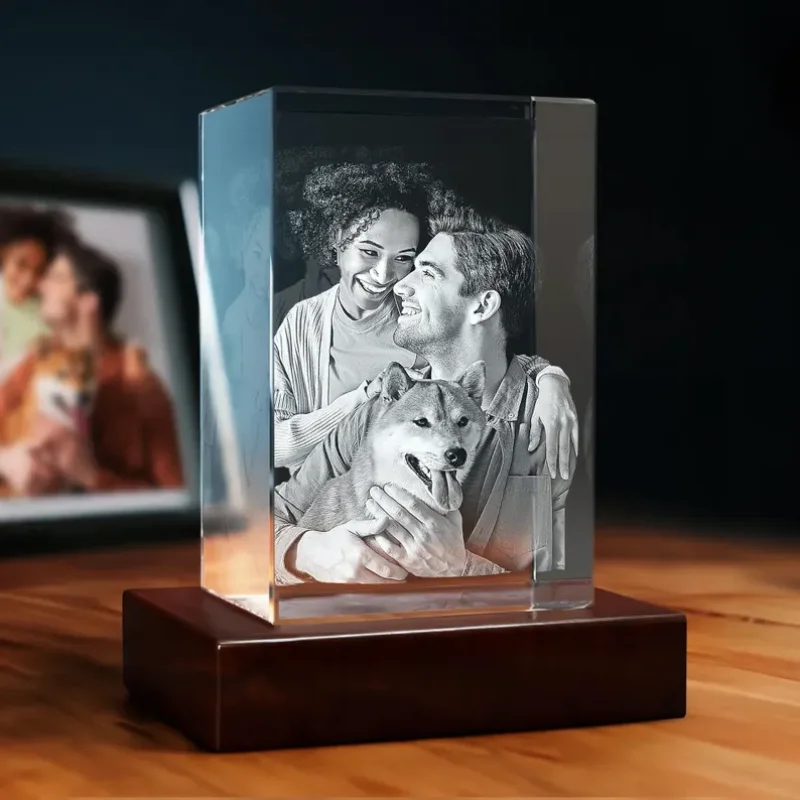
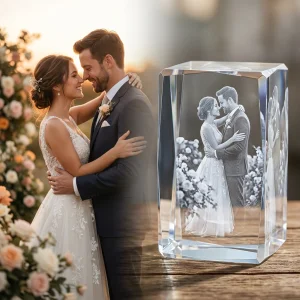
That search led her to a personalized graduation portrait rendered inside solid glass. Not printed on top of the block, but suspended inside it. Creating a graduation crystal gift that survives decades without fading requires specific technical choices, ranging from file preparation to laser wavelength.
Converting Flat Photos into 3D Depth Maps
A standard JPEG image contains flat pixels arranged on X and Y axes. To turn Marcus’s portrait into a 3D crystal sculpture, specialized CAD software converts those flat pixels into a spatial coordinates point cloud (X, Y, and Z axes). Technicians map the facial structure, calculating precise physical distances between the tip of the nose, cheekbones, and ears.
Shadows help determine contour depths. Light falling across the forehead tells the software how far forward the brow sits relative to the eyes. High-contrast images make this mapping accurate. Dark, muddy lighting confuses the algorithm, flattening features or distorting jawlines.
The output file isn't a solid surface mesh. Instead, it's a dense coordinate file containing anywhere from 800,000 to over 2,000,000 discrete points. Each point in that cloud represents an exact coordinate where a laser pulse will strike inside the block.
Sub-Surface Laser Engraving with 532nm Green Lasers
Standard lasers cut or burn surfaces. Sub-surface laser engraving (SSLE) works differently. It leaves the exterior glass completely smooth while creating targeted micro-fractures deep inside the block.
This process relies on a green light laser operating at a 532nm wavelength. Green light passes straight through clear optical glass without heating the exterior surface layers. High-precision optical lenses converge two or more laser beams at a single focal point inside the block. At that exact coordinate, energy density spikes. The sudden heat shock causes a tiny, controlled micro-fracture—a micro-dot measuring roughly 50 to 100 microns across.
Focal depth control drives this step. The laser starts at the deepest layer inside the crystal and works back toward the front surface. Working back-to-front prevents existing micro-fractures from blocking subsequent laser passes. Dot pitch—the spacing between micro-fractures—determines visual clarity. Tight dot pitch produces smooth skin tones and detailed fabric folds in the graduation gown.
Optical-Grade K9 Crystal Selection
Glass quality makes or breaks the final object. Standard architectural glass contains iron impurities that create a greenish hue along the edges. Cheap decorative glass contains microscopic air bubbles and internal stress lines that crack under laser pressure.
K9 crystal is high-purity borosilicate optical glass. Optical components like camera lenses and prisms use K9 because of its low dispersion rate and high refractive index (around 1.516). For crystal keepsakes, K9 blocks undergo mechanical inspection to ensure zero inclusions, zero bubbles, and uniform density. When green laser energy hits pure K9, the resulting micro-fractures reflect light sharply without cloudiness.

Selecting the Best Photo for Engraving
Violet audited three photos of Marcus before selecting the final file. Small details in your source image dictate whether the final crystal looks sharp or blurry.
- Resolution matters: Upload original files at 300 DPI or higher. Use images taken with modern digital cameras or raw phone photos rather than heavily compressed social media downloads.
- Lighting angles: Direct frontal or three-quarter lighting yields optimal depth maps. Avoid heavy backlighting that leaves the face in deep shadow.
- Contrast: Dark graduation caps and gowns need clear separation from background elements. If black fabric merges into a black backdrop, the depth engine struggles to separate subject from background.
- Pose selection: Front-facing portraits map cleanly into 3D space. Profile shots looking sideways at 90 degrees lack depth information for the far side of the face.
Dimensions and Wooden LED Base Integration
Block proportions alter viewing angles. Rectangular blocks measuring 8x12x6 cm provide ideal depth space for full upper-body portraits, allowing room for cap, tassel, and face to sit on distinct Z-planes without crowding.
Micro-fractures do not emit light on their own. They scatter light hitting them from external sources. Positioning the crystal on a polished wooden LED light base directs light vertically through the bottom face. Light travels up through clear K9 optical glass, striking each etched point. The micro-fractures refract light toward the observer, making the image glow brightly inside the solid block.
Will the etched image inside the crystal fade over time?
No. The image consists of physical micro-fractures created inside solid K9 optical glass. Because it contains no inks, dyes, or organic materials, direct sunlight, humidity, and ambient heat will not fade, degrade, or yellow the etching.
What is the best crystal size for a single person's portrait?
A rectangular crystal block measuring 5x8x5 cm or 8x12x6 cm offers optimal optical depth for individual head-and-shoulder or half-body photos. These dimensions allow clear physical separation between facial features without crowding the Z-axis depth plane.
Can low-resolution phone photos be used for 3D crystal engraving?
Low-resolution photos under 300 DPI or images heavily compressed by texting apps reduce depth accuracy. While basic 3D rendering is still possible, crisp features require clear, high-contrast photos where facial details and lighting gradients remain sharp.
How does an LED light base improve crystal visibility?
Clear K9 glass passes light straight through without scattering it. Internal micro-fractures require ambient or direct light to reflect off their micro-edges. An LED base sends focused light upward through the bottom face, illuminating each etched dot and making the image stand out clearly in dark or ambient room lighting.