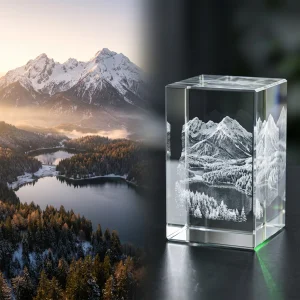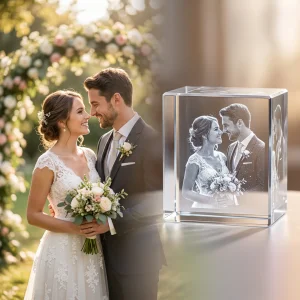
The Technical Science of Etching Wedding Photos into Optical Crystal
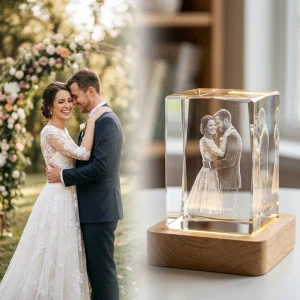
Light travels through pure K9 crystal without scattering. When transforming a couple's wedding portrait into a permanent keepsake, the glass itself dictates the resolution. Standard gift glass contains impurities that deflect light. High-purity K9 optical crystal provides a homogeneous lattice, letting a laser focus tightly inside the block without breaking the outer surface.
Choosing the Glass Base: K9 Crystal vs. Soda-Lime and Leaded Glass
Optical purity forms the baseline of quality. K9 optical crystal, a borosilicate crown glass variant, features an exceptionally low bubble count and high transparency. It registers a refractive index of 1.5168 and a Mohs hardness of 6.0. These attributes allow laser light to pass clean through the outer walls without premature attenuation.
Soda-lime glass—the material used in standard window panes and cheap drinkware—contains iron contaminants that produce a green tint. This iron absorbs light in the green spectrum, causing energy to dump into the surface layer. The glass shatters under internal strain. Leaded crystal presents a different issue. Containing upwards of 24% lead oxide, leaded glass offers brilliant sparkle for wine stems. However, lead lowers the thermal shock threshold of the glass matrix. Under a focused beam, leaded glass forms irregular, cloudy fractures rather than crisp, controlled dots.
Subsurface Engraving Mechanics: The 532nm Green Laser
Inside-glass etching uses subsurface laser engraving (SSLE). The process relies on frequency-doubled Nd:YAG lasers emitting at a 532-nanometer wavelength. This specific green light passes through the transparent surface of K9 glass with near-zero energy absorption.
Lenses focus the beam into a tight spot at target depths ranging from 2mm to 40mm beneath the surface. At the focal point, energy density hits 10 to 15 Joules per square centimeter within a pulse window of 3 to 10 nanoseconds. This localized energy spike vaporizes a tiny volume of glass, leaving a controlled micro-fracture measuring 30 to 60 microns in diameter. Each dot acts as a micro-prism, scattering room light back to the viewer's eye.
Dot pitch defines resolution. Set the distance between micro-fractures to 0.08mm for standard portrait blocks. Spacing below 0.04mm forces stress fractures to interconnect, generating internal structural failure. Spacing wider than 0.15mm makes details like lace trim or eye highlights appear washed out. High-volume production for custom glass wedding favors relies on precise coordinate tables to balance speed and resolution.
Surface Etching for Crystal Plaques
Flat keepsakes, thin awards, and bevel-edged invitations require surface-level marks instead of internal point clouds. Here, operators use CO2 lasers operating at a 10.6-micrometer wavelength.
Glass absorbs this far-infrared light on contact. The beam heats the upper 0.01mm layer of glass past 1,000°C instantly. Microscopic fragments pop off the surface in a process called spalling, leaving a textured, opaque frosted finish. Setting the pulse frequency between 20 kHz and 30 kHz with a 40% line overlap yields clean text lettering down to 6-point typography without chipping crisp edges.
Converting Photography to 3D Laser Point Clouds
Professional wedding photos cannot be sent straight to a crystal engraver. Raw files require processing to translate color data into physical point grids.
- Resolution targeting: Input images require a minimum of 300 DPI at true physical size. Downsampling lowers edge definition on small features like rings or dress lace.
- Greyscale mapping: RGB files convert to 8-bit greyscale (256 values). Operators boost mid-tone contrast by 15% to 20% to account for glass reflection physics.
- Density distribution: Bright areas require maximum dot density (up to 12,000 dots per cubic centimeter). Shadow areas receive sparse point arrays.
- Z-axis mapping: For 2.5D portraits, software converts tone into depth parameters. Noses and suit lapels shift forward along the Z-axis by 5mm to 12mm, while backgrounds drop back.
Precision calibration ensures wedding crystal keepsakes preserve intricate embroidery and facial expressions for decades without fading.
Technical Specifications for Glass Etching Methods
| Technical Parameter | Subsurface Green Laser (532nm) | Surface CO2 Laser (10.6µm) |
|---|---|---|
| Substrate Compatibility | K9 Optical Crystal Blocks | K9 Crystal, Soda-Lime Flat Plaques |
| Operational Focal Depth | 2.0 mm to 40.0 mm internal | 0.00 mm to 0.01 mm surface |
| Micro-Fracture / Dot Size | 30 to 60 microns | 100 to 250 microns |
| Recommended Dot Pitch | 0.06 mm – 0.10 mm | 0.12 mm – 0.20 mm |
| Laser Energy Density | 10 to 15 J/cm² | 2 to 5 J/cm² |
| Typical Application | 3D Portraits, Heavy Cube Keepsakes | Etched Vows, Flat Favors, Plaques |
Material Limitations and Maintenance Protocols
Optical crystal offers high permanence, but physical limitations dictate how you handle and display finished pieces. Optical crystal isn't indestructible.
Thermal stress remains the primary risk for subsurface engraved crystal. Micro-fractures introduce localized internal tension points. Exposing a 3D block to thermal swings greater than 35°C, like placing it directly on a windowsill in summer sun or near a space heater, can cause internal stress lines to propagate. A sudden drop in room temperature can snap the block along its internal point grid.
Photo selection also presents physical constraints. Out-of-focus background bokeh converts poorly into point clouds, resulting in random, messy dot scatters. High-contrast photos taken in direct studio light produce sharper dot resolution than backlit or heavily filtered social media photos.
Surface-etched crystal plaques require specialized cleaning. Avoid ammonia-based glass cleaners. Chemical residue settles into the micro-spalls of frosted text, attracting dust and turning the white etching grey. Wash surface etched pieces using warm distilled water and mild liquid soap. Dry gently with a clean, unwashed microfiber cloth to prevent lint from snagging on the micro-fractures.
Why is K9 optical crystal preferred over regular glass for 3D keepsakes?
K9 crystal contains virtually zero air bubbles, inclusions, or iron impurities. Its chemical stability and high refractive index allow green 532nm laser light to pass straight through the surface without power loss, creating tight, crisp micro-fractures inside the glass without cracking the outer faces.
Can any wedding photo be turned into a 3D laser engraved crystal?
Most photos work, but images with clear lighting, high contrast, and sharp focus perform best. The image must be processed to at least 300 DPI. Extremely dark photos or heavily blurred backgrounds lack the tonal variance needed to create distinct depth maps and dot density variations inside the crystal.
Do laser engraved crystal keepsakes fade or turn yellow over time?
No. Unlike resin, acrylic, or printed photo glass, laser engraving alters the physical structure of the crystal itself. The white marks inside K9 optical crystal are microscopic physical fractures that never yellow, fade, or degrade under normal ambient indoor light and room temperatures.