The Physics of Nacre: How UV Lasers Engrave Shells Without Thermal Damage
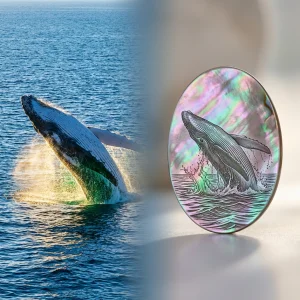
Nacre consists of microscopic bricks and mortar. Tiny polygonal plates of aragonite calcium carbonate measure between 300 and 500 nanometers thick. These dense mineral sheets stack in thousands of parallel layers, separated by thin organic membranes made of conchiolin biopolymers. Light bounces off these layered surfaces at slightly different angles, creating the shimmering optical phenomenon known as thin-film interference. Vaporizing parts of this composite material with concentrated light requires precise energy control. Excess heat destroys the fragile organic glue, turning the iridescent shell into a dull white powder.
Shell processing fails when heat spreads into neighboring aragonite crystals. Traditional CO2 lasers operate at a 10,600 nanometer wavelength, relying on pure thermal ablation. Infrared energy heats the shell surface rapidly. At temperatures above 400°C, aragonite calcium carbonate undergoes an irreversible phase transition, transforming into soft, opaque calcite powder. The biopolymer layers burn instantly, causing micro-explosions between the layers. The result is a chipped edge surrounded by a chalky white ring of ruined shell material.
Wavelength Mechanics: 355nm UV vs 1064nm Fiber
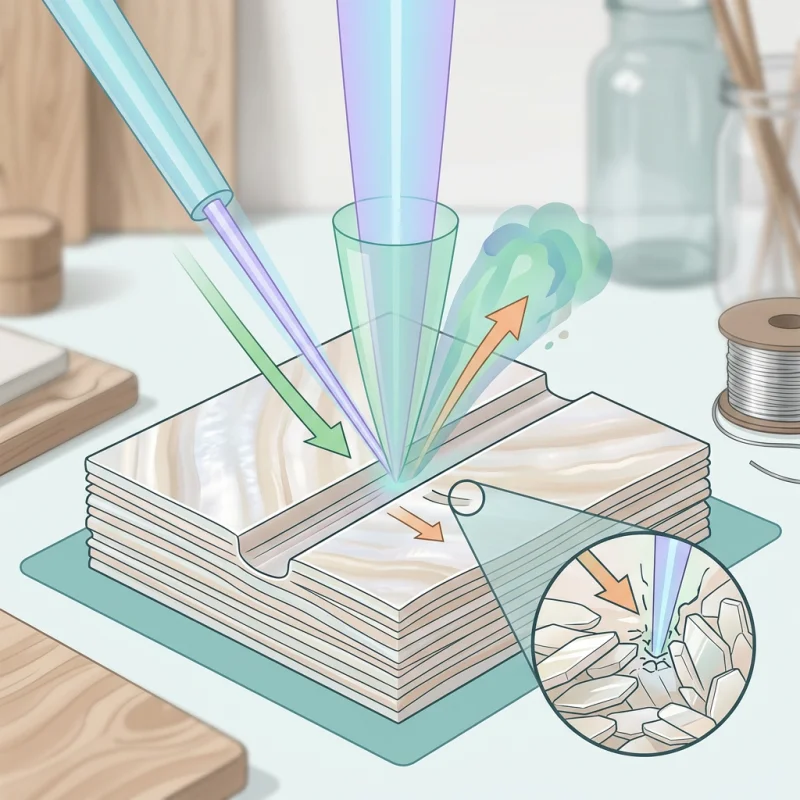
Ultraviolet lasers operating at 355 nanometers bypass thermal destruction through photodecomposition. UV photons carry enough quantum energy to break covalent bonds in the organic matrix without generating high localized heat. Physicists call this cold processing. Standard 1064 nanometer fiber lasers melt metallic targets effectively, but organic shell layers absorb near-infrared energy poorly. Instead of crisp lines, a fiber laser creates micro-fractures that spider along the structural planes of mother of pearl laser engraving projects.
Controlling the Heat-Affected Zone
Pulse duration dictates how deep heat travels before it dissipates. Long pulse widths, measured in microsecond or millisecond intervals, allow thermal energy to bleed sideways into surrounding nacre layers. Shortening pulse duration to picoseconds (10-12 seconds) confines heat energy strictly to the targeted coordinates. Energy enters and vaporizes target atoms faster than thermal conduction can transfer heat to adjacent aragonite tablets. This keeps the Heat-Affected Zone below 3 micrometers, preserving structural integrity right up to the engraved boundary.
Laser Processing Specifications for Shell Substrates
| Parameter | 355nm UV Laser | 1064nm Fiber Laser | 10,600nm CO2 Laser |
|---|---|---|---|
| Primary Laser Mechanism | Photodecomposition (Cold) | Photothermal (Melt/Stress) | Photothermal (Vaporization) |
| Typical Pulse Duration | 10 to 15 Picoseconds | 20 to 200 Nanoseconds | Continuous / Microsecond |
| Heat-Affected Zone (HAZ) | Under 3 µm | 15 to 45 µm | Over 100 µm |
| Ablation Spot Diameter | 10 to 20 µm | 30 to 50 µm | 100 to 150 µm |
| Calcination Risk | Minimal | High | Severe |
| Recommended Material Thickness | 0.2mm to 2.0mm | Not Recommended | Over 3.0mm (Rough Cut Only) |
Material Limitations and Failure Points
Natural shell exhibits severe structural variations that limit engraving depth. Mollusk growth rings create inconsistent density across a single piece of mother-of-pearl veneer. Thickness constraints are rigid. Shell blanks under 0.3 millimeters warp or crack under mechanical stress if engraved past a depth of 50 micrometers.
Deep 3D relief carving degrades nacre's visual optical properties. Iridescence relies on light refracting through intact stacks of aragonite calcium carbonate. Cutting deeper than 150 micrometers removes the polished outer layers, exposing unaligned crystalline structures underneath. Engravings deeper than this threshold appear flat grey or chalky white regardless of laser wavelength.
Abalone shell presents distinct challenges due to its uneven organic content. High concentrations of green and pink conchiolin absorb light faster than white freshwater mother-of-pearl. Applying identical laser power across colored patches causes uneven ablation depths, resulting in pitted or blotchy surfaces. Technicians must adjust laser power in real-time to match the density profile of the specific shell species.
Preserving Natural Luster in Custom Objects
Crafting personalized shell inlay requires precise laser tuning to keep structural colors intact. Modern jewelry studios pair 355nm UV sources with high-speed galvo scanners operating at speeds above 1,500 millimeters per second. High scanning speeds distribute laser pulses across the surface without dwelling long enough to accumulate heat. The resulting mark is sharp, dark, and perfectly legible against the shifting iridescence of the surrounding nacre.
Why does standard laser engraving burn mother of pearl?
Standard infrared or CO2 lasers rely on extreme heat to vaporize materials. Shell consists of aragonite calcium carbonate held together by organic proteins. High heat burns these organic binders and transforms aragonite into calcite at 400°C, leaving behind a brittle, dull, chalky white residue.
What is the best laser type for mother of pearl laser engraving?
Ultraviolet (UV) lasers operating at a 355nm wavelength offer the cleanest results. Their short wavelength breaks organic chemical bonds directly without generating intense thermal energy. This prevents micro-cracking and maintains the shell's natural iridescent luster.
Can deep 3D reliefs be laser engraved into abalone or shell pendants?
Deep 3D reliefs are unsuitable for thin shell materials. Engraving deeper than 150 micrometers cuts through the structural aragonite layers responsible for light refraction. Removing these top layers destroys the iridescent effect, leaving a matte, greyish sub-surface. Shells thinner than 0.5mm also risk structural cracking under deep engraving pass cycles.