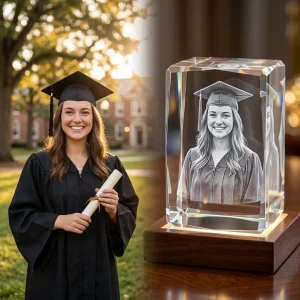
Preserving Graduation Memories in K9 Glass: A Technical Guide to 3D Sub-Surface Engraving
Lucas spread three sample prints across his desk, watching the evening light glint off cheap paper frames. His daughter Maya had just earned her biomedical engineering degree after five brutal years of lab work and late-night finals. Paper prints bend. Ink fades under UV light inside five years, and molded acrylic turns cloudy when exposed to household dust and humidity. He wanted a heavy, permanent piece with genuine visual depth.
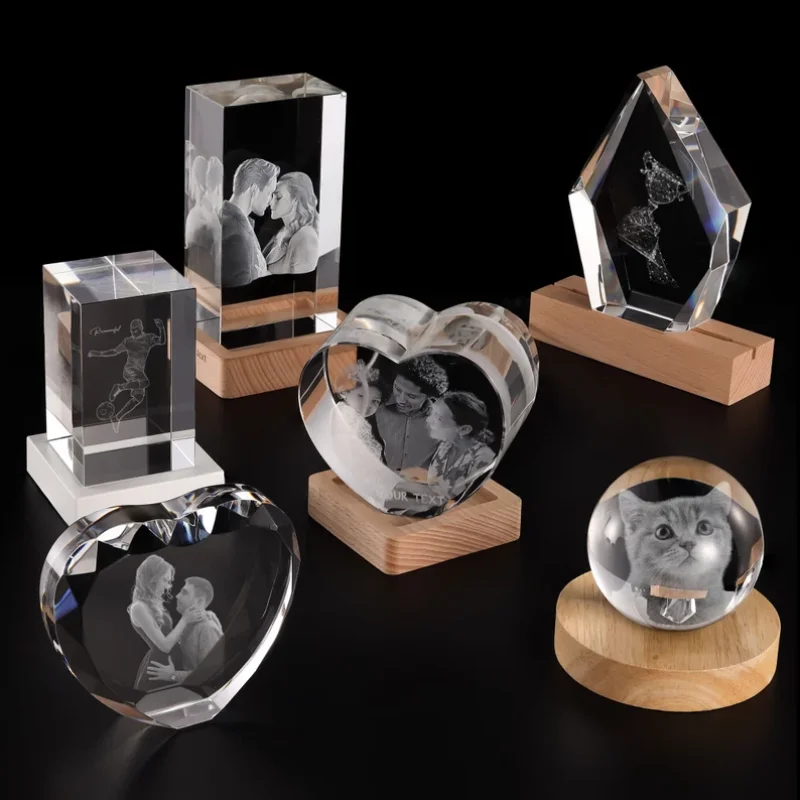
That search led Lucas to a custom 3d photo crystal graduation gift. Instead of printing ink on paper, high-precision manufacturers burn images directly into the interior of a solid optical glass block. Yet as Lucas reviewed production specs, he realized that getting a sharp, lifelike portrait required understanding the laser physics and glass quality behind the product.
Sub-Surface Laser Engraving Versus Surface Etching
Many traditional awards shops rely on CO2 surface lasers. A CO2 laser operates at a long wavelength (typically 10,600 nanometers) that gets absorbed instantly by glass surfaces. It heats the exterior glass layer, creating micro-fractures on the outside edge. The result is a flat, frosted etch you can run your finger over. It catches dust, wears down over time, and offers zero depth.
Sub-Surface Laser Engraving (SSLE) works on an entirely different optical principle. SSLE systems utilize 532-nanometer green diode-pumped solid-state lasers. Glass is optically transparent to this specific green wavelength. The laser beam passes straight through the outer surface without burning, scratching, or heating the exterior wall.
Focusing lenses converge multiple light paths at an exact three-dimensional coordinate inside the block. At that precise focal point, energy density peaks. The intense heat creates a tiny, controlled internal fracture, a micro-crack measuring roughly 20 to 50 microns across. By firing thousands of pulses per minute, the machine suspends thousands of microscopic white points inside clear glass without touching the surface.
Optical Glass Quality: Why K9 Crystal Matters
Lucas quickly discovered that laser technology means nothing if the glass medium contains impurities. Lower-grade soda-lime glass or decorative leaded crystal contains internal metal traces and microscopic inclusions. Fire a high-frequency green laser into cheap glass, and those internal defects absorb energy unevenly. The result? The glass fractures violently, causing spiderweb cracks across the entire block.
High-grade optical K9 crystal serves as the industry standard for precision optics, prisms, and lens elements. K9 glass features specific structural advantages:
- Zero internal air bubbles or metallic inclusions.
- A high refractive index of 1.5168 for extreme optical clarity.
- Superior mechanical hardness that withstands internal thermal shock.
- Low dispersion rates, ensuring light refracts cleanly without color distortion.
When the 532nm laser hits pristine K9 optical glass, each micro-crack snaps cleanly into place. The light refracts off these tiny internal points, making the etched image glow brilliant white under overhead lighting.
Micro-Crack Dot Density and Point Cloud Rendering
Resolution in a 3d laser engraved crystal isn't measured in traditional print pixels. It relies on point-cloud density, which is the total count of laser pulses targeted within a cubic centimeter.
Cheap renders use low-density point clouds around 100,000 to 200,000 dots. This leaves portraits looking thin, ghost-like, and hollow. Premium graduation keepsakes use high-density settings yielding between 800,000 and 1,000,000 individual micro-cracks. Higher point counts allow the laser to map subtle gradient changes across a graduate's face, rendering fine details:
- Individual fabric threads on a graduation cap tassel.
- Wrinkles along the velvet collar of an academic gown.
- Reflections inside eye pupils and subtle facial contours.
Photo Requirements and Depth Mapping
Lucas pulled up Maya's official commencement photo. It looked great on a phone screen, but flat digital files need proper prep work before entering CAD software. Converting a 2D photograph into a 3D model requires precise depth mapping.
Engineers isolate the subject's head, shoulders, and hair, assigning depth values to every feature. Nose tips sit closest to the front plane; ears recess farther back; cheekbones bridge the curve. Standard 2D prints require a minimum file resolution of 300 DPI (dots per inch) to extract smooth depth maps without blocky pixelation.
Avoid these common photo pitfalls:
- Low contrast and harsh shadows: Deep side shadows trick the software into seeing missing geometry, creating sunken cheeks or gaping holes in the point cloud.
- Backlighting: Strong rear light silhouetting the graduate obscures facial features and flattens foreground detail.
- Overcompressed files: Photos saved from messaging apps suffer from compression artifacts, blurring hair strands and graduation cap edges.
Lucas picked a well-lit, direct headshot. Maya faced forward with even, balanced flash lighting across her face. Her cap sat straight, providing clear reference points for the depth algorithm.
Selecting Shapes for Portraits and Diplomas
Crystal shape changes how internal etchings reflect ambient room light. Lucas had to decide between several structural formats based on what he wanted to include.
Vertical rectangular blocks and optical towers suit single-person portraits best. The extra vertical space gives room for a full upper-body rendering: cap, gown, sash, and diploma tube included. Rectangular blocks feature flat, polished sides that act as natural viewfinders, channeling light straight into the center point cloud.
Horizontal blocks or wide flat plaques work best when etching an official university diploma alongside a portrait. A diploma etching requires tight, linear micro-crack lines to keep Latin lettering legible. Combining a 2D text line render of the diploma with a 3D volumetric headshot creates two distinct visual focal planes inside one block.
Beveled edge blocks add extra refraction angles. As you walk past the desk, light hits the angled outer corners, multiplying the etched portrait into floating echoes along the edges.
The Final Product in Hand
Ten days after placing his order, Lucas unpacked a heavy presentation box. He lifted the three-pound optical K9 crystal block onto his desk. Maya’s portrait floated in the center, perfectly proportioned, crisp down to the embroidery lines on her stole. Under his warm desk lamp, the 900,000 micro-cracks trapped the light, glowing bright white against the clear glass background. No fading ink. No yellowing plastic. Just pure, precise physics capturing five years of hard work.
How long does a 3D laser-engraved crystal last?
Because the etching occurs inside optically pure K9 crystal, the image cannot scratch, fade, or peel. Sub-surface micro-cracks are permanent. Unless the glass block suffers a catastrophic drop or thermal shock above 500 degrees Celsius, the inner image remains pristine indefinitely.
Can you etch a photo and a diploma in the same crystal block?
Yes. Production software layers a volumetric 3D portrait next to a high-density 2D laser etch of the diploma text. Selecting a wider horizontal block or flat rectangular plaque provides enough physical real estate to keep both elements legible without overlapping.
What is the best photo resolution for 3D crystal etching?
Choose original, uncompressed photo files with a resolution of at least 300 DPI. High-contrast images taken in bright, even lighting produce the cleanest 3D depth maps. Avoid screenshots or heavily compressed photos taken from social media platforms.
Do 3D photo crystals require specialized lighting to look good?
While internal etchings are visible under ambient room light, placing the crystal on an LED light base significantly enhances visual impact. White light firing up through the bottom face highlights all micro-crack points, making the portrait pop in dark or dimly lit spaces.