Subsurface Laser Engraving in K9 Crystal: The Engineering Behind 3D Wedding Keepsakes
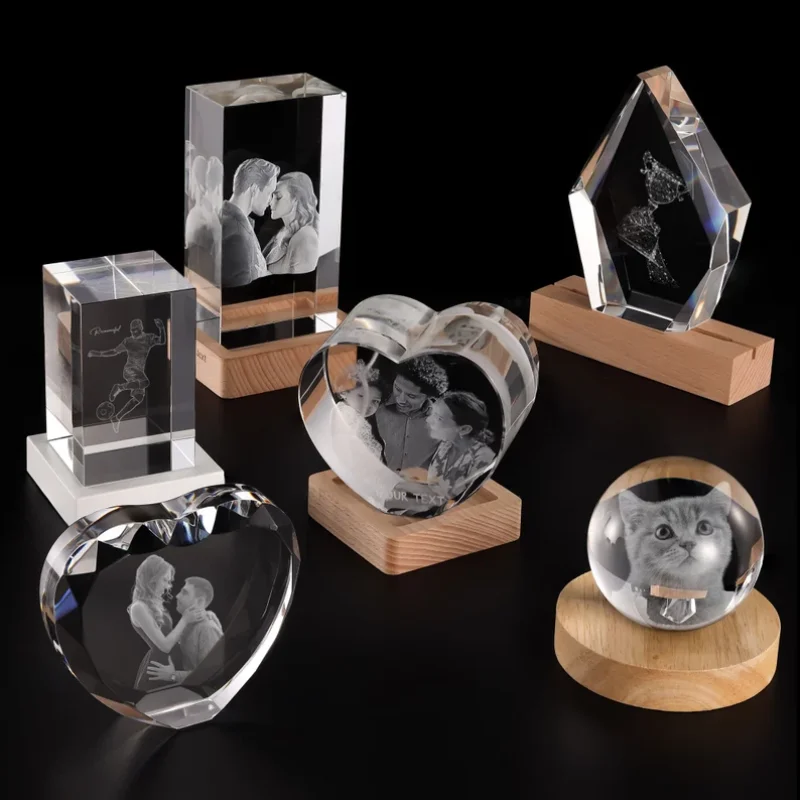
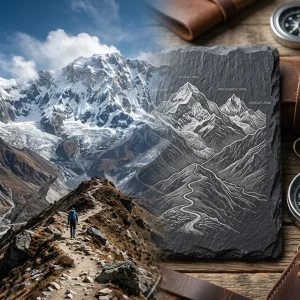
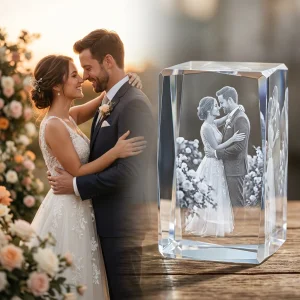
Subsurface laser engraving alters the interior structure of optical glass without breaking the outer surface. A focused laser beam passes straight through transparent material and creates microscopic points of refraction at specific focal depths. Light striking these tiny internal fractures creates a white dot. Thousands of these dots combine inside the block to generate a floating portrait of the bride and groom.
Optical-Grade K9 Crystal Selection
Raw material choice dictates image sharpness. Decorative lead crystal sounds premium, but lead oxide alters refractive indices and traps micro-bubbles. These internal defects scatter laser light. The beam explodes early, burning the glass or leaving dark irregular fractures. Precision keepsakes require optical-grade K9 crystal, a high-purity borosilicate crown glass.
K9 glass offers high optical clarity, zero internal striae, and a stable refractive index of 1.5168. Every block undergoes inspection under polarized light filters before reaching the production table. Technicians reject blanks showing internal strain lines. Pure glass allows laser energy to travel uninterrupted to the exact target coordinate.
Point-Cloud Conversion and Depth Mapping
A standard 2D portrait photo cannot be sent directly to an internal laser system. Software engineers first convert flat imagery into a 3D spatial coordinate map. Achieving high facial clarity requires an original photograph of at least 300 DPI.
Specialized CAD software builds a depth map. Technicians manually define facial structures, including the distance from cheekbones to the nose bridge, jawline curves, and shoulder lines. The software translates pixels into a point cloud containing between 800,000 and 2.5 million spatial nodes.
Dot spacing demands tight tolerance control. Placing points closer than 0.03mm creates continuous internal fractures, causing the glass to split internally. Spacing points too far apart makes the image look faint. Optimal point density achieves balanced shadow tones across skin surfaces and formal attire.
Laser Physics: 532nm Wavelength and Micro-Cracking
Standard CO2 laser engravers operate at a 10,600nm wavelength. CO2 laser light absorbs immediately at the surface, thermal-shocking outer glass layers and causing heavy chipping. Internal micro-carving requires a diode-pumped solid-state (DPSS) green laser operating at a 532nm wavelength.
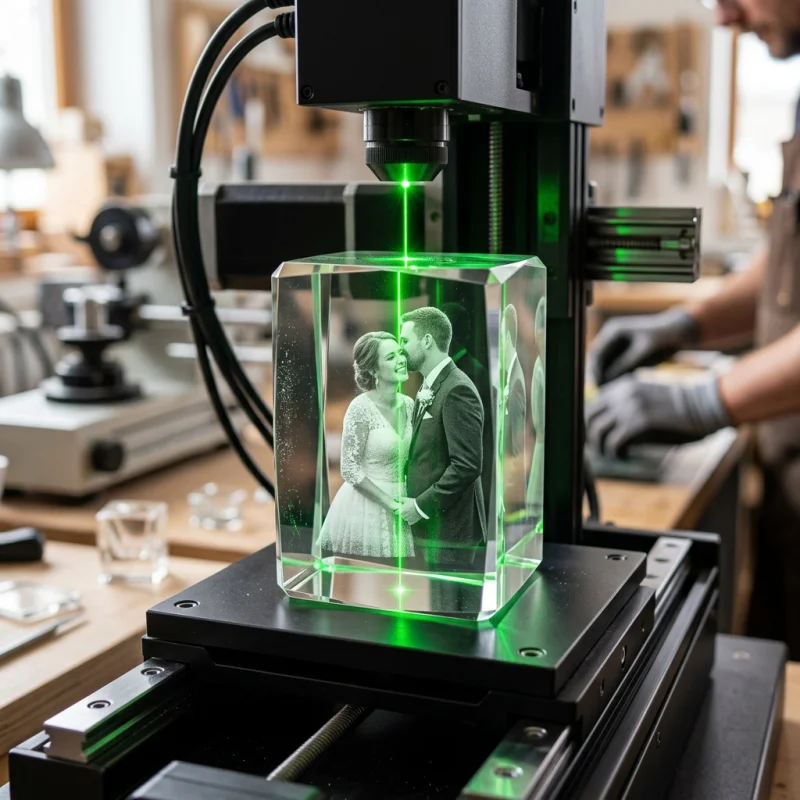
At 532nm, K9 crystal remains transparent to light at low power densities. The beam enters through the polished surface without burning or heating the exterior glass. High-speed galvo-scanning mirrors steer the beam through a focusing lens assembly.
At the precise focal point inside the block, light concentration hits peak power density. Non-linear optical absorption occurs instantly. Glass material undergoes microscopic thermal shock, expanding and creating a tiny fracture roughly 50 microns wide. The machine repeats this process up to 3,000 times per minute, building the 3D photo crystal wedding gift layer by layer along XYZ axes.
Surface Etching vs. Subsurface Engraving
Traditional surface etching relies on chemical hydrofluoric acid treatments or abrasive sandblasting. These methods score the glass skin. Over time, skin oils, dust, and environmental humidity collect in etched surface grooves, degrading visual contrast.
Subsurface laser engraving leaves outer faces flat and polished. Moisture and dust cannot reach internal image coordinates. A personalized wedding crystal plaque engraved beneath the surface maintains high internal contrast indefinitely. Exterior maintenance requires only simple glass cleaner.
Crystal Geometries and Edge Beveling
Optical crystal production starts with massive molten pours cooled under strict annealing schedules to avoid structural tension. Industrial CNC diamond saws cut large slabs into target shapes.
Common wedding keepsake silhouettes include:
- Iceberg Blocks: Hand-chipped outer edges surround a flat, highly polished front face, combining natural stone texture with optical glass.
- Heart Shapes: Precision CNC-ground curves with hand-polished edge contours designed for desktop display.
- Octagonal Plaques: Multi-faceted edge bevels angled at 45 degrees to refract ambient light into the central image chamber.
After shape cutting, multi-stage lapidary wheels polish edges using diamond grits from 120 mesh down to 3000 mesh. A final cerium oxide slurry polishing pass brings surfaces to optical clarity.
Process Parameters and Machinery Specifications
| Process Stage | Equipment Type | Operating Parameter | Technical Objective |
|---|---|---|---|
| Blank Inspection | Polarized Strain Tester | 550nm tint plate illumination | Detects internal stress patterns to avoid glass shatter during laser firing. |
| Depth Modeling | 3D Point-Cloud CAD Software | Min 300 DPI photo; 0.03-0.08mm point spacing | Converts 2D imagery into XYZ spatial nodes without structural overlap. |
| Internal Engraving | 532nm DPSS Green Laser | Pulse width <5ns; 3,000 Hz pulse rate | Triggers non-linear optical breakdown inside K9 crystal without surface damage. |
| Faceting & Beveling | CNC Diamond Lapidary Wheel | 120 to 3000 mesh diamond grit series | Grinds bevel edges and removes micro-burrs along block perimeters. |
| Final Polish | Felt Wheel + Cerium Oxide | 1,200 RPM polishing speed | Restores high light transmission (over 99%) across glass entry faces. |
Can any photo be converted into a 3D photo crystal wedding gift?
High-resolution portraits with clear lighting work best. The image must have a minimum resolution of 300 DPI so software artists can map facial depth details accurately along the nose, cheeks, and eyes. Low-resolution or heavily compressed images lack the spatial data required to construct a dense 3D point cloud.
Why does leaded glass fail during internal laser engraving?
Leaded glass contains heavy metal additives that absorb laser energy too quickly, altering the refractive path of the beam. When a 532nm laser hits internal lead impurities, energy spreads uncontrollably, creating dark fractures or causing the block to crack completely. K9 optical crystal features high material purity and consistent density, allowing focal points to form clean micro-fractures without damaging the surrounding matrix.
How do you clean and store a personalized wedding crystal plaque?
Because the laser image sits protected inside the solid crystal block, routine maintenance only involves cleaning the external surfaces. Use a soft microfiber towel with ammonia-free glass cleaner to wipe away fingerprints. Store the keepsake away from hard marble surfaces that could chip outer bevels if bumped.